About six months ago, on August 16, 2006 I wrote about Pfizer's insulin inhaler:
And this year Exubera was launched, an insulin inhaler used for the treatment of type 1 and type 2 diabetes that has blockbuster potential. According to Pfizer.But look at the Exubra inhaler! It is BIG. A foot long, when unfolded, which makes it feel like a baseball bat. Think your girlfriend would like to haul that out of her handbag while seated in a restaurant?Common sense, folks. Common sense. NO ONE would be caught dead with this foot long pocket rocket in their pocket. Or handbag.
Today, Pharmalot made the following comment:
Get Ready For Those Exubera Ads
Pfizer is making good on those recent threats and will soon run them on tv and in magazines. The desperate drugmaker wants to go directly to diabetics to salvage its failing insulin inhaler, which has bombed due to a high price tag and its cumbersome design (it looks like a bong, if you didn't already know).
As always, you heard it on Question Authority first.
Qustion Authority calls it as we see it.
Showing posts sorted by relevance for query Exubera. Sort by date Show all posts
Showing posts sorted by relevance for query Exubera. Sort by date Show all posts
Thursday, February 22, 2007


Thursday, April 19, 2007
John Mack: "The Howard Stern of drug blogging?"
John Mack is a lovely guy, but his predilection to spin data faster than the drug industry spins PR doesn't increase his credibility. And his choice of language is reaching a new low, only matched by some FCC banned shock jocks.
First, let's start with the data spin. John has done a blogosphere survey, which we all helped steer our readers to, but the only thing we've seen so far is spin, spin, spin.
John's major objective seems to be to show snippets of data that shows his blog ranks high.
To do this he cuts the respondents into different groups, and he favors selecting the results only from individuals who happen to work for the drug industry.
In fact, in a post today on the PharmaBlogosphere, culling the data this way, and looking for "readability," "credibility" and "usefulness" the only three blogs that made it into all three top five lists was . . . surprise, John's blog PharmaMarketing, Eye on FDA, and In the Pipeline.
Two of those blogs are so dry, you'd have to be a scientist to enjoy them, and one of the blogs that made it onto one of those lists, Pharma Watch, isn't even available to the public!
I graciously note that even though my blog didn't make it into any of John's spin-controlled lists, he still couldn't resist the temptation to write about Question Authority, and this is what he said:
"Sorry, Peter, Question Authority -- popular as it might be among all readers -- did not make the "Industry Top 5" in any category! But I will say this: Industry readers thought that Question Authority was more supportive of the industry than did non-industry readers! In fact, it was second on that list (behind Pharma Marketing Blog) of blogs that the industry thought supportive. Perhaps if the survey was done over again today, industry respondents would have a different opinion! Perhaps more closely aligned with a view expressed on CafePharma; namely, "This Rost guy is a Michael Moore crony that is an industry and medical community outcast that has nothing better to do then sit at his computer all day long blogging about things he knows little about, blowing things out of proportion, and surfing porn."
I don't think the "industry supportive" result was surprising. I didn't spend 20 years in the drug industry not liking it. It is a great industry. The fact that I disagree with a few delusional drug company CEOs is a different story. I expect history to prove me right and their nose diving share prices to prove them wrong. Just one example, look at what I wrote about Pfizer's Exubera long before the analysts realized this thing was a flop.
As for John, I think the quote he picked up from CafePharma shuould have stayed on CafePharma. It is one thing for an anonymous idiot to post drivel about porn on CP, another thing for John to make it his own, by using it the way he did.
What made me react is not only this comment, but John also--in the name of being funny--posted this unprecedented "composite comment" from CafePharma about On Pharma, (On Pharma is written by a wonderful journalist; Agnes M. Shanley, Editorial Director for Putman Media, Inc.'s Pharma Group):
"The only word that can accurately describe you is inept. Are you kidding me? Stick your ethics up your ass. Listen up, you skeevy retard: You should have clean hands before you start spewing moral turpitude...Typing fagbot on an internet forum is not the same thing as screaming it out while waiting at the counter for my BK Broiler. You remain an idiot! Selfish egotistical asshole. If you are so interested in doing the right thing why don't you ... get into a circle jerk?"
 So in conclusion, c'mon John, stop twisting the data to make yourself look good, show us the whole blog survey thing, and PLEASE, shape up your approach to your fellow bloggers. In fact, another blogger wrote me today about that last comment . . . so I know I'm alone saying that no one in the blog world expects silk gloves, but we also don't think paraphrasing or adopting the worst of CafePharma is the way to go, unless your objective is to be known as John Mack, the "Howard Stern of drug blogging."
First, let's start with the data spin. John has done a blogosphere survey, which we all helped steer our readers to, but the only thing we've seen so far is spin, spin, spin.
John's major objective seems to be to show snippets of data that shows his blog ranks high.
To do this he cuts the respondents into different groups, and he favors selecting the results only from individuals who happen to work for the drug industry.
In fact, in a post today on the PharmaBlogosphere, culling the data this way, and looking for "readability," "credibility" and "usefulness" the only three blogs that made it into all three top five lists was . . . surprise, John's blog PharmaMarketing, Eye on FDA, and In the Pipeline.
Two of those blogs are so dry, you'd have to be a scientist to enjoy them, and one of the blogs that made it onto one of those lists, Pharma Watch, isn't even available to the public!
I graciously note that even though my blog didn't make it into any of John's spin-controlled lists, he still couldn't resist the temptation to write about Question Authority, and this is what he said:
"Sorry, Peter, Question Authority -- popular as it might be among all readers -- did not make the "Industry Top 5" in any category! But I will say this: Industry readers thought that Question Authority was more supportive of the industry than did non-industry readers! In fact, it was second on that list (behind Pharma Marketing Blog) of blogs that the industry thought supportive. Perhaps if the survey was done over again today, industry respondents would have a different opinion! Perhaps more closely aligned with a view expressed on CafePharma; namely, "This Rost guy is a Michael Moore crony that is an industry and medical community outcast that has nothing better to do then sit at his computer all day long blogging about things he knows little about, blowing things out of proportion, and surfing porn."
I don't think the "industry supportive" result was surprising. I didn't spend 20 years in the drug industry not liking it. It is a great industry. The fact that I disagree with a few delusional drug company CEOs is a different story. I expect history to prove me right and their nose diving share prices to prove them wrong. Just one example, look at what I wrote about Pfizer's Exubera long before the analysts realized this thing was a flop.
As for John, I think the quote he picked up from CafePharma shuould have stayed on CafePharma. It is one thing for an anonymous idiot to post drivel about porn on CP, another thing for John to make it his own, by using it the way he did.
What made me react is not only this comment, but John also--in the name of being funny--posted this unprecedented "composite comment" from CafePharma about On Pharma, (On Pharma is written by a wonderful journalist; Agnes M. Shanley, Editorial Director for Putman Media, Inc.'s Pharma Group):
"The only word that can accurately describe you is inept. Are you kidding me? Stick your ethics up your ass. Listen up, you skeevy retard: You should have clean hands before you start spewing moral turpitude...Typing fagbot on an internet forum is not the same thing as screaming it out while waiting at the counter for my BK Broiler. You remain an idiot! Selfish egotistical asshole. If you are so interested in doing the right thing why don't you ... get into a circle jerk?"
 So in conclusion, c'mon John, stop twisting the data to make yourself look good, show us the whole blog survey thing, and PLEASE, shape up your approach to your fellow bloggers. In fact, another blogger wrote me today about that last comment . . . so I know I'm alone saying that no one in the blog world expects silk gloves, but we also don't think paraphrasing or adopting the worst of CafePharma is the way to go, unless your objective is to be known as John Mack, the "Howard Stern of drug blogging."
Tuesday, January 27, 2009
Letter from a Pfizer employee to Wyeth employees.
As a 20 year Pfizer employee, I've seen my company go from the best place to work in the industry to one of (if not) the worst. We had 20% layoffs in 2005 (FFO). At the 2006 Exubera launch (hah!) in San Francisco, the VP for US sales stood up and said "FFO is F-F-Over". 2 weeks later the CEO (also in attendance) was canned, Jeff "The Hatchet Man" Kindler was brought in, and 5 months later we were getting phone calls informing us of our job status (retained or Pfired - 30% were canned including unfilled vacancies). Those cuts (called FFT) were finalized less than 2 years ago (April 2007), and now we're cutting another 50%. We get the call this Friday. This one is called F-F-U, because they actually want us to go out and work that day.
And for those who are retained, we're getting electronic babysitters (computers with signature time stamps), and you can bet your butt every new GM in each new Business Unit will be riding RM/DM butt to ensure that their signature numbers look the best (daily average, average time of first/last call, number of computer detail pages viewed per call, etc). This place has got to be the worst place to work in the industry. But then again, we'll be going through another round of layoffs as soon as Wyeth is devoured. I'm sure it will hit reps in both companies hard. I look for another 50-75% reduction in sales, with a severance package that will be far less generous than our current agreement (which expires June 1, 2009... 2 month WARN, 3 months pay + 3 weeks for every year with the company up to a maximum of 2 years).
I feel sorry for the good people of Wyeth. You didn't ask to be gobbled up by this monster. As for myself, I was just to lazy/stupid/complacent to leave. I got caught up remembering all the good times, and I forgot that they pretty much ended 10 years ago.
Best wishes to all of you, and please accept my hearfelt apologies.
And for those who are retained, we're getting electronic babysitters (computers with signature time stamps), and you can bet your butt every new GM in each new Business Unit will be riding RM/DM butt to ensure that their signature numbers look the best (daily average, average time of first/last call, number of computer detail pages viewed per call, etc). This place has got to be the worst place to work in the industry. But then again, we'll be going through another round of layoffs as soon as Wyeth is devoured. I'm sure it will hit reps in both companies hard. I look for another 50-75% reduction in sales, with a severance package that will be far less generous than our current agreement (which expires June 1, 2009... 2 month WARN, 3 months pay + 3 weeks for every year with the company up to a maximum of 2 years).
I feel sorry for the good people of Wyeth. You didn't ask to be gobbled up by this monster. As for myself, I was just to lazy/stupid/complacent to leave. I got caught up remembering all the good times, and I forgot that they pretty much ended 10 years ago.
Best wishes to all of you, and please accept my hearfelt apologies.
Thursday, April 17, 2008
Just as I predicted, Pfizer drops like a rock.
On March 17 I wrote an article for the Swedish business daily, Realtid, with the headline "Pfizer stock will tumble."
Today PFE stock did tumble. If shareholders listened to my comments, including the ones I made about failed Exubera way before anyone on Wall Street woke up they'd have saved a bundle. And if Pfizer would have cared to have listened to me maybe they'd have saved a bundle too, rather than taking billion dollar charges for failed products. At least some investment banks and hedge funds are taking notice and are, indeed, listening. I told those guys what was coming in January.
So anyway, Pfizer Inc. today tumbled to its lowest price per share in more than a decade in New York trading after it missed analysts' estimates in reporting that profit plunged 18 percent.
"Unless Kindler's plan is to tank revenue, I would say his plan is not working,'' said Les Funtleyder, an analyst with Miller Tabak & Co. in New York, in a telephone interview today. "There has been a lot of dissatisfaction from shareholders that they haven't been more aggressive. I think this announcement will only raise the din of investment concern.''
First-quarter net income declined to $2.8 billion, or 41 cents a share, the New York-based company said today in a statement. Revenue fell 5 percent to $11.8 billion as a boost from currency exchange rates failed to overcome a combined $777 million drop in sales for its cholesterol pill Lipitor and blood pressure drug Norvasc, both facing generic competition. Profit excluding some items missed analysts' estimates by 5 cents.
The company doesn't have enough products in development to replace those going off patent within four years, including Lipitor, which accounts for about 40 percent of profits, analysts said. Pfizer Chief Executive Officer Jeffrey Kindler has tried to keep earnings up by cutting as much as $2 billion in costs and squeezing more revenue out of existing products.
Pfizer fell 81 cents, or 3.8 percent, to $20.29, at 9:37 a.m. in New York Stock Exchange composite trading, after declining 22 percent in the 12 months before today. The last time the stock price was lower was Sept. 30, 1997, when it hit $20.04. The drop is the biggest since Dec. 4, 2006.
Today PFE stock did tumble. If shareholders listened to my comments, including the ones I made about failed Exubera way before anyone on Wall Street woke up they'd have saved a bundle. And if Pfizer would have cared to have listened to me maybe they'd have saved a bundle too, rather than taking billion dollar charges for failed products. At least some investment banks and hedge funds are taking notice and are, indeed, listening. I told those guys what was coming in January.
So anyway, Pfizer Inc. today tumbled to its lowest price per share in more than a decade in New York trading after it missed analysts' estimates in reporting that profit plunged 18 percent.
"Unless Kindler's plan is to tank revenue, I would say his plan is not working,'' said Les Funtleyder, an analyst with Miller Tabak & Co. in New York, in a telephone interview today. "There has been a lot of dissatisfaction from shareholders that they haven't been more aggressive. I think this announcement will only raise the din of investment concern.''
First-quarter net income declined to $2.8 billion, or 41 cents a share, the New York-based company said today in a statement. Revenue fell 5 percent to $11.8 billion as a boost from currency exchange rates failed to overcome a combined $777 million drop in sales for its cholesterol pill Lipitor and blood pressure drug Norvasc, both facing generic competition. Profit excluding some items missed analysts' estimates by 5 cents.
The company doesn't have enough products in development to replace those going off patent within four years, including Lipitor, which accounts for about 40 percent of profits, analysts said. Pfizer Chief Executive Officer Jeffrey Kindler has tried to keep earnings up by cutting as much as $2 billion in costs and squeezing more revenue out of existing products.
Pfizer fell 81 cents, or 3.8 percent, to $20.29, at 9:37 a.m. in New York Stock Exchange composite trading, after declining 22 percent in the 12 months before today. The last time the stock price was lower was Sept. 30, 1997, when it hit $20.04. The drop is the biggest since Dec. 4, 2006.
Wednesday, April 09, 2008
The final nail in the coffin.
Pfizer Inc (PFE.N) and Nektar Therapeutics (NKTR.O) said on Wednesday clinical trials of the inhaled insulin Exubera found increased cases of lung cancer, leading Nektar to stop seeking a marketing partner for the troubled product and abandon it.
Source.
Source.
Friday, September 28, 2007

Friday, September 29, 2006
"Pfizer Cuts Marketing Execs, Not Marketing"
Pfizer Cuts Marketing Execs, Not Marketing
September 29, 2006
By Jim Edwards
NEW YORK -- Things at Pfizer are likely to get smaller, faster and more efficient, according to CEO Jeffrey Kindler and vice chairman David Shedlarz.
The pruning shears already appear to be at work in the company's marketing offices. Four senior executives were reported this week to have left the company: Greg Duncan, head of Pfizer’s Latin America operations; Julie Fisher, a vp-group leader/head of neuroscience therapeutics; Neil Levine, senior director/group leader for ophthalmology and endocrine care; and Theresa Natalicchio, vp/head of arthritis, according to Medical Marketing & Media.
Pfizer did not confirm or deny the departures Thursday. In a statement, company rep Paul Fitzhenry said, "We're making decisions across the company . . . Pfizer will become more cost-efficient and cost-effective by reducing organizational layers to speed decision-making."
Two other execs with marketing responsibilities have left since Kindler was named CEO in July. Pat Kelly, president of U.S. pharmaceuticals, and Karen Katen, a vice chairman, departed shortly after Katen was bypassed for the CEO job vacated by Hank McKinnell.
Fitzhenry said management cuts would not mean reduced marketing budgets. Pfizer this year is launching Exubera, a diabetes treatment; Chantix, a smoking-cessation product; and Sutent, a kidney-cancer drug. "Those three are important launches," Fitzhenry said.
At a Bank of America investment conference Sept. 20, Kindler told the audience, "We're moving more quickly, taking risks . . . we're adopting the spirit of a small company, the entrepreneurial, agile culture that characterizes a small enterprise. The changes in our management team . . . are part of a larger undertaking that will make our company more nimble and entrepreneurial and therefore more likely to win."
At a UBS Global Life Sciences Conference on Sept. 26 in New York, Shedlarz stated, "Jeff's announcement of his new management team . . . illustrates his commitment to eliminating bureaucracy and speeding decision-making in our company. Pfizer is creating a flatter organization to accelerate decision-making."
September 29, 2006
By Jim Edwards
NEW YORK -- Things at Pfizer are likely to get smaller, faster and more efficient, according to CEO Jeffrey Kindler and vice chairman David Shedlarz.
The pruning shears already appear to be at work in the company's marketing offices. Four senior executives were reported this week to have left the company: Greg Duncan, head of Pfizer’s Latin America operations; Julie Fisher, a vp-group leader/head of neuroscience therapeutics; Neil Levine, senior director/group leader for ophthalmology and endocrine care; and Theresa Natalicchio, vp/head of arthritis, according to Medical Marketing & Media.
Pfizer did not confirm or deny the departures Thursday. In a statement, company rep Paul Fitzhenry said, "We're making decisions across the company . . . Pfizer will become more cost-efficient and cost-effective by reducing organizational layers to speed decision-making."
Two other execs with marketing responsibilities have left since Kindler was named CEO in July. Pat Kelly, president of U.S. pharmaceuticals, and Karen Katen, a vice chairman, departed shortly after Katen was bypassed for the CEO job vacated by Hank McKinnell.
Fitzhenry said management cuts would not mean reduced marketing budgets. Pfizer this year is launching Exubera, a diabetes treatment; Chantix, a smoking-cessation product; and Sutent, a kidney-cancer drug. "Those three are important launches," Fitzhenry said.
At a Bank of America investment conference Sept. 20, Kindler told the audience, "We're moving more quickly, taking risks . . . we're adopting the spirit of a small company, the entrepreneurial, agile culture that characterizes a small enterprise. The changes in our management team . . . are part of a larger undertaking that will make our company more nimble and entrepreneurial and therefore more likely to win."
At a UBS Global Life Sciences Conference on Sept. 26 in New York, Shedlarz stated, "Jeff's announcement of his new management team . . . illustrates his commitment to eliminating bureaucracy and speeding decision-making in our company. Pfizer is creating a flatter organization to accelerate decision-making."
Wednesday, August 16, 2006
"More fizz at Pfizer?"
When I wrote about all the journalists who had called me to ask about Pfizer I forgot about Nature. Anyway, their article was published today, under the headline, "More fizz at Pfizer?"

Nature: Bitter pill: disappointing results have seen Hank McKinnell (left) removed as Pfizer's chief executive to make way for Jeff Kindler.
"But despite the generally upbeat reaction to Kindler's appointment, the value of Pfizer's stock has remained unmoved. And close observers of the company question whether the appointment will do much to change its outlook."
(I guess that's me.)
"Like other major pharmaceutical firms, Pfizer is in a hole. Patents will soon run out on its major products, including the world's best-selling drug, cholesterol treatment Lipitor (atorvastatin). "They need to generate $10 billion in extra revenue each year and that's impossible," says Peter Rost, a former vice-president of Pfizer who runs a carping blog, http://peterrost.blogspot.com, on its predicament. "The only way they can stay afloat is as a black hole, sucking in other companies to boost revenue. I think they are going to collapse under their own weight."
So why would I say such a thing?
Simple.
Pfizer had eight drugs with more than a billion dollars in sales in 2005 (down from 10 in 2004), including Lipitor ($12 billion), Norvasc, a therapy for high blood pressure ($4.7 billion), Zoloft ($3.3 billion), Celebrex ($1.7 billion), Zithromax ($2 billion), and Viagra ($1.6 billion). Those eight drugs also account for nearly 60% of the company's human health segment sales (down from 70% in 2004).
Pfizer's revenues from these establish blockbusters continue to slide due to one of the pitfalls of the drug business: patent expiration. The company has warned investors it will probably lose some $14 billion due to patent expirations over the next two years; because of patent expirations in 2005, revenues from Zithromax slipped 40%, Accupril dropped 56%, Neurontin was down 77%; and Diflulcan, 47%. Additional losses from the blows to Celebrex and Bextra didn't help either; this double punch reduced revenues by nearly $6 billion.
The hubris driven druggernaut is confident that by 2007 it will be able to launch new blockbusters from its "robust pipeline" (hahahaha) to make up for the losses.
But, take a look at early sales of the company's seven new medicines released in 2005 -- Inspira, Caduet, Olmetec, Macugen, Revatio, Zmax (an extended dose variation of Zithromax still under patent protection), and Lyrica -- most of which were developed with partners and only contribute a portion of their revenues to Pfizer's bottom line, hardly look to be any big blockbusters. In fact, 2006 doesn't look to be much brighter for Pfizer: Zmax's sales are feeling pressure from the generic version of Zithromax. Additionally, both Lipitor and Zoloft face strong competition from other companies' generic treatments.
In early 2005, Pfizer announced plans to cut $4 billion in costs by restructuring certain divisions, including its US sales division and will have to continue to tighten its belt internally in 2006.
That "robust pipeline" includes some 225 projects in development (about 150 new drugs and about 75 enhancements to existing products), including drugs for atherosclerosis, diabetes, osteoporosis, breast cancer, epilepsy, anxiety disorders, and Parkinson's disease.
 Pfizer has relied on acquisitions and partnerships to build its R&D activities. Pfizer has applied to the FDA to market cessation drug Champix, antifungal Eraxis, insomnia treatment Indiplon, and Zeven, a powerful intravenous antibiotic. Stutent, used to treat kidney and gastrointestinal stromal tumors, was approved by the FDA in January 2006.
And this year Exubera was launched, an insulin inhaler used for the treatment of type 1 and type 2 diabetes that has blockbuster potential. According to Pfizer.
But look at the Exubra inhaler! It is BIG. A foot long, when unfolded, which makes it feel like a baseball bat. Think your girlfriend would like to haul that out of her handbag while seated in a restaurant?
Common sense, folks. Common sense. NO ONE would be caught dead with this foot long pocket rocket in their pocket. Or handbag.
And of course, Pfizer is buying other companies.
Pfizer's latest acquisitions included the purchase of Angiosyn, a private biotech working on an anti-angiogenesis therapy for macular degeneration, which can lead to blindness and Idun Pharmaceuticals, which is developing apoptosis (programmed cell death) inhibitors to treat liver disease, cancer, and other diseases.
The company is also sucking up the research divisions of QuoreX, which develops anti-bacterial drugs targeting hospital infections; research partner Vicuron Pharmaceuticals, which has two anti-infective (anidulafungin and dalbavancin) drugs under review by the FDA; and Bioren, which has developed a technology that helps drugs last longer through antibody optimization.
Pfizer says it plans to spend about $4 billion on acquisitions in 2006 in order to beef up its pipeline. In 2006 the company announced plans to acquire Rinat Neuroscience, a company developing drugs for pain, Alzheimer's disease, and other neurological disorders. Pfizer hopes the purchase will help it gain ground in the biotechnology sector.
So is Pfizer turning into a black hole?
Noooooooooo.
Pfizer is a black hole!
And as long as they can keep it going the deck of cards will remain standing and the Ponzi scheme will go on. But the day they don't find another company to dismantle, it is all over. And they will fall down under their own weight.
That day is coming closer.
Bloomberg recently announced that "Pfizer's AAA Credit Ratings Are in Jeopardy, Bond Prices Show "
They write: "Pfizer was dealt a blow on Aug. 2, when the U.S. Court of Appeals for the Federal Circuit in Washington invalidated a patent on Lipitor that expires in June 2011.
The ruling means Pfizer may face generic competition to Lipitor, which accounts for as much as 40 percent of the company's profits, a year earlier than analysts forecast.
Cheaper copies of the Zocor cholesterol pill captured 9.3 percent of the U.S. market in the first week after Merck's patent expired June 23. Lipitor's share fell to 30.6 percent from 32.8 percent at the same time.
``There's a bit of concern surrounding patent expirations and pipeline prospects,'' meaning new products, said Maryann Hennessey, analyst at bond-research firm CreditSights Inc. in New York. ``You've got the whole Lipitor patent expiration issue, which is a big overhang. And, well what are they going to do to enhance shareholder value?''
A bit of concern. You could say that.
Meanwhile Wall Street is trying to trick the public into buying Pfizer stock again.
I guess they think we're all suckers.
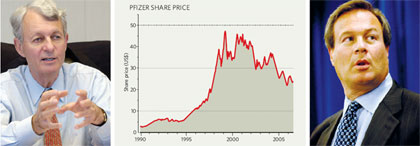
Nature: Bitter pill: disappointing results have seen Hank McKinnell (left) removed as Pfizer's chief executive to make way for Jeff Kindler.
"But despite the generally upbeat reaction to Kindler's appointment, the value of Pfizer's stock has remained unmoved. And close observers of the company question whether the appointment will do much to change its outlook."
(I guess that's me.)
"Like other major pharmaceutical firms, Pfizer is in a hole. Patents will soon run out on its major products, including the world's best-selling drug, cholesterol treatment Lipitor (atorvastatin). "They need to generate $10 billion in extra revenue each year and that's impossible," says Peter Rost, a former vice-president of Pfizer who runs a carping blog, http://peterrost.blogspot.com, on its predicament. "The only way they can stay afloat is as a black hole, sucking in other companies to boost revenue. I think they are going to collapse under their own weight."
So why would I say such a thing?
Simple.
Pfizer had eight drugs with more than a billion dollars in sales in 2005 (down from 10 in 2004), including Lipitor ($12 billion), Norvasc, a therapy for high blood pressure ($4.7 billion), Zoloft ($3.3 billion), Celebrex ($1.7 billion), Zithromax ($2 billion), and Viagra ($1.6 billion). Those eight drugs also account for nearly 60% of the company's human health segment sales (down from 70% in 2004).
Pfizer's revenues from these establish blockbusters continue to slide due to one of the pitfalls of the drug business: patent expiration. The company has warned investors it will probably lose some $14 billion due to patent expirations over the next two years; because of patent expirations in 2005, revenues from Zithromax slipped 40%, Accupril dropped 56%, Neurontin was down 77%; and Diflulcan, 47%. Additional losses from the blows to Celebrex and Bextra didn't help either; this double punch reduced revenues by nearly $6 billion.
The hubris driven druggernaut is confident that by 2007 it will be able to launch new blockbusters from its "robust pipeline" (hahahaha) to make up for the losses.
But, take a look at early sales of the company's seven new medicines released in 2005 -- Inspira, Caduet, Olmetec, Macugen, Revatio, Zmax (an extended dose variation of Zithromax still under patent protection), and Lyrica -- most of which were developed with partners and only contribute a portion of their revenues to Pfizer's bottom line, hardly look to be any big blockbusters. In fact, 2006 doesn't look to be much brighter for Pfizer: Zmax's sales are feeling pressure from the generic version of Zithromax. Additionally, both Lipitor and Zoloft face strong competition from other companies' generic treatments.
In early 2005, Pfizer announced plans to cut $4 billion in costs by restructuring certain divisions, including its US sales division and will have to continue to tighten its belt internally in 2006.
That "robust pipeline" includes some 225 projects in development (about 150 new drugs and about 75 enhancements to existing products), including drugs for atherosclerosis, diabetes, osteoporosis, breast cancer, epilepsy, anxiety disorders, and Parkinson's disease.
 Pfizer has relied on acquisitions and partnerships to build its R&D activities. Pfizer has applied to the FDA to market cessation drug Champix, antifungal Eraxis, insomnia treatment Indiplon, and Zeven, a powerful intravenous antibiotic. Stutent, used to treat kidney and gastrointestinal stromal tumors, was approved by the FDA in January 2006.
And this year Exubera was launched, an insulin inhaler used for the treatment of type 1 and type 2 diabetes that has blockbuster potential. According to Pfizer.
But look at the Exubra inhaler! It is BIG. A foot long, when unfolded, which makes it feel like a baseball bat. Think your girlfriend would like to haul that out of her handbag while seated in a restaurant?
Common sense, folks. Common sense. NO ONE would be caught dead with this foot long pocket rocket in their pocket. Or handbag.
And of course, Pfizer is buying other companies.
Pfizer's latest acquisitions included the purchase of Angiosyn, a private biotech working on an anti-angiogenesis therapy for macular degeneration, which can lead to blindness and Idun Pharmaceuticals, which is developing apoptosis (programmed cell death) inhibitors to treat liver disease, cancer, and other diseases.
The company is also sucking up the research divisions of QuoreX, which develops anti-bacterial drugs targeting hospital infections; research partner Vicuron Pharmaceuticals, which has two anti-infective (anidulafungin and dalbavancin) drugs under review by the FDA; and Bioren, which has developed a technology that helps drugs last longer through antibody optimization.
Pfizer says it plans to spend about $4 billion on acquisitions in 2006 in order to beef up its pipeline. In 2006 the company announced plans to acquire Rinat Neuroscience, a company developing drugs for pain, Alzheimer's disease, and other neurological disorders. Pfizer hopes the purchase will help it gain ground in the biotechnology sector.
So is Pfizer turning into a black hole?
Noooooooooo.
Pfizer is a black hole!
And as long as they can keep it going the deck of cards will remain standing and the Ponzi scheme will go on. But the day they don't find another company to dismantle, it is all over. And they will fall down under their own weight.
That day is coming closer.
Bloomberg recently announced that "Pfizer's AAA Credit Ratings Are in Jeopardy, Bond Prices Show "
They write: "Pfizer was dealt a blow on Aug. 2, when the U.S. Court of Appeals for the Federal Circuit in Washington invalidated a patent on Lipitor that expires in June 2011.
The ruling means Pfizer may face generic competition to Lipitor, which accounts for as much as 40 percent of the company's profits, a year earlier than analysts forecast.
Cheaper copies of the Zocor cholesterol pill captured 9.3 percent of the U.S. market in the first week after Merck's patent expired June 23. Lipitor's share fell to 30.6 percent from 32.8 percent at the same time.
``There's a bit of concern surrounding patent expirations and pipeline prospects,'' meaning new products, said Maryann Hennessey, analyst at bond-research firm CreditSights Inc. in New York. ``You've got the whole Lipitor patent expiration issue, which is a big overhang. And, well what are they going to do to enhance shareholder value?''
A bit of concern. You could say that.
Meanwhile Wall Street is trying to trick the public into buying Pfizer stock again.
I guess they think we're all suckers.
Subscribe to:
Posts (Atom)