Those of you following my blog know that I broke the story about the AstraZeneca Regional Sales Director who was quoted in an AstraZeneca Oncology Newsletter saying "there is a big bucket of money sitting in every [doctor's] office."
AstraZeneca reacted swiftly: They fired Michael Zubillaga today. This is how big pharma operates. AstraZeneca lacked the internal controls to make sure the truth didn't get out, and now they are trying to show they are holier than thou, by firing the guy who said what everyone knows to be true. Of course sales reps and drug companies regard doctor's offices as buckets of money, ready to be taken. And so, instead of a reprimand, Astra Zeneca created a sacrificial lamb to cover their corporate rear end.
Astra sales manager fired over his comments in a newsletter
By Thomas Ginsberg
INQUIRER STAFF WRITER
AstraZeneca P.L.C., the pharmaceutical giant with U.S. headquarters near Wilmington, summarily fired a regional sales director from Kennett Square today after his avaricious advice for sales people found its way to the Internet.
Michael Zubillaga, 50, made the comments in an internal Oncology Newsletter, published by and for employees at AstraZeneca's Mid-Atlantic Business Center in Wayne.
In a Q&A section of the newsletter's winter edition, Zubillaga is quoted stating three sales goals for calling on cancer doctors' offices for 2007. His goal No. 3:
"Call Execution - Not making the calls you are supposed to make does not drive your business. I see it like this: there is a big bucket of money sitting in every office. Every time you go in, you reach your hand in the bucket and grab a handful. The more times you are in, the more money goes in your pocket. Every time you make a call, you are looking to make more money."
Little in the statement would surprise sales people, their critics or, for that matter, most physicians they call on. And Zubillaga did, at another point, don the industry's standard patients-first mantle: "Hold your doctors accountable for the data we have, so that patients are getting the best treatment."
Still, the low-level manager's comments in a company newsletter, no less one dealing with cancer, quickly made waves on the Internet after industry bloggers Peter Rost and Ed Silverman published it.
In a statement this evening, the company said Zubillaga had been fired.
"AstraZeneca strongly repudiates the negative comments made in this newsletter," the statement said. "This newsletter was produced outside of AstraZeneca's required approval and review processes."
Messages left for Zubillaga at his home and work were not returned.
AstraZeneca spokeswoman Kirsten Evaire said Zubillaga was fired not for actual improper conduct, but for his comments, which violated the company's "robust compliance program that calls for responsible sales and marketing practices and conduct."
"All of our sales representatives are trained under these guidelines," the statement said. "We will reiterate with employees the importance of adhering to the highest ethical standards and all our compliance policies."
Asked whether Zubillaga was fired for merely speaking his mind, Evaire said: "Our statement speaks to everything we have to say about the situation."
Zubillaga's comments lit up several blogs and chat boards on the Internet, some condemning Zubillaga for propagating a negative image and others complimenting him for speaking the truth - even while predicting he would be fired for it.
"Crass, but some may well be motivated by such imagery," said Silverman in a post on his blog Pharmalot.com. "Of course, many docs know that's what the sales teams think of them. That's why some docs hold out for expensive meals, nice trips and good seats to good games, and why others won't let the sales rep past reception."
AstraZeneca employs about 4,500, throughout the Philadelphia-Wilmington region.
April 6, 2007, 7:57 pm
AstraZeneca Dismisses Sales Exec In Internet Flap
Posted by Scott Hensley, Wall Street Journal
Drug giant AstraZeneca fired a cancer medicine sales executive whose alleged comments comparing doctors’ offices to “a big bucket of money” in a newsletter for company employees caused a stir on the Internet.
Mike Zubillaga, a regional sales director at AstraZeneca, allegedly told reps in an interview for the internal newsletter: “There is a big bucket of money sitting in every office. Every time you go in, you reach your hand in the bucket and grab a handful. The more times you are in, the more money goes in your pocket. Every time you make a call, you are looking to make more money.”
While it’s a sales executive’s job to rouse his troops to action, the blunt language in the newsletter clashed with the company’s public statements of dedication to cancer patients.
Peter Rost, a former Pfizer marketing executive, posted an image of the newsletter on his blog Thursday. The newsletter sparked a vigorous discussion on Cafe Pharma, an Internet forum frequented by pharmaceutical sales reps.
Early Friday afternoon, a spokeswoman for AstraZeneca said Zubillaga wasn’t available for an interview and that the company was trying to ascertain the authenticity of the document containing his remarks. Late in the day, the spokeswoman wrote the Health Blog that the drug maker “strongly repudiates the negative comments made in this newsletter. Our company and employees are devoted to helping physicians provide their patients with the care they require.”
The newsletter was produced outside of “required approval and review processes, ” she wrote. Finally, the statement said that “swift disciplinary action has been taken and the employee whose comments were published has been terminated.”
The Health Blog’s call to Zubillaga’s office late Friday wasn’t immediately returned.
Showing posts sorted by relevance for query Zubillaga. Sort by date Show all posts
Showing posts sorted by relevance for query Zubillaga. Sort by date Show all posts
Friday, April 06, 2007


Sunday, April 08, 2007
New questions about the AstraZeneca scandal.
 Question Authority has learned new information about the AstraZeneca scandal involving, Michael Zubillaga, 50, Regional Sales Director, AstraZeneca Oncology.
In an AstraZeneca newsletter, which got Mr. Zubillaga fired the day after the content was revealed on Question Authority, Mr. Zubillaga stated, "There is a big bucket of money sitting in every office. Every time you go in, you reach your hand in the bucket and grab a handful. The more times you are in, the more money goes in your pocket. Every time you make a call, you are looking to make more money."

 The person who wrote down Mr. Zubillaga's words, Lisa Mossburg, was not a journalist, nor an in-house public relations person or someone independent of Mr. Zubillaga; she was simply a regular Oncology Sales Representative, Question Authority has learned from a source inside AstraZeneca.
If true, for a Regional Sales Director to use company resources and ask one of his subordinates to write up what he may initially hoped was a flattering story about himself, raises a number of additional questions, and at a minimum would appear unseemly.
The fact that "this newsletter was produced outside of AstraZeneca's required approval and review processes," according to AstraZeneca, also raises numerous questions about AstraZeneca's internal control system as it relates to the conduct of AstraZeneca's senior management and what kind of cowboy mentality exists within AstraZeneca's US organization.
More importantly, Question Authority has also learned that there have allegedly been several Code of Conduct (888 244-1769) reports from employees about Mike Zubillaga since November of 2006. Two or three of these reports allegedly involved Mr. Zubillaga's instructions to use Medical Science Liaisons (called Regional Scientific Managers at AstraZeneca) to sell off-label and for reps to coordinate these efforts using cell phones (allegedly to avoid voicemail and email so as to not leave a permanent record).
If true, AstraZeneca should have investigated and filed a report with the Office of the Inspector General, since on June 4, 2003, AstraZeneca Pharmaceuticals LP and AstraZeneca LP was forced to enter into a Corporate Integrity Agreement (“CIA”) with the Office of Inspector General (“OIG”) of the United States Department of Health and Human Services (“HHS”), based on prior illegal conduct.
The CIA is effective until June 3, 2008, and under the agreement, Mr. Zubillaga would have received extensive training in how to market and sell pharmaceuticals. More importantly, if AstraZeneca determines through any means that there is a reportable event, (such as a Regional Sales Director accused of off-label marketing), AstraZeneca must notify OIG in writing, within 30 days.
It will be interesting to find out if AstraZeneca took any such action with respect to the allegations above.
If the company received such notices and did not take such action, AstraZeneca may be in breach of their agreement with the OIG, and would have to pay certain fines. If the OIG decided that AstraZeneca was in Material Breach of the agreement, AstraZeneca could be excluded from participation in Federal health care programs.
Please note that the alleged code of conduct violations may have no foundation, they may have been fully investigated and dismissed by AstraZeneca, or they may still be under investigation. They may also have already been reported to the OIG.
What can be verified is that this statement, "Sorry, I'm not willing to face civil or criminal fines for MZ or anyone else. AZ is currently under close scrutiny by the Office of Inspector General under a five year Corporated Integrity Agreement" was made on March 7, 2007, one month ago on AstraZeneca's message board for sales reps and that a vigorous debate appear to have taken place on that tread about "MZ," and how "MZ" conducted his business.
One response was this: "I am sure MZ is scared of you little cowards, remember management never takes the fall it is always the reps so call the number and most of you will be let go by the end of the week, just comply and you will be rewarded."
That comment was followed by this one: "That Number is BS I called it once to report an HR person. The next thing I new I got thrown under the bus by my rsd and dsm."
Chilling comments, indeed.
Tuesday, April 10, 2007
Philadelphia Inquirer Writes Second Article about "The Zube Affair."
And, based on the calls I'm getting from other major media outlets in US and Europe, not the last one.
I guess having another pharma executive telling it like it is, even if done inadvertently, is truly newsworthy.
The interest in this story says more about Big Pharma's lack of credibility then it says about the story itself:
Mixed reaction to firing at AstraZenecaAstraZeneca's firing of a sales director sparked comment over what motivates drugmakers.
By Thomas Ginsberg
Inquirer Staff Writer
AstraZeneca P.L.C., the pharmaceutical giant, received a mixed reaction yesterday to its firing of a Chester County sales director who had likened doctors' offices to "a big bucket of money."
"AstraZeneca did the right thing," said Richard Levick, a consultant on pharmaceutical public relations and president of Levick Strategic Communications L.L.C., of Washington.
"He is saying they put profits in front of customers. That may be truthful. But in the hope business, people want to think these companies are more than just profit-motivated," Levick said.
Michael Zubillaga of Kennett Square, regional sales director at AstraZeneca's Mid-Atlantic Business Center in Wayne, was fired Friday, just hours after his comments in an internal company newsletter appeared on the Internet and drew attention from bloggers, fellow sales representatives, and newspaper journalists.
In a Q&A section of the office's internal Oncology Newsletter, Zubillaga was quoted as urging his sales reps to view sales calls on doctors' offices as a way to "reach in and grab a handful" of money.
"The more times you are in, the more money goes in your pocket. Every time you make a call, you are looking to make more money," the newsletter quoted Zubillaga as advising his sales representatives.
Zubillaga did not return messages left at his Kennett Square home.
The notion that sales reps may be motivated by money is neither new nor insightful. But pharmaceutical companies in recent years have struggled - and expended millions of advertising dollars - to portray themselves as firms equally motivated by patient care.
"Managers will do whatever it takes to sell more drugs," said Kathleen Slattery-Moschkau, a onetime drug sales rep from Madison, Wis., who has become a vigorous critic of the industry.
Some "sales reps are motivated by money, so that's what they'll say. Other times they use patient-oriented tactics, because that will work with other reps," she said.
The fact that Zubillaga expressed the sentiment in print "is a shock," she added. "But I'm not surprised that, in this climate of trying to spin the P.R., that he was fired."
Peter Rost, a blogger and former marketing executive at Pfizer Inc. who obtained the newsletter from a person he described as an AstraZeneca "whistle-blower," said Zubillaga "just said what people think, but he was caught saying it, and in a company newsletter."
But Michael Luby, a drug-sales consultant and president of TargetRx Inc., of Horsham, said AstraZeneca did the right thing.
"His statement is wrong because it's so incomplete," he said. "The point is to help a patient and register a sale. These companies are not selling ice cream."
AstraZeneca, in statements Friday and Sunday, said it "repudiated" Zubillaga's comments and had launched an investigation to find out how the newsletter was produced without proper clearance.
It said the newsletter was dated "Winter 2007" but was not distributed until last week. It was not known whether other employees were being disciplined.
"Our company is disturbed by the content and particularly concerned about the impact the content of this unapproved newsletter may have on our employees and others," the Sunday statement said.
"In addition, we are concerned that a manager in our sales organization used this vehicle to communicate messages that directly contravene our core values as a responsible pharmaceutical company," it said.
I guess having another pharma executive telling it like it is, even if done inadvertently, is truly newsworthy.
The interest in this story says more about Big Pharma's lack of credibility then it says about the story itself:
Mixed reaction to firing at AstraZenecaAstraZeneca's firing of a sales director sparked comment over what motivates drugmakers.
By Thomas Ginsberg
Inquirer Staff Writer
AstraZeneca P.L.C., the pharmaceutical giant, received a mixed reaction yesterday to its firing of a Chester County sales director who had likened doctors' offices to "a big bucket of money."
"AstraZeneca did the right thing," said Richard Levick, a consultant on pharmaceutical public relations and president of Levick Strategic Communications L.L.C., of Washington.
"He is saying they put profits in front of customers. That may be truthful. But in the hope business, people want to think these companies are more than just profit-motivated," Levick said.
Michael Zubillaga of Kennett Square, regional sales director at AstraZeneca's Mid-Atlantic Business Center in Wayne, was fired Friday, just hours after his comments in an internal company newsletter appeared on the Internet and drew attention from bloggers, fellow sales representatives, and newspaper journalists.
In a Q&A section of the office's internal Oncology Newsletter, Zubillaga was quoted as urging his sales reps to view sales calls on doctors' offices as a way to "reach in and grab a handful" of money.
"The more times you are in, the more money goes in your pocket. Every time you make a call, you are looking to make more money," the newsletter quoted Zubillaga as advising his sales representatives.
Zubillaga did not return messages left at his Kennett Square home.
The notion that sales reps may be motivated by money is neither new nor insightful. But pharmaceutical companies in recent years have struggled - and expended millions of advertising dollars - to portray themselves as firms equally motivated by patient care.
"Managers will do whatever it takes to sell more drugs," said Kathleen Slattery-Moschkau, a onetime drug sales rep from Madison, Wis., who has become a vigorous critic of the industry.
Some "sales reps are motivated by money, so that's what they'll say. Other times they use patient-oriented tactics, because that will work with other reps," she said.
The fact that Zubillaga expressed the sentiment in print "is a shock," she added. "But I'm not surprised that, in this climate of trying to spin the P.R., that he was fired."
Peter Rost, a blogger and former marketing executive at Pfizer Inc. who obtained the newsletter from a person he described as an AstraZeneca "whistle-blower," said Zubillaga "just said what people think, but he was caught saying it, and in a company newsletter."
But Michael Luby, a drug-sales consultant and president of TargetRx Inc., of Horsham, said AstraZeneca did the right thing.
"His statement is wrong because it's so incomplete," he said. "The point is to help a patient and register a sale. These companies are not selling ice cream."
AstraZeneca, in statements Friday and Sunday, said it "repudiated" Zubillaga's comments and had launched an investigation to find out how the newsletter was produced without proper clearance.
It said the newsletter was dated "Winter 2007" but was not distributed until last week. It was not known whether other employees were being disciplined.
"Our company is disturbed by the content and particularly concerned about the impact the content of this unapproved newsletter may have on our employees and others," the Sunday statement said.
"In addition, we are concerned that a manager in our sales organization used this vehicle to communicate messages that directly contravene our core values as a responsible pharmaceutical company," it said.
Tuesday, April 17, 2007
Philadelphia Inquirer: "Additional AstraZeneca staff disciplined"
Posted on Tue, Apr. 17, 2007
Additional AstraZeneca staff disciplined
By Thomas Ginsberg
Philadelphia Inquirer Staff Writer
AstraZeneca P.L.C. said yesterday that it was actively investigating some employees for improper promotional activity and already has taken corrective action after other undisclosed lapses.
London-based AstraZeneca, with U.S. headquarters in Wilmington and major operations around Philadelphia, made the statement in the face of persistent questions about its firing 10 days ago of a regional sales director, Michael Zubillaga, 50, of Kennett Square.
Zubillaga, in an internal newsletter, had exhorted sales representatives who call on cancer doctors to view those doctors' offices as a "bucket of money." After industry bloggers obtained and published his comments on the Internet, casting the company in a negative light, AstraZeneca fired him for allegedly violating its policy on ethical conduct.
But another comment by Zubillaga, in the same newsletter, appears to highlight a more troublesome issue underlying the firing. Zubillaga was quoted as lamenting that sales reps last year had been too slow to promote AstraZeneca's cancer drug Arimidex in direct comparison to Novartis AG's treatment, Femara.
"We should have changed our strategy with our core messages earlier in regards to selling against letrozole," Zubillaga says in the newsletter. Letrozole is the generic name for Femara.
Such direct comparison or counter-promotion of two drugs could be improper, since neither company has tested the products directly against each other.
The U.S. Food and Drug Administration prohibits drug companies from promoting their products without valid or FDA-approved data and requires them always to present "fair" and "balanced" data in their sales pitches.
Sales reps who make such comparisons, in violation of company or FDA policy, could be penalized individually.
Peter Rost, a former Pfizer Inc. marketing executive and now author of the blog Question Authority (www.peterrost. blogspot.com), said anonymous sources had sent him documents indicating that AstraZeneca sales managers might have subtly ordered or encouraged sales reps to make the improper comparison.
Rost said the source, or sources, of the documents was the same who initially sent him the Zubillaga newsletter that turned out to be genuine.
In response, AstraZeneca said in a statement:
"The company takes claims of misconduct very seriously and investigates these in a timely and effective manner. Investigations concerning the specific claims referenced were initiated. Some claims reported prior to this incident were investigated and concluded with appropriate corrective action being taken. More recent claims are actively being investigated."
A spokeswoman, Emily Denney, said she could not immediately explain "corrective action" and declined to say whether the affected employees worked in sales or performed other duties.
AstraZeneca already is under heightened scrutiny by regulators from the U.S. Department of Health and Human Services for illegal marketing and billing involving another cancer drug, Zoladex, in 2003. It paid $355 million to settle the case and must report suspicious or improper activities by its employees to regulators.
Under its Corporate Integrity Agreement with regulators, the company must report any infractions, such as those alleged by Rost's sources.
Denney emphasized that the company has made proper disclosure to authorities. "In each instance, AstraZeneca acted in a manner consistent with its compliance program requirements and its obligations," Denney said.
Don White, a spokesman for the Department of Health and Human Services, declined to confirm or deny whether investigators had received recent complaints regarding AstraZeneca promotions of Arimidex.
AstraZeneca's share price closed up 73 cents, or about 1.3 percent, to $56.70 on the New York Stock Exchange.
AstraZeneca employs about 5,000 in the Philadelphia region.
--------------------------------------------------------------------------------
Contact staff writer Thomas Ginsberg at 215-854-4177 or tginsberg@phillynews.com.
Additional AstraZeneca staff disciplined
By Thomas Ginsberg
Philadelphia Inquirer Staff Writer
AstraZeneca P.L.C. said yesterday that it was actively investigating some employees for improper promotional activity and already has taken corrective action after other undisclosed lapses.
London-based AstraZeneca, with U.S. headquarters in Wilmington and major operations around Philadelphia, made the statement in the face of persistent questions about its firing 10 days ago of a regional sales director, Michael Zubillaga, 50, of Kennett Square.
Zubillaga, in an internal newsletter, had exhorted sales representatives who call on cancer doctors to view those doctors' offices as a "bucket of money." After industry bloggers obtained and published his comments on the Internet, casting the company in a negative light, AstraZeneca fired him for allegedly violating its policy on ethical conduct.
But another comment by Zubillaga, in the same newsletter, appears to highlight a more troublesome issue underlying the firing. Zubillaga was quoted as lamenting that sales reps last year had been too slow to promote AstraZeneca's cancer drug Arimidex in direct comparison to Novartis AG's treatment, Femara.
"We should have changed our strategy with our core messages earlier in regards to selling against letrozole," Zubillaga says in the newsletter. Letrozole is the generic name for Femara.
Such direct comparison or counter-promotion of two drugs could be improper, since neither company has tested the products directly against each other.
The U.S. Food and Drug Administration prohibits drug companies from promoting their products without valid or FDA-approved data and requires them always to present "fair" and "balanced" data in their sales pitches.
Sales reps who make such comparisons, in violation of company or FDA policy, could be penalized individually.
Peter Rost, a former Pfizer Inc. marketing executive and now author of the blog Question Authority (www.peterrost. blogspot.com), said anonymous sources had sent him documents indicating that AstraZeneca sales managers might have subtly ordered or encouraged sales reps to make the improper comparison.
Rost said the source, or sources, of the documents was the same who initially sent him the Zubillaga newsletter that turned out to be genuine.
In response, AstraZeneca said in a statement:
"The company takes claims of misconduct very seriously and investigates these in a timely and effective manner. Investigations concerning the specific claims referenced were initiated. Some claims reported prior to this incident were investigated and concluded with appropriate corrective action being taken. More recent claims are actively being investigated."
A spokeswoman, Emily Denney, said she could not immediately explain "corrective action" and declined to say whether the affected employees worked in sales or performed other duties.
AstraZeneca already is under heightened scrutiny by regulators from the U.S. Department of Health and Human Services for illegal marketing and billing involving another cancer drug, Zoladex, in 2003. It paid $355 million to settle the case and must report suspicious or improper activities by its employees to regulators.
Under its Corporate Integrity Agreement with regulators, the company must report any infractions, such as those alleged by Rost's sources.
Denney emphasized that the company has made proper disclosure to authorities. "In each instance, AstraZeneca acted in a manner consistent with its compliance program requirements and its obligations," Denney said.
Don White, a spokesman for the Department of Health and Human Services, declined to confirm or deny whether investigators had received recent complaints regarding AstraZeneca promotions of Arimidex.
AstraZeneca's share price closed up 73 cents, or about 1.3 percent, to $56.70 on the New York Stock Exchange.
AstraZeneca employs about 5,000 in the Philadelphia region.
--------------------------------------------------------------------------------
Contact staff writer Thomas Ginsberg at 215-854-4177 or tginsberg@phillynews.com.
Saturday, April 07, 2007
"Sales manager: Grab "bucket of money" at doctor's office"
Finally, the story reaches AP, and so, goes mainstream:
Sales manager: Grab "bucket of money" at doctor's office
Associated Press
KENNETT SQUARE, Pa. - A pharmaceutical sales manager was fired after his advice to "grab a handful" of money when calling on cancer doctors reached the Internet.
AstraZeneca regional sales director Michael Zubillaga, 50, was fired Friday over comments initially written for the Oncology Newsletter, an internal publication produced at the company's office in the Philadelphia suburb of Wayne.
In his advice for calling on doctors, The Philadelphia Inquirer reported Saturday, Zubillaga wrote:
"I see it like this: There is a big bucket of money sitting in every office. Every time you go in, you reach your hand in the bucket and grab a handful. The more times you are in, the more money goes in your pocket."
His words echoed through cyberspace after pharmaceutical industry bloggers Peter Rost and Ed Silverman published them. Zubillaga did add that doctors should provide their patients with the best care possible.
"AstraZeneca strongly repudiates the negative comments made in this newsletter," the company said in a statement. "This newsletter was produced outside of AstraZeneca's required approval and review processes."
Zubillaga was fired for comments that violated the company's standard of "responsible sales and marketing practices and conduct," company spokeswoman Kirsten Evraire said.
Zubillaga did not return phone messages the newspaper left Friday at his home and office. Reached by phone Saturday, his mother said he may be out of town.
Silverman, on his blog Pharmalot.com, said the advice, while crass, might motivate some employees.
"Of course, many docs know that's what the sales teams think of them," he wrote. "That's why some docs hold out for expensive meals, nice trips, and good seats to good games, and why others won't let the sales rep past reception."
AstraZeneca, which has its U.S. headquarters near Wilmington, Del., employs about 4,500 throughout the Philadelphia and Wilmington region.
Sales manager: Grab "bucket of money" at doctor's office
Associated Press
KENNETT SQUARE, Pa. - A pharmaceutical sales manager was fired after his advice to "grab a handful" of money when calling on cancer doctors reached the Internet.
AstraZeneca regional sales director Michael Zubillaga, 50, was fired Friday over comments initially written for the Oncology Newsletter, an internal publication produced at the company's office in the Philadelphia suburb of Wayne.
In his advice for calling on doctors, The Philadelphia Inquirer reported Saturday, Zubillaga wrote:
"I see it like this: There is a big bucket of money sitting in every office. Every time you go in, you reach your hand in the bucket and grab a handful. The more times you are in, the more money goes in your pocket."
His words echoed through cyberspace after pharmaceutical industry bloggers Peter Rost and Ed Silverman published them. Zubillaga did add that doctors should provide their patients with the best care possible.
"AstraZeneca strongly repudiates the negative comments made in this newsletter," the company said in a statement. "This newsletter was produced outside of AstraZeneca's required approval and review processes."
Zubillaga was fired for comments that violated the company's standard of "responsible sales and marketing practices and conduct," company spokeswoman Kirsten Evraire said.
Zubillaga did not return phone messages the newspaper left Friday at his home and office. Reached by phone Saturday, his mother said he may be out of town.
Silverman, on his blog Pharmalot.com, said the advice, while crass, might motivate some employees.
"Of course, many docs know that's what the sales teams think of them," he wrote. "That's why some docs hold out for expensive meals, nice trips, and good seats to good games, and why others won't let the sales rep past reception."
AstraZeneca, which has its U.S. headquarters near Wilmington, Del., employs about 4,500 throughout the Philadelphia and Wilmington region.
Tuesday, May 22, 2007
Congressional Quarterly: "Senior Manager Leaves AstraZeneca in Midst of Congressional Scrutiny"
Senior Manager Leaves AstraZeneca in Midst of Congressional Scrutiny
By Drew Armstrong, CQ Staff
As Congress continues to look closely at allegations of illegal marketing of a breast cancer drug by manufacturer AstraZeneca, a senior manager connected to the company’s off-label promotion of the drug, Arimidex, has resigned.
AstraZeneca Spokeswoman Emily Denney confirmed Monday that Scarlett Spring, the company’s national sales director of oncology, will resign from AstraZeneca, as of June 1. Spring was the supervisor of former AstraZeneca Regional Sales Manager Mike Zubillaga, who allegedly encouraged his regional sales team to promote Arimidex off-label and was fired by AstraZeneca in April as part of the company’s investigation into the allegations.
Off-label promotion of drugs by pharmaceutical sales personnel is illegal, according to the Food and Drug Administration.
Denney would not comment on Spring’s departure, other than to say that Spring was leaving the company for personal reasons.
"She announced internally that she decided to leave AstraZeneca for personal reasons to pursue other opportunities," Denney said.
Public scrutiny of the company’s marketing of its cancer medications began in April, when employees familiar with AstraZeneca’s cancer drug marketing operation leveled allegations that AstraZeneca ignored previous warnings the employees issued about being told to promote the drug off-label.
The employees say they first reported the alleged violations through an internal hotline in November 2006. The employees say they waited for five months without receiving a response, and that AstraZeneca only acted on their claims after the employees wrote a letter in March to the Department of Health and Human Services’ Office of Inspector General (OIG), and forwarded copies to a few industry news Web sites several weeks later. The letter detailed their allegations, including the purported lack of action by AstraZeneca.
Meanwhile, AstraZeneca has blamed a "systems error" that caused the results of AstraZeneca’s ongoing investigation into the matter not to be sent back to the employees.
The company faults an error within Global Compliance, an outside company that anonymously transmits employee complaints of ethical violations to AstraZeneca, which then sends a response back through Global Compliance to the employees.
A May 2 AstraZeneca memo sent to the sales team reads, "We subsequently became aware of a systems issue with our prior helpline vendor. Some employees who had reported suspected violations were prevented from receiving the information that AZ had provided as a follow-up to their reports. We address [sic] the systems issue as soon as we discovered it, and we do not expect it to recur. Responding promptly and appropriately to reported violations is a fundamental element of our compliance program," says the memo.
Under AstraZeneca’s compliance system, employees can call Global Compliance with concerns about a legal or ethical violation. Global Compliance then anonymously sends the claims to the company, which investigates them and returns a response that the employees can access with a unique code number.
AstraZeneca’s firing of Zubillaga — which occurred after the disclosure of other internal memos and training materials also provided to Congressional Quarterly by the employees — has been the most public result of its investigation.
The company has declined to state the exact timeline of its investigation. However, in an April 20 statement, AstraZeneca said that some of the claims were being examined before they were made public.
In the November 2006 call to the Global Compliance hotline, AstraZeneca employees say they reported that members of the cancer drug sales team had been instructed by managers to promote the off-label use of the drug Arimidex, also known as anastrozole.
On April 5, 2007, Web sites posted excerpts from a sales team newsletter in which a sales manager named Mike Zubillaga referred to cancer doctors’ offices as "a big bucket of money." According to the group of employees, Zubillaga also was the management figure encouraging the sales force to promote the off-label use of Arimidex. The employees released copies of the OIG letter a week later.
AstraZeneca fired Zubillaga April 6. Denney later confirmed that the company had hired an outside law firm to look into the allegations made in the OIG letter.
The OIG has confirmed that it is looking into the accusations, and House lawmakers are interested as well.
Henry A. Waxman, D-Calif., chairman of the House Oversight and Government Reform Committee, has asked AstraZeneca to provide documents on the marketing of the cancer drug. Rep. Pete Stark, D-Calif., also is looking into the claims.
By Drew Armstrong, CQ Staff
As Congress continues to look closely at allegations of illegal marketing of a breast cancer drug by manufacturer AstraZeneca, a senior manager connected to the company’s off-label promotion of the drug, Arimidex, has resigned.
AstraZeneca Spokeswoman Emily Denney confirmed Monday that Scarlett Spring, the company’s national sales director of oncology, will resign from AstraZeneca, as of June 1. Spring was the supervisor of former AstraZeneca Regional Sales Manager Mike Zubillaga, who allegedly encouraged his regional sales team to promote Arimidex off-label and was fired by AstraZeneca in April as part of the company’s investigation into the allegations.
Off-label promotion of drugs by pharmaceutical sales personnel is illegal, according to the Food and Drug Administration.
Denney would not comment on Spring’s departure, other than to say that Spring was leaving the company for personal reasons.
"She announced internally that she decided to leave AstraZeneca for personal reasons to pursue other opportunities," Denney said.
Public scrutiny of the company’s marketing of its cancer medications began in April, when employees familiar with AstraZeneca’s cancer drug marketing operation leveled allegations that AstraZeneca ignored previous warnings the employees issued about being told to promote the drug off-label.
The employees say they first reported the alleged violations through an internal hotline in November 2006. The employees say they waited for five months without receiving a response, and that AstraZeneca only acted on their claims after the employees wrote a letter in March to the Department of Health and Human Services’ Office of Inspector General (OIG), and forwarded copies to a few industry news Web sites several weeks later. The letter detailed their allegations, including the purported lack of action by AstraZeneca.
Meanwhile, AstraZeneca has blamed a "systems error" that caused the results of AstraZeneca’s ongoing investigation into the matter not to be sent back to the employees.
The company faults an error within Global Compliance, an outside company that anonymously transmits employee complaints of ethical violations to AstraZeneca, which then sends a response back through Global Compliance to the employees.
A May 2 AstraZeneca memo sent to the sales team reads, "We subsequently became aware of a systems issue with our prior helpline vendor. Some employees who had reported suspected violations were prevented from receiving the information that AZ had provided as a follow-up to their reports. We address [sic] the systems issue as soon as we discovered it, and we do not expect it to recur. Responding promptly and appropriately to reported violations is a fundamental element of our compliance program," says the memo.
Under AstraZeneca’s compliance system, employees can call Global Compliance with concerns about a legal or ethical violation. Global Compliance then anonymously sends the claims to the company, which investigates them and returns a response that the employees can access with a unique code number.
AstraZeneca’s firing of Zubillaga — which occurred after the disclosure of other internal memos and training materials also provided to Congressional Quarterly by the employees — has been the most public result of its investigation.
The company has declined to state the exact timeline of its investigation. However, in an April 20 statement, AstraZeneca said that some of the claims were being examined before they were made public.
In the November 2006 call to the Global Compliance hotline, AstraZeneca employees say they reported that members of the cancer drug sales team had been instructed by managers to promote the off-label use of the drug Arimidex, also known as anastrozole.
On April 5, 2007, Web sites posted excerpts from a sales team newsletter in which a sales manager named Mike Zubillaga referred to cancer doctors’ offices as "a big bucket of money." According to the group of employees, Zubillaga also was the management figure encouraging the sales force to promote the off-label use of Arimidex. The employees released copies of the OIG letter a week later.
AstraZeneca fired Zubillaga April 6. Denney later confirmed that the company had hired an outside law firm to look into the allegations made in the OIG letter.
The OIG has confirmed that it is looking into the accusations, and House lawmakers are interested as well.
Henry A. Waxman, D-Calif., chairman of the House Oversight and Government Reform Committee, has asked AstraZeneca to provide documents on the marketing of the cancer drug. Rep. Pete Stark, D-Calif., also is looking into the claims.
Monday, April 09, 2007
What other blogs are saying about Zubillaga affair.
Brandweek has a very thoughtful post today. He is now completely on Zubillaga's side, and pens the headline, "Worst PR Move of the Week: AZ Turns 'Bucket of Money' Incident Into a Full-Blown Fiasco."
And most voters on the PharmaGossip poll appear to agree with Jim at Brandweek. 237 votes so far, and they indicate that 57% think that Zubillaga was just motivating his troops or AZ tried to put out fire they started or he was just telling it as it is.
Of course, none of those options are palatable to AstraZeneca, which is just as hard at work to change the image of big pharma as any other big pharma company.
As for me, I agree that this doesn't look good for AstraZeneca, however, I also note that Mr. Zubillaga's reign has been filled with controversy, as exemplified by comments on AstraZeneca's message board and allegations of "code of conduct violations."
Also, we still don't know why AstraZeneca was in such a rush to suddenly fire him. At a minimum, me thinks there are more things going on in this affair, that none of us know about. And to AstraZeneca's and Edelman PR's credit, whatever they would have done, they would have been critizised. This is a no-win situation.
And what the real truth is we may never find out.
And most voters on the PharmaGossip poll appear to agree with Jim at Brandweek. 237 votes so far, and they indicate that 57% think that Zubillaga was just motivating his troops or AZ tried to put out fire they started or he was just telling it as it is.
Of course, none of those options are palatable to AstraZeneca, which is just as hard at work to change the image of big pharma as any other big pharma company.
As for me, I agree that this doesn't look good for AstraZeneca, however, I also note that Mr. Zubillaga's reign has been filled with controversy, as exemplified by comments on AstraZeneca's message board and allegations of "code of conduct violations."
Also, we still don't know why AstraZeneca was in such a rush to suddenly fire him. At a minimum, me thinks there are more things going on in this affair, that none of us know about. And to AstraZeneca's and Edelman PR's credit, whatever they would have done, they would have been critizised. This is a no-win situation.
And what the real truth is we may never find out.
Thursday, May 03, 2007
Congressional Quarterly: Capitol Hill Scrutinizes Marketing of Breast Cancer Meds"
Capitol Hill Scrutinizes Marketing of Breast Cancer Meds
By Drew Armstrong, CQ Staff
Drug maker AstraZeneca is drawing scrutiny from Capitol Hill over allegations made by a group of individuals claiming to be from inside the company regarding the improper marketing of Arimidex, a breast cancer medication.
A spokesman for the group of current and former employees alleges that AstraZeneca failed to stop unethical and illegal activity related to marketing strategies to sell the breast cancer drug, despite reports filed by the group with an internal compliance hotline. Specifically, the group alleges that AstraZeneca directed its sales force to push for the off-label use of Arimidex — an illegal practice prohibited by the Food and Drug Administration (FDA).
Last week, Rep. Pete Stark, D-Calif., sent a letter to the Health and Human Services Department’s Office of Inspector General (OIG), requesting that the OIG begin an investigation into whether AstraZeneca used sales representatives to illegally promote the drug off-label.
While doctors can freely prescribe drugs for “labeled uses” — those approved by the FDA — it is illegal for drug companies to use their sales forces to promote off-label use. While drug company-employed science experts, known as “medical science liaisons,” are permitted to discuss off-label use with a doctor, they can do so only if the doctor requests such a meeting. Drug company sales representatives are forbidden from encouraging such discussions between doctors and a drug company’s medical liaisons.
The prohibition of off-label marketing is designed to protect patients from drug makers pitching unapproved uses of drugs. The law defers to doctors, however, allowing them to exercise their clinical judgment in such instances.
Congressional Quarterly received several company documents from the group that support the allegations. According to the documents — memos, company training materials and performance evaluations — AstraZeneca sales representatives were allegedly instructed to promote the off-label use of Arimidex by engaging doctors in a discussion about a competing drug called Femara.
The spokesman for the group claims that the sales strategy was designed to spur doctors to set up meetings with AstraZeneca’s medical liaisons. Because the drugs are similar, Arimidex and Femara, made by rival drug maker Novartis, compete for market share both on- and off-label.
According to one memo detailing performance objectives for the sales force, AstraZeneca sales representatives were encouraged to “utilize resources i.e., RSM (regional scientific managers) ... and brand team.” “Regional Scientific Managers” is another term for the medical science liaisons who are allowed to answer physician questions on off-label use.
On a training CD used by AstraZeneca sales representatives, a role-playing scenario between a doctor and salesperson lays out how AstraZeneca representatives can create a discussion with doctors about Arimidex compared to Femara. According to AstraZeneca’s company policy, sales employees are not allowed to make comparisons against competing drugs.
According to AstraZeneca, the company recorded $614 million in sales of the drug in 2006. Worldwide, the drug’s sales totaled $1.5 billion in 2006.
Stark’s letter asking the OIG to investigate appears to have generated results. OIG Spokesman Don White said the office is looking into the allegations.
“At this point, there is just a preliminary evaluation going on,” White said. “I’m not going to make any comment on an ultimate conclusion of a review, ” White added, referring to whether or not AstraZeneca has broken the law. He continued, “We have no indication that there is any kind of breach — we just don’t know yet. We don’t have hard info.”
White did not address specific questions about the documents, or comment on what materials the company might have received from the group making the allegations.
AstraZeneca spokeswoman Emily Denney acknowledged Wednesday that the company has been in contact with the OIG about its own internal efforts to address the allegations.
“We took all those allegations very seriously, Denney said. “We have concluded our investigation of the claims.” She added in a statement, “In some cases, there was merit to the allegations and appropriate disciplinary action has been taken. Our investigation also revealed that a number of the allegations were either unsubstantiated or a result of misunderstanding.”
Denney said all of the issues reported to the company have now been resolved.
She also emphasized that the company’s sales force has been trained not to share inappropriate material with physicians, but that having some of the information is necessary to do their jobs.
“Our sales reps have to be accurately aware of the competitive landscape in which they’re operating,” Denney said.
On April 20, Denney confirmed that the company has hired an outside law firm to investigate the allegations, and had already fired one sales manager named by the group.
The group has said in documents posted on industry Web sites that they are in contact with government investigators, but they have so far declined to speak with the media on record.
The documents do not state specifically what AstraZeneca sales representatives were asked to say — whether they emphasized risks from Femara, or played up the benefits of Arimidex — but so far there have been no head-to-head clinical trails between the two drugs, and any claims the sales team made regarding one drug’s efficacy over the other would be suspect.
Meanwhile, proven allegations that AstraZeneca violated company policy over the marketing of Arimidex could carry serious consequences.
AstraZeneca is already operating under a Corporate Integrity Agreement (CIA) with the inspector general’s office that it signed in 2003 over a marketing scandal involving Zoladex, a drug used to treat prostate cancer. Often applied as part of a court verdict, the CIA is an agreement between a company and the government to adhere to certain standards of conduct.
In AstraZeneca’s case, the integrity agreement was the result of a 2003 court case in which it pleaded guilty to charges around the improper sale and marketing of Zoladex. In addition to pledging to adhere to the integrity agreement, AstraZeneca was fined $355 million, and is required to oversee that marketing and sales practices stay “in full compliance with the law.”
Because AstraZeneca is legally bound under the CIA to ensure its marketing practices comply with the law, any violation of company policy could be tantamount to a breach of the agreement with HHS. According to White, the OIG would be responsible for investigating any such breach.
The internal documents were first posted online by Peter Rost, a former Pfizer executive who now writes about the industry, and by Pharmalot.com, an industry news site published by the Star Ledger of New Jersey. Rost is considered a controversial figure in the pharmaceutical world. He was fired in 2005 from his position as a vice president at Pfizer after filing a whistleblower suit against the company and going to Capitol Hill to oppose his company’s position on drug importation.
The inquiry into AstraZeneca’s marketing practices began after the group posted on Rost’s Web site a letter originally sent to the OIG on April 12.
In an electronic copy of the letter provided by the group, the group alleges to the OIG that sales representatives were told specifically by a sales manager to promote meetings between physicians and company medical science liaisons in order to drive off-label uses of Arimidex. In the letter, group says that despite reporting the action to the company hotline, no action was taken by the company.
Following several news reports on AstraZeneca’s alleged mismarketing of Arimidex, Stark asked the OIG to begin an investigation. “I urge you to immediately investigate the allegations described herein, and to open an investigation into the FDA’s oversight of pharmaceutical marketing to physicians,” Stark wrote in his letter.
One AstraZeneca manager named in the developing allegations has already been fired.
Regional Sales Manager Mike Zubillaga was let go after an internal sales force newsletter surfaced in April that quoted Zubillaga referring to oncology doctors’ offices as “a big bucket of money.”
In the newsletter, Zubillaga says, “I see it like this: There is a big bucket of money sitting in every office. Every time you go in, you reach your hand in the bucket and grab a handful. The more times you are in, the more money goes in your pocket. Every time you make a call, you are looking to make more money.”
Zubillaga did not return a phone call. Through his mother, who is taking his calls and declined to be named, Zubillaga said that he wanted to try and put the accusations behind him.
By Drew Armstrong, CQ Staff
Drug maker AstraZeneca is drawing scrutiny from Capitol Hill over allegations made by a group of individuals claiming to be from inside the company regarding the improper marketing of Arimidex, a breast cancer medication.
A spokesman for the group of current and former employees alleges that AstraZeneca failed to stop unethical and illegal activity related to marketing strategies to sell the breast cancer drug, despite reports filed by the group with an internal compliance hotline. Specifically, the group alleges that AstraZeneca directed its sales force to push for the off-label use of Arimidex — an illegal practice prohibited by the Food and Drug Administration (FDA).
Last week, Rep. Pete Stark, D-Calif., sent a letter to the Health and Human Services Department’s Office of Inspector General (OIG), requesting that the OIG begin an investigation into whether AstraZeneca used sales representatives to illegally promote the drug off-label.
While doctors can freely prescribe drugs for “labeled uses” — those approved by the FDA — it is illegal for drug companies to use their sales forces to promote off-label use. While drug company-employed science experts, known as “medical science liaisons,” are permitted to discuss off-label use with a doctor, they can do so only if the doctor requests such a meeting. Drug company sales representatives are forbidden from encouraging such discussions between doctors and a drug company’s medical liaisons.
The prohibition of off-label marketing is designed to protect patients from drug makers pitching unapproved uses of drugs. The law defers to doctors, however, allowing them to exercise their clinical judgment in such instances.
Congressional Quarterly received several company documents from the group that support the allegations. According to the documents — memos, company training materials and performance evaluations — AstraZeneca sales representatives were allegedly instructed to promote the off-label use of Arimidex by engaging doctors in a discussion about a competing drug called Femara.
The spokesman for the group claims that the sales strategy was designed to spur doctors to set up meetings with AstraZeneca’s medical liaisons. Because the drugs are similar, Arimidex and Femara, made by rival drug maker Novartis, compete for market share both on- and off-label.
According to one memo detailing performance objectives for the sales force, AstraZeneca sales representatives were encouraged to “utilize resources i.e., RSM (regional scientific managers) ... and brand team.” “Regional Scientific Managers” is another term for the medical science liaisons who are allowed to answer physician questions on off-label use.
On a training CD used by AstraZeneca sales representatives, a role-playing scenario between a doctor and salesperson lays out how AstraZeneca representatives can create a discussion with doctors about Arimidex compared to Femara. According to AstraZeneca’s company policy, sales employees are not allowed to make comparisons against competing drugs.
According to AstraZeneca, the company recorded $614 million in sales of the drug in 2006. Worldwide, the drug’s sales totaled $1.5 billion in 2006.
Stark’s letter asking the OIG to investigate appears to have generated results. OIG Spokesman Don White said the office is looking into the allegations.
“At this point, there is just a preliminary evaluation going on,” White said. “I’m not going to make any comment on an ultimate conclusion of a review, ” White added, referring to whether or not AstraZeneca has broken the law. He continued, “We have no indication that there is any kind of breach — we just don’t know yet. We don’t have hard info.”
White did not address specific questions about the documents, or comment on what materials the company might have received from the group making the allegations.
AstraZeneca spokeswoman Emily Denney acknowledged Wednesday that the company has been in contact with the OIG about its own internal efforts to address the allegations.
“We took all those allegations very seriously, Denney said. “We have concluded our investigation of the claims.” She added in a statement, “In some cases, there was merit to the allegations and appropriate disciplinary action has been taken. Our investigation also revealed that a number of the allegations were either unsubstantiated or a result of misunderstanding.”
Denney said all of the issues reported to the company have now been resolved.
She also emphasized that the company’s sales force has been trained not to share inappropriate material with physicians, but that having some of the information is necessary to do their jobs.
“Our sales reps have to be accurately aware of the competitive landscape in which they’re operating,” Denney said.
On April 20, Denney confirmed that the company has hired an outside law firm to investigate the allegations, and had already fired one sales manager named by the group.
The group has said in documents posted on industry Web sites that they are in contact with government investigators, but they have so far declined to speak with the media on record.
The documents do not state specifically what AstraZeneca sales representatives were asked to say — whether they emphasized risks from Femara, or played up the benefits of Arimidex — but so far there have been no head-to-head clinical trails between the two drugs, and any claims the sales team made regarding one drug’s efficacy over the other would be suspect.
Meanwhile, proven allegations that AstraZeneca violated company policy over the marketing of Arimidex could carry serious consequences.
AstraZeneca is already operating under a Corporate Integrity Agreement (CIA) with the inspector general’s office that it signed in 2003 over a marketing scandal involving Zoladex, a drug used to treat prostate cancer. Often applied as part of a court verdict, the CIA is an agreement between a company and the government to adhere to certain standards of conduct.
In AstraZeneca’s case, the integrity agreement was the result of a 2003 court case in which it pleaded guilty to charges around the improper sale and marketing of Zoladex. In addition to pledging to adhere to the integrity agreement, AstraZeneca was fined $355 million, and is required to oversee that marketing and sales practices stay “in full compliance with the law.”
Because AstraZeneca is legally bound under the CIA to ensure its marketing practices comply with the law, any violation of company policy could be tantamount to a breach of the agreement with HHS. According to White, the OIG would be responsible for investigating any such breach.
The internal documents were first posted online by Peter Rost, a former Pfizer executive who now writes about the industry, and by Pharmalot.com, an industry news site published by the Star Ledger of New Jersey. Rost is considered a controversial figure in the pharmaceutical world. He was fired in 2005 from his position as a vice president at Pfizer after filing a whistleblower suit against the company and going to Capitol Hill to oppose his company’s position on drug importation.
The inquiry into AstraZeneca’s marketing practices began after the group posted on Rost’s Web site a letter originally sent to the OIG on April 12.
In an electronic copy of the letter provided by the group, the group alleges to the OIG that sales representatives were told specifically by a sales manager to promote meetings between physicians and company medical science liaisons in order to drive off-label uses of Arimidex. In the letter, group says that despite reporting the action to the company hotline, no action was taken by the company.
Following several news reports on AstraZeneca’s alleged mismarketing of Arimidex, Stark asked the OIG to begin an investigation. “I urge you to immediately investigate the allegations described herein, and to open an investigation into the FDA’s oversight of pharmaceutical marketing to physicians,” Stark wrote in his letter.
One AstraZeneca manager named in the developing allegations has already been fired.
Regional Sales Manager Mike Zubillaga was let go after an internal sales force newsletter surfaced in April that quoted Zubillaga referring to oncology doctors’ offices as “a big bucket of money.”
In the newsletter, Zubillaga says, “I see it like this: There is a big bucket of money sitting in every office. Every time you go in, you reach your hand in the bucket and grab a handful. The more times you are in, the more money goes in your pocket. Every time you make a call, you are looking to make more money.”
Zubillaga did not return a phone call. Through his mother, who is taking his calls and declined to be named, Zubillaga said that he wanted to try and put the accusations behind him.
Monday, April 09, 2007
The Zubillaga Affair and Employee Blogging
John Mack has written a thoughtful analysis on the AstraZeneca Zubillaga affair, called "The Zubillaga Affair: Effect on the Prospects for Pharma Blogging."
It is worth reading.
The final conclusion, however, is a real whopper. John Mack writes:
Rules for Pharma Employee Blogging
The following personnel should NOT be allowed to contribute to employee blogs:
The following personnel should be ENCOURAGED to contribute to employee blogs:
It is worth reading.
The final conclusion, however, is a real whopper. John Mack writes:
Rules for Pharma Employee Blogging
The following personnel should NOT be allowed to contribute to employee blogs:
- Marketing, sales, legal, or corporate communications personnel
- Managers or higher
The following personnel should be ENCOURAGED to contribute to employee blogs:
- Rank and file employees including secretaries, assistants, etc.
- Research and development personnel, including clinicians, lab people, etc.
I have to admit that I fail to understand why a secretary could be more trusted blogging than someone in legal, or corporate communications personnel. John, are you OK over there???
Frankly, to think that any highly regulated pharma company would encourage their employees to blog at anytime, anywhere, about anything, including the company is ludicrous.
Saturday, May 05, 2007
MedAdNews "Pharma Blogs: Week in Review"
I'm enjoying this weekly summary more and more . . .:


The aftershocks of the Zubillaga saga won't go away and may turn into even more powerful earthquakes. Right before Easter, AstraZeneca fired oncology regional sales manager Michael Zubillaga over an unapproved internal newsletter after his crass comments referring to doctors' offices as a "big bucket of money" hit the blogs and even the mainstream media. Then an anonymous group of AstraZeneca employees shared internal sales documents with blogger Dr. Peter Rost at Question Authority, alleging that AstraZeneca was engaged in illegal off-label marketing of the breast cancer drug Arimidex against Novartis' Femara. Specifically, the employees claimed that confidential training tapes used by AstraZeneca show reps how to raise doubts over the results of trials of Femara, and then switch back to discussing Arimidex's own positive trial data. Dr. Rost says he believes the tapes prove that AstraZeneca is operating illegally.
This prompted a request from California Democrat Rep. Peter Stark to the Office of the Inspector General to investigate FDA's oversight of pharmaceutical marketing to physicians.
The April 25 letter from Mr. Stark was not unexpected. At Pharmalot, Ed Silverman's sources told him earlier in April that the Congressman was curious and wanted to know more about the off-label allegations. In his letter, Mr. Stark says he is "concerned about industry greed leading to clinical decisions not based on sound medical science." He goes on to say, "If this is happening at one company, it's likely happening at most drug manufacturers."
According to the Congressional Quarterly, the request from Mr. Stark has stirred the Office of Inspector General (OIG) into looking into the allegations. Meanwhile, AstraZeneca says its own internal investigation into the anonymous allegations has yielded disciplinary action. Mr. Silverman says, "there were no details provided about the number of people involved, their employee rank, or the specific violations uncovered. So for the moment, there is no way to verify the extent to which the company has actually taken action."
As an aside, BrandweekNRx claims that the Zubillaga saga marks a turning point in the coverage of pharma. "The Bucket of Money scandal, with a few exceptions, has unfolded almost entirely on blogs," BrandweekNRx says. "It marks a real turning point in Big Pharma's relationship with the media, if only because these whistleblowers have turned to Rost rather than Alex Berenson at the Times. I mean, how many other Congressional inquiry demands have been based on blog coverage?"
AstraZeneca is not the only company dealing with allegations of illegal marketing based on the leak of internal sales documents from an anonymous employee. On Monday, Dr. Rost revealed that a whistleblower, whom he calls Jane Roe, claims that Pfizer used the HIV sales force to illegally promote the AIDS drug maraviroc before its approval. The allegations came after an FDA advisory committee voted unanimously to recommend the accelerated approval of maraviroc, a CCR5 inhibitor, for use along with other antiretroviral agents for treatment-experienced patients infected with CCR5-tropic HIV-1. If approved, maraviroc would be the first member of a new class of oral HIV medicines in more than a decade. Discovered by Pfizer scientists in 1997, maraviroc works by blocking viral entry to human cells. Rather than fighting HIV inside white blood cells, it prevents the virus from entering uninfected cells by blocking its predominant entry route, the CCR5 co-receptor.
Jane Roe claims that she and other representatives were given an unapproved slide set for maraviroc in 2006 and were asked to slip the slide set onto memory sticks and give them to doctors that the company trusted. Allegedly, the sales representatives were asked to promote an expanded access trial for maraviroc. The reps were allegedly used as liaisons to help medical affairs enroll new research sites and promote the trial.
In a thread on Cafe Pharma, Jane Roe allegedly speaks up about why she went to Dr. Rost to get the news out about her complaint. "I tried going to Pfizer, hired a lawyer, and called the OIG," she says. "I finally decided I wanted to do the right thing and going [to] Rost was my best option for getting out the truth. He does have a bias against Pfizer but I asked him and he agreed once he knew the story and saw the evidence. He was willing to do what everyone else was not. I am on my way out as it is just a matter of time before they put it all together. I know many will blame me for doing this just remember I didn't initiate the wrong I witnessed it and tried to tell Pfizer. Once I told them they iced me out and have made my life pretty stressful. I am looking at it now and thinking its kind of comical in [a] wierd [sic] way. I just wanted to do my job and be treated fairly and trust me if you ever complain that will not happen."
Where does it begin?
When I first learned about the Pfizer employee and AstraZeneca employees' allegations, they sounded hauntingly familiar to me because of an e-mail inquiry I received months ago. As editor of Med Ad News, marketing and advertising executives occasionally ask me for an opinion or advice on tracking down a bit of information. In this particular case, an advertising executive was doing research for a direction for a campaign that they were going to propose to a client. The executive asked me, "Is there a precedent for a brand doing competitive advertising that references the generic name of a product that is not approved in the U.S., but is branded and approved in other countries?"
Did this set off alarm bells in your head like it did in mine? In my reply to the executive, I stated that FDA would probably look askance at any materials developed on this concept as they would not offer U.S. physicians a true comparison - the competing drug referenced is not available in the United States and the doctors wouldn't have any clinical experience with it.
The executive agreed that the tactic would not fly with FDA and that it would probably not even get past the client's legal and regulatory departments. The agency was "just curious" if there was a precedent.
This may have been just an extreme case of brainstorming, but I do wonder if all the oxygen gets sucked out of the room by all the talking done during marketing sessions. I also wonder what kind of strategy the agency (who I will not name) went with for that particular client and brand (which was not named by the agency). And if this tactic was too extreme to go with, why look into it in the first place?
It seems to be human nature to push right up against firmly drawn lines, and if there is a gray area, to dance around in it. Logic seems to have nothing to do with it - like the person in the horror movie who has to check if the axe-wielding psychopath is still lurking just outside the door because they haven't heard him in five minutes.
BrandweekNRx sees another parallel between the AstraZeneca and Pfizer sales representatives' complaints. According to BrandweekNRx, the whistleblowers highlight an unresponsive OIG. In both instances, the whistleblowers claimed to go to OIG first and had not gotten any response, so they then went to Dr. Rost. "Clearly, the lesson here is that if the OIG could just respond to emails and faxes a little quicker - even just a note to say 'Thanks! We're on it! We'll get back to you as soon as we can!' - neither of these people would have gone anywhere near Rost," BrandweekNRx says.
Pink cupcakes
On the lighter side, there has been some note made of AstraZeneca's breast cancer drug marketing initiatives centered around Mother's Day. Dr. Rost posts AstraZeneca's directive to to sales representatives . The May and Mother's Day-centered initiative promotes MUMs (Mothers United for Mammograms), which AstraZeneca's Missy Moran of the Mid-Atlantic Sales Team says offers the company an opportunity to not only support breast cancer education, but "can also be leveraged to enhance our presence in key accounts . . . Utilize this campaign to gain access and enhance selling opportunities for Arimidex, Abraxane, and Faslodex with your key accounts." The idea is for sales representatives to set up tables in waiting rooms and other areas ("chemo areas can be successful") and distribute pink flowers, information in pink Arimidex bags ("They will also be highly visible throughout the entire office"), and pink-iced cupcakes ("Refreshments and food will help attract patients to the table.").
The bloggers writing about this gave the impression that they think this initiative is tacky. They're also all men. Quite frankly, if I were a breast cancer patient and some cheerful people are handing me flowers and cupcakes on my way out of chemo, I'd be very happy about that (and having had a breast cancer scare in the past, this is not a topic far from my mind at times). I'm also enough of a cynic to understand that the flowers and cupcakes are not being given out just to make me feel happy. I realize that other people might not think the same way, though, and might ask their doctor about treatment with Arimidex even if it's not right for them.
But I don't think this initiative is truly tacky. Truly tacky is the tale that I heard once of an initiative by a sales representative from a top 10 pharmaceutical company - I am leaving out the company name and the name of the drug to protect the innocent in this admittedly anecdotal tale. If the tale is true (it was passed on to me from someone at the University of Pennsylvania Center for Bioethics), then this beats pink cupcakes all out. It seems that the rep went into the doctor's office with a tarp, a beach backdrop, and a sunlamp. She spread sand on the tarp, stripped down to a bikini, and sunbathed. The sign on the backdrop read, "[Our SSRI] is like a day at the beach." Allegedly this was a hit with the doctor, and the rep's idea, published in the department newsletter, got her a nice cash bonus that month.
This incident happened during the early '90s, I was told. Sales behavior like this seems to have been curbed over the years, as scrutiny of pharma has become more intense. I don't expect to see a sunbathing rep in the waiting room anytime soon, but let's hope tacky doesn't make a comeback, and that more internal and external policing of marketing departments will fend off borderline unethical sales tactics.
Get your subscription to Pharma Blogs here.


The aftershocks of the Zubillaga saga won't go away and may turn into even more powerful earthquakes. Right before Easter, AstraZeneca fired oncology regional sales manager Michael Zubillaga over an unapproved internal newsletter after his crass comments referring to doctors' offices as a "big bucket of money" hit the blogs and even the mainstream media. Then an anonymous group of AstraZeneca employees shared internal sales documents with blogger Dr. Peter Rost at Question Authority, alleging that AstraZeneca was engaged in illegal off-label marketing of the breast cancer drug Arimidex against Novartis' Femara. Specifically, the employees claimed that confidential training tapes used by AstraZeneca show reps how to raise doubts over the results of trials of Femara, and then switch back to discussing Arimidex's own positive trial data. Dr. Rost says he believes the tapes prove that AstraZeneca is operating illegally.
This prompted a request from California Democrat Rep. Peter Stark to the Office of the Inspector General to investigate FDA's oversight of pharmaceutical marketing to physicians.
The April 25 letter from Mr. Stark was not unexpected. At Pharmalot, Ed Silverman's sources told him earlier in April that the Congressman was curious and wanted to know more about the off-label allegations. In his letter, Mr. Stark says he is "concerned about industry greed leading to clinical decisions not based on sound medical science." He goes on to say, "If this is happening at one company, it's likely happening at most drug manufacturers."
According to the Congressional Quarterly, the request from Mr. Stark has stirred the Office of Inspector General (OIG) into looking into the allegations. Meanwhile, AstraZeneca says its own internal investigation into the anonymous allegations has yielded disciplinary action. Mr. Silverman says, "there were no details provided about the number of people involved, their employee rank, or the specific violations uncovered. So for the moment, there is no way to verify the extent to which the company has actually taken action."
As an aside, BrandweekNRx claims that the Zubillaga saga marks a turning point in the coverage of pharma. "The Bucket of Money scandal, with a few exceptions, has unfolded almost entirely on blogs," BrandweekNRx says. "It marks a real turning point in Big Pharma's relationship with the media, if only because these whistleblowers have turned to Rost rather than Alex Berenson at the Times. I mean, how many other Congressional inquiry demands have been based on blog coverage?"
AstraZeneca is not the only company dealing with allegations of illegal marketing based on the leak of internal sales documents from an anonymous employee. On Monday, Dr. Rost revealed that a whistleblower, whom he calls Jane Roe, claims that Pfizer used the HIV sales force to illegally promote the AIDS drug maraviroc before its approval. The allegations came after an FDA advisory committee voted unanimously to recommend the accelerated approval of maraviroc, a CCR5 inhibitor, for use along with other antiretroviral agents for treatment-experienced patients infected with CCR5-tropic HIV-1. If approved, maraviroc would be the first member of a new class of oral HIV medicines in more than a decade. Discovered by Pfizer scientists in 1997, maraviroc works by blocking viral entry to human cells. Rather than fighting HIV inside white blood cells, it prevents the virus from entering uninfected cells by blocking its predominant entry route, the CCR5 co-receptor.
Jane Roe claims that she and other representatives were given an unapproved slide set for maraviroc in 2006 and were asked to slip the slide set onto memory sticks and give them to doctors that the company trusted. Allegedly, the sales representatives were asked to promote an expanded access trial for maraviroc. The reps were allegedly used as liaisons to help medical affairs enroll new research sites and promote the trial.
In a thread on Cafe Pharma, Jane Roe allegedly speaks up about why she went to Dr. Rost to get the news out about her complaint. "I tried going to Pfizer, hired a lawyer, and called the OIG," she says. "I finally decided I wanted to do the right thing and going [to] Rost was my best option for getting out the truth. He does have a bias against Pfizer but I asked him and he agreed once he knew the story and saw the evidence. He was willing to do what everyone else was not. I am on my way out as it is just a matter of time before they put it all together. I know many will blame me for doing this just remember I didn't initiate the wrong I witnessed it and tried to tell Pfizer. Once I told them they iced me out and have made my life pretty stressful. I am looking at it now and thinking its kind of comical in [a] wierd [sic] way. I just wanted to do my job and be treated fairly and trust me if you ever complain that will not happen."
Where does it begin?
When I first learned about the Pfizer employee and AstraZeneca employees' allegations, they sounded hauntingly familiar to me because of an e-mail inquiry I received months ago. As editor of Med Ad News, marketing and advertising executives occasionally ask me for an opinion or advice on tracking down a bit of information. In this particular case, an advertising executive was doing research for a direction for a campaign that they were going to propose to a client. The executive asked me, "Is there a precedent for a brand doing competitive advertising that references the generic name of a product that is not approved in the U.S., but is branded and approved in other countries?"
Did this set off alarm bells in your head like it did in mine? In my reply to the executive, I stated that FDA would probably look askance at any materials developed on this concept as they would not offer U.S. physicians a true comparison - the competing drug referenced is not available in the United States and the doctors wouldn't have any clinical experience with it.
The executive agreed that the tactic would not fly with FDA and that it would probably not even get past the client's legal and regulatory departments. The agency was "just curious" if there was a precedent.
This may have been just an extreme case of brainstorming, but I do wonder if all the oxygen gets sucked out of the room by all the talking done during marketing sessions. I also wonder what kind of strategy the agency (who I will not name) went with for that particular client and brand (which was not named by the agency). And if this tactic was too extreme to go with, why look into it in the first place?
It seems to be human nature to push right up against firmly drawn lines, and if there is a gray area, to dance around in it. Logic seems to have nothing to do with it - like the person in the horror movie who has to check if the axe-wielding psychopath is still lurking just outside the door because they haven't heard him in five minutes.
BrandweekNRx sees another parallel between the AstraZeneca and Pfizer sales representatives' complaints. According to BrandweekNRx, the whistleblowers highlight an unresponsive OIG. In both instances, the whistleblowers claimed to go to OIG first and had not gotten any response, so they then went to Dr. Rost. "Clearly, the lesson here is that if the OIG could just respond to emails and faxes a little quicker - even just a note to say 'Thanks! We're on it! We'll get back to you as soon as we can!' - neither of these people would have gone anywhere near Rost," BrandweekNRx says.
Pink cupcakes
On the lighter side, there has been some note made of AstraZeneca's breast cancer drug marketing initiatives centered around Mother's Day. Dr. Rost posts AstraZeneca's directive to to sales representatives . The May and Mother's Day-centered initiative promotes MUMs (Mothers United for Mammograms), which AstraZeneca's Missy Moran of the Mid-Atlantic Sales Team says offers the company an opportunity to not only support breast cancer education, but "can also be leveraged to enhance our presence in key accounts . . . Utilize this campaign to gain access and enhance selling opportunities for Arimidex, Abraxane, and Faslodex with your key accounts." The idea is for sales representatives to set up tables in waiting rooms and other areas ("chemo areas can be successful") and distribute pink flowers, information in pink Arimidex bags ("They will also be highly visible throughout the entire office"), and pink-iced cupcakes ("Refreshments and food will help attract patients to the table.").
The bloggers writing about this gave the impression that they think this initiative is tacky. They're also all men. Quite frankly, if I were a breast cancer patient and some cheerful people are handing me flowers and cupcakes on my way out of chemo, I'd be very happy about that (and having had a breast cancer scare in the past, this is not a topic far from my mind at times). I'm also enough of a cynic to understand that the flowers and cupcakes are not being given out just to make me feel happy. I realize that other people might not think the same way, though, and might ask their doctor about treatment with Arimidex even if it's not right for them.
But I don't think this initiative is truly tacky. Truly tacky is the tale that I heard once of an initiative by a sales representative from a top 10 pharmaceutical company - I am leaving out the company name and the name of the drug to protect the innocent in this admittedly anecdotal tale. If the tale is true (it was passed on to me from someone at the University of Pennsylvania Center for Bioethics), then this beats pink cupcakes all out. It seems that the rep went into the doctor's office with a tarp, a beach backdrop, and a sunlamp. She spread sand on the tarp, stripped down to a bikini, and sunbathed. The sign on the backdrop read, "[Our SSRI] is like a day at the beach." Allegedly this was a hit with the doctor, and the rep's idea, published in the department newsletter, got her a nice cash bonus that month.
This incident happened during the early '90s, I was told. Sales behavior like this seems to have been curbed over the years, as scrutiny of pharma has become more intense. I don't expect to see a sunbathing rep in the waiting room anytime soon, but let's hope tacky doesn't make a comeback, and that more internal and external policing of marketing departments will fend off borderline unethical sales tactics.
Get your subscription to Pharma Blogs here.
Tuesday, April 24, 2007
"AstraZeneca's fortunes have sagged lately"
AstraZeneca's fortunes have sagged lately
It has been hurt by competition from generics, failed heart drug
By Meredith Cohn
SUN REPORTER
Originally published April 24, 2007
AstraZeneca PLC, formed from two companies in 1999, has grown into one of the world's largest pharmaceutical companies with 66,000 employees and $26.5 billion in sales last year.
Based in London, it has a stable of top-selling drugs, including Crestor to reduce cholesterol, Nexium for acid reflux disease and Seroquel for treating schizophrenia.
But not everything is going the company's way these days.
Faced with increased competition from generic drugs, it said in February that it would lay off 3,000 workers. A promising heart drug it was developing with another company didn't pan out. And the company recently fired a regional sales director after he made impolitic comments that brought the company's sales practices into question for the second time in four years.
Yesterday, the company sought to boost its fortunes - and its bank of drugs in the pipeline - with the purchase of MedImmune Inc., the Gaithersburg-based maker of FluMist.
"This is very important and strategic for us," said Emily Denney, a company spokeswoman. "More products means more medicines we can deliver to our patients."
Michael J. Werner, president of the Werner Group, a biotechnology consulting firm in Washington, said MedImmune's vaccine business could be of particular benefit to AstraZeneca.
MedImmune has been developing pandemic and seasonal flu vaccines. And it gets royalties for developing technology used to make vaccines such as Merck's Gardasil for the human papillomavirus, which causes cervical cancer.
"This is an opportunity for them to get into the vaccine space and to do it with a market leader," Werner said.
Astra AB of Sweden and Zeneca Group PLC of Britain joined eight years ago to form AstraZeneca, which has its U.S. headquarters in Wilmington, Del., and has 12,000 employees there and in Waltham, Mass.
Peter Rost, a former Pfizer Inc. marketing vice president who is now an author and blogger on industry practices, said AstraZeneca's size helps explain why it needs to buy another drug-development company.
"It's very big now, and it's hard to discover a new drug that can significantly increase sales," Rost said. "When you make that much money it's hard for any one drug to have a significant impact. It's a Catch-22. ... It's much easier to grow when you're small."
AstraZeneca has had to overcome other problems.
In 2003, the company agreed to pay $355 million to resolve federal criminal and civil charges stemming from pricing and marketing practices concerning its prostate cancer drug Zoladex, according to the U.S. Justice Department.
The company also agreed to sign a corporate integrity agreement. That brings the company an extra layer of scrutiny from the government, Rost said.
AstraZeneca acted quickly when Rost's Web site posted provocative comments that a regional sales director, Michael Zubillaga, had made in a recent internal newsletter. Zubillaga said of doctors' offices: "There is a big bucket of money sitting in every office. Every time you go in, you reach your hand in the bucket and grab a handful."
AstraZeneca fired Zubillaga.
"It was one person, and when we became aware of the comments, which were not in line with the purposes of our company, we moved to dismiss him," spokeswoman Denney said.
meredith.cohn@baltsun.com
Sun reporter Tricia Bishop contributed to this article.
It has been hurt by competition from generics, failed heart drug
By Meredith Cohn
SUN REPORTER
Originally published April 24, 2007
AstraZeneca PLC, formed from two companies in 1999, has grown into one of the world's largest pharmaceutical companies with 66,000 employees and $26.5 billion in sales last year.
Based in London, it has a stable of top-selling drugs, including Crestor to reduce cholesterol, Nexium for acid reflux disease and Seroquel for treating schizophrenia.
But not everything is going the company's way these days.
Faced with increased competition from generic drugs, it said in February that it would lay off 3,000 workers. A promising heart drug it was developing with another company didn't pan out. And the company recently fired a regional sales director after he made impolitic comments that brought the company's sales practices into question for the second time in four years.
Yesterday, the company sought to boost its fortunes - and its bank of drugs in the pipeline - with the purchase of MedImmune Inc., the Gaithersburg-based maker of FluMist.
"This is very important and strategic for us," said Emily Denney, a company spokeswoman. "More products means more medicines we can deliver to our patients."
Michael J. Werner, president of the Werner Group, a biotechnology consulting firm in Washington, said MedImmune's vaccine business could be of particular benefit to AstraZeneca.
MedImmune has been developing pandemic and seasonal flu vaccines. And it gets royalties for developing technology used to make vaccines such as Merck's Gardasil for the human papillomavirus, which causes cervical cancer.
"This is an opportunity for them to get into the vaccine space and to do it with a market leader," Werner said.
Astra AB of Sweden and Zeneca Group PLC of Britain joined eight years ago to form AstraZeneca, which has its U.S. headquarters in Wilmington, Del., and has 12,000 employees there and in Waltham, Mass.
Peter Rost, a former Pfizer Inc. marketing vice president who is now an author and blogger on industry practices, said AstraZeneca's size helps explain why it needs to buy another drug-development company.
"It's very big now, and it's hard to discover a new drug that can significantly increase sales," Rost said. "When you make that much money it's hard for any one drug to have a significant impact. It's a Catch-22. ... It's much easier to grow when you're small."
AstraZeneca has had to overcome other problems.
In 2003, the company agreed to pay $355 million to resolve federal criminal and civil charges stemming from pricing and marketing practices concerning its prostate cancer drug Zoladex, according to the U.S. Justice Department.
The company also agreed to sign a corporate integrity agreement. That brings the company an extra layer of scrutiny from the government, Rost said.
AstraZeneca acted quickly when Rost's Web site posted provocative comments that a regional sales director, Michael Zubillaga, had made in a recent internal newsletter. Zubillaga said of doctors' offices: "There is a big bucket of money sitting in every office. Every time you go in, you reach your hand in the bucket and grab a handful."
AstraZeneca fired Zubillaga.
"It was one person, and when we became aware of the comments, which were not in line with the purposes of our company, we moved to dismiss him," spokeswoman Denney said.
meredith.cohn@baltsun.com
Sun reporter Tricia Bishop contributed to this article.
Thursday, April 12, 2007
Pharmalot: "AstraZeneca's Mike Zubillaga Speaks"
 Pharmalot finally reached Mike Zubillaga.
Read what he had to say, here:
AstraZeneca's Mike Zubillaga Speaks
Monday, June 04, 2007
FORTUNE: "PETER ROST HAS BECOME THE DRUG INDUSTRY'S MOST ANNOYING - AND EFFECTIVE - ONLINE SCOURGE."
BLOGGING ON DRUGS
Fortune Magazine - Jun. 11, 2007
BOOTED OUT OF A LUCRATIVE CAREER, PETER ROST HAS BECOME THE DRUG INDUSTRY'S MOST ANNOYING - AND EFFECTIVE - ONLINE SCOURGE.
(Click on images to view article in orginal format and full size.)
 Peter Rost is worked up about pink cupcakes. The ex--Pfizer senior executive turned blogger believes he has uncovered another instance of unethical marketing by Big Pharma. Today he's taking on AstraZeneca, the British pharmaceutical giant. A group of AstraZeneca salespeople anonymously e-mailed Rost a damning internal newsletter. The handout, among other things, encouraged company salespeople to set up brightly decorated display tables in chemotherapy treatment rooms. In honor of Mother's Day, reps were instructed to give away pink flowers, cupcakes with pink icing, and pink bags filled with information about the company's Arimidex breast cancer medicine. The problem? AstraZeneca's sweet sales event could violate patient privacy laws, American Medical Association guidelines, and the company's own policy of not serving food to patients. "Besides," Rost says with a laugh, "it's a bit cheesy. Patients just finishing up a chemo session are on the verge of vomiting. A cupcake is the last thing they want."
 The ridicule comes easy for Rost. In his former life, the 48-year-old physician earned $600,000 a year conjuring up marketing plans for companies like Pfizer, Pharmacia, and Wyeth. That's all behind him. Since Pfizer fired Rost from his post as a vice president of marketing in December 2005, he has been blogging from the basement of his suburban New Jersey home. Rost's blog, Question Authority With Dr. Rost (peterrost.blogspot.com), is one part mocking rant, two parts investigative chronicle. A recent week's headlines included PFIZER, VIAGRA, AND THE MOB; and FORMER U.S. ASTRAZENECA CEO LARS BILDMAN: THE CRAZIEST BIG PHARMA CEO EVER? He has also published an exposé of his years in the drug industry, The Whistleblower: Confessions of a Healthcare Hitman.
[PHOTO: PHOTOGRAPH BY NIGEL DICKSON, UNBLINKING Rost, holding a sculpted lamp, believes he has a mission to shed light on pharma malfeasance.]
Trained as a physician in his native Sweden, Rost has worked in the drug industry for most of the past 20 years. He almost certainly never will again. The blog, then, is perhaps Rost's toughest marketing job ever. The product: Dr. Peter Rost. On the site he also hawks T-shirts, coffee mugs, and postage stamps emblazoned with his own square-jawed Nordic visage. Married with two children, Rost hopes that Question Authority-named after the FORTUNE column in which he was once featured-will help him create a new career. "I'm knitting a parachute," he says, "as I see the ground coming closer and closer."
 Rost's many critics would love to be able to dismiss him as an embittered crank. But they can't. The blog has clout. As a conduit for Big Pharma whistleblowers, it has taken some notable scalps. Earlier this spring, for example, Rost's muckraking spurred congressional curiosity; federal investigators are now looking into AstraZeneca for Arimidex-related marketing irregularities. Another series of blog entries resulted in a government probe into Pfizer's marketing activities. And a dispatch on dubious sales practices led to at least one sales director's ouster.
For Big Pharma, whose public image is already battered, blogs are an added nuisance. The problem, says Robert Ehrlich, CEO of DTC Perspectives, a health-care marketing consultancy, is that most pharma companies are ill-suited to deal with the blogosphere. "They are medically oriented and legally oriented," he notes. "But as an industry they are not consumer-oriented." The rise of blogging (see table) also coincides with increasing federal scrutiny into how drugs are sold. From 2000 to 2006, drugmakers paid $5.4 billion in civil and criminal penalties to settle sales and marketing violations; in the ten years before that, the figure was $395 million. To bring such cases, the government relies heavily on tips from company insiders. Whistleblowers and their qui tam lawyers-they work essentially on contingency-initiate some 80% of health-care fraud cases. Tipsters get a cut of any penalty-on average, 16%.
These days, people whose complaints do not rise to the level of a federal case are likely to take their grievances to the web. Last April, for example, Rost received a phone call from an anonymous AstraZeneca employee. The caller claimed that sales reps had been instructed to promote the company's $1.5 billion breast cancer medicine, Arimidex, for uses not approved by the FDA. Marketing such off-label uses is illegal.
"SINCE BEING FIRED BY PFIZER IN DECEMBER 2005, ROST HAS STARTED A NEW CAREER AS A PROFESSIONAL PAIN IN THE ASS."
 Rost pressed the caller to back up the charges and within hours received e-mails containing scanned documents from sales representatives at AstraZeneca. On April 5 he posted some of the papers and wrote stories about what he saw as possible ethics breaches and marketing violations.
In an internal publication, Mike Zubillaga, an AstraZeneca regional sales director, encouraged the cancer medicine salespeople to think of each oncology office they visit as a "big bucket of money."
[PHOTO, FOR SALE Among the other items Rost is hawking on his site: boxer shorts, infant bibs, and mousepads]
"Every time you go in, you reach your hand in and grab a handful," Zubillaga continued. "The more times you're in, the more money goes in your pocket." Rost printed the quotations in bright green. A day after Rost publicized the "bucket of money" comments, AstraZeneca fired Mike Zubillaga and issued a statement repudiating the language.
Over the next several weeks Rost continued to pore through the AstraZeneca documents, highlighting questionable practices. The mainstream press caught on, and so did Congress. On April 25, Congressman Pete Stark (D-California), chairman of the House Ways and Means Subcommittee on Health, urged the Department of Health and Human Services to investigate the allegations. Meanwhile, AstraZeneca continued an internal review. Says spokesperson Emily Denney: "We investigated the claims from the group of [insiders who sent the documents] and we found there was some merit to what they were saying. These involve personnel matters, so we aren't sharing information with the public, but we are sharing" it with the government.
In the middle of the AstraZeneca brouhaha, a Pfizer employee sent Rost some internal sales documents and presentations relating to the company's HIV medicine, Maraviroc. The drug is still under FDA review but is considered likely to be approved. Once it hits the market, analysts predict sales of $500 million a year. In this case, the tipster alleged that Pfizer is marketing Maraviroc before its FDA approval. This practice, known as "premarketing," is illegal. Rost received a PowerPoint presentation on Maraviroc, which the informant alleged Pfizer wanted passed along to doctors on a thumb-sized computer storage device. "Rost is on that website everyday, accusing people here of everything from wife beating to God knows what," says Bryant Haskins, a Pfizer spokesperson. "We're just not going to respond to every single allegation." On May 1, Rost wrote that his Pfizer contact had received an e-mail from HHS investigators requesting a meeting.
Why did these people go to Rost with their stories? The AstraZeneca whistleblower tried the New York Times and the Washington Post, but says there was no reply: "Dr. Rost understood the importance of what we sent him," the source told FORTUNE, "and posted about it right away."
Rost also offered empathy: He has been through the mill himself. It all began when he was working in Europe as a head of Nordic regional marketing for Wyeth. In the late 1990s, as Rost tells the story, he noticed that Wyeth was sending bonus checks from the U.S. without withholding the proper taxes. He says he reported the noncompliance internally, to no avail. Rost sued the company in 2001, claiming he was demoted for bringing the tax issues to light. The matter was resolved privately in December 2003. Neither Rost nor the company will comment.
Rost left Wyeth in 2001 and joined Pharmacia, where he became a vice president of marketing, overseeing the company's endocrine products, including Genotropin. Genotropin is a human growth hormone approved to spur growth in children with hormonal deficiencies. Rost became suspicious that Pharmacia drug reps were selling Genotropin off-label as an anti-aging drug. Then, in the summer of 2002, Pfizer bought Pharmacia.
From the moment Pfizer took over, Rost says, he tried to alert his new bosses to the illegal marketing and unethical arrangements he believed plagued the Genotropin marketing operations. Pfizer lawyers listened but were "very hostile," says Rost. "It was disheartening. I thought I was such a hotshot with great results, etc., that I could be the one to change things." Instead, he says, he was marginalized.
His career already damaged, in June 2003 Rost took the final step. He got a lawyer and filed a qui tam suit against the company over its alleged off-label marketing of Genotropin. In 2004 he went public, speaking at conferences where he detailed drug industry transgressions and argued in favor of lower drug prices and cheaper reimported drugs from Canada.
Pfizer has a different story to tell. Ethan Posner, an attorney at Covington & Burling who represented Pfizer in the matter, says Rost presented the company with a list of alleged problems and asked for $12.5 million to "go away." Rost says Pfizer asked for the list, and the $12.5 million figure refers to an estimate the company asked him to provide of damages he might be able to prove in court if he was fired. At any rate, Pfizer fired Rost in late 2005. The proximate cause was that Pfizer was restructuring. Clearly, though, Rost had worn out his welcome, just as he had at Wyeth.
In early April, Rost felt vindicated when Pfizer admitted publicly that its Pharmacia subsidiary had paid doctors to plug Genotropin for unapproved use as an anti-aging medication. The company agreed to pay a $34.7 million penalty. (Because the case was settled as a criminal matter and not as a qui tam suit, Rost got no reward.)
Since leaving Pfizer a year and a half ago, Rost has become a professional pain in the ass. It wasn't long before he got an offer to write for the Huffington Post. But Rost ruffled feathers there too. Last June he found that a frequent heckler posting replies to his blog was actually the website's head technician. When Rost revealed that, he was promptly barred. He began Question Authority last fall.
Is Rost a gadfly looking for a cause? Or is he a guardian, protecting consumers from unethical drug companies? Actually, he is both. His zeal is real; it is also sometimes excessive. Even his critics admit that when Rost is on his game, he is a force to be reckoned with. And he is part of a larger phenomenon that is forcing Big Pharma into a new era of accountability. For better or worse, the drug industry is going to have to get used to Dr. Peter Rost-and others like him.
[BOX]
CRITICAL MASS
Thanks to blogs, no industry can escape from its critics.
PHARMA: corante.com/pipeline Balanced critique of drug science. pharmagossip.blogspot.com Witty Brit takes on drugmakers.
FINANCE: wallstreetfolly.com The URL says it all. dealbreaker.com A Wall Street tabloid.
AIRLINES: planebuzz.com Smart analysis, savvy gossip.
RETAIL: walmartwatch.com/blog Hostile views of America's largest retailer.
TECH: calacanis.com Inside Silicon Valley. fakesteve.blogspot.com Satirical riffs on you-know-who.
Fortune Magazine - Jun. 11, 2007
BOOTED OUT OF A LUCRATIVE CAREER, PETER ROST HAS BECOME THE DRUG INDUSTRY'S MOST ANNOYING - AND EFFECTIVE - ONLINE SCOURGE.
(Click on images to view article in orginal format and full size.)
 Peter Rost is worked up about pink cupcakes. The ex--Pfizer senior executive turned blogger believes he has uncovered another instance of unethical marketing by Big Pharma. Today he's taking on AstraZeneca, the British pharmaceutical giant. A group of AstraZeneca salespeople anonymously e-mailed Rost a damning internal newsletter. The handout, among other things, encouraged company salespeople to set up brightly decorated display tables in chemotherapy treatment rooms. In honor of Mother's Day, reps were instructed to give away pink flowers, cupcakes with pink icing, and pink bags filled with information about the company's Arimidex breast cancer medicine. The problem? AstraZeneca's sweet sales event could violate patient privacy laws, American Medical Association guidelines, and the company's own policy of not serving food to patients. "Besides," Rost says with a laugh, "it's a bit cheesy. Patients just finishing up a chemo session are on the verge of vomiting. A cupcake is the last thing they want."
 The ridicule comes easy for Rost. In his former life, the 48-year-old physician earned $600,000 a year conjuring up marketing plans for companies like Pfizer, Pharmacia, and Wyeth. That's all behind him. Since Pfizer fired Rost from his post as a vice president of marketing in December 2005, he has been blogging from the basement of his suburban New Jersey home. Rost's blog, Question Authority With Dr. Rost (peterrost.blogspot.com), is one part mocking rant, two parts investigative chronicle. A recent week's headlines included PFIZER, VIAGRA, AND THE MOB; and FORMER U.S. ASTRAZENECA CEO LARS BILDMAN: THE CRAZIEST BIG PHARMA CEO EVER? He has also published an exposé of his years in the drug industry, The Whistleblower: Confessions of a Healthcare Hitman.
[PHOTO: PHOTOGRAPH BY NIGEL DICKSON, UNBLINKING Rost, holding a sculpted lamp, believes he has a mission to shed light on pharma malfeasance.]
Trained as a physician in his native Sweden, Rost has worked in the drug industry for most of the past 20 years. He almost certainly never will again. The blog, then, is perhaps Rost's toughest marketing job ever. The product: Dr. Peter Rost. On the site he also hawks T-shirts, coffee mugs, and postage stamps emblazoned with his own square-jawed Nordic visage. Married with two children, Rost hopes that Question Authority-named after the FORTUNE column in which he was once featured-will help him create a new career. "I'm knitting a parachute," he says, "as I see the ground coming closer and closer."
 Rost's many critics would love to be able to dismiss him as an embittered crank. But they can't. The blog has clout. As a conduit for Big Pharma whistleblowers, it has taken some notable scalps. Earlier this spring, for example, Rost's muckraking spurred congressional curiosity; federal investigators are now looking into AstraZeneca for Arimidex-related marketing irregularities. Another series of blog entries resulted in a government probe into Pfizer's marketing activities. And a dispatch on dubious sales practices led to at least one sales director's ouster.
For Big Pharma, whose public image is already battered, blogs are an added nuisance. The problem, says Robert Ehrlich, CEO of DTC Perspectives, a health-care marketing consultancy, is that most pharma companies are ill-suited to deal with the blogosphere. "They are medically oriented and legally oriented," he notes. "But as an industry they are not consumer-oriented." The rise of blogging (see table) also coincides with increasing federal scrutiny into how drugs are sold. From 2000 to 2006, drugmakers paid $5.4 billion in civil and criminal penalties to settle sales and marketing violations; in the ten years before that, the figure was $395 million. To bring such cases, the government relies heavily on tips from company insiders. Whistleblowers and their qui tam lawyers-they work essentially on contingency-initiate some 80% of health-care fraud cases. Tipsters get a cut of any penalty-on average, 16%.
These days, people whose complaints do not rise to the level of a federal case are likely to take their grievances to the web. Last April, for example, Rost received a phone call from an anonymous AstraZeneca employee. The caller claimed that sales reps had been instructed to promote the company's $1.5 billion breast cancer medicine, Arimidex, for uses not approved by the FDA. Marketing such off-label uses is illegal.
"SINCE BEING FIRED BY PFIZER IN DECEMBER 2005, ROST HAS STARTED A NEW CAREER AS A PROFESSIONAL PAIN IN THE ASS."
 Rost pressed the caller to back up the charges and within hours received e-mails containing scanned documents from sales representatives at AstraZeneca. On April 5 he posted some of the papers and wrote stories about what he saw as possible ethics breaches and marketing violations.
In an internal publication, Mike Zubillaga, an AstraZeneca regional sales director, encouraged the cancer medicine salespeople to think of each oncology office they visit as a "big bucket of money."
[PHOTO, FOR SALE Among the other items Rost is hawking on his site: boxer shorts, infant bibs, and mousepads]
"Every time you go in, you reach your hand in and grab a handful," Zubillaga continued. "The more times you're in, the more money goes in your pocket." Rost printed the quotations in bright green. A day after Rost publicized the "bucket of money" comments, AstraZeneca fired Mike Zubillaga and issued a statement repudiating the language.
Over the next several weeks Rost continued to pore through the AstraZeneca documents, highlighting questionable practices. The mainstream press caught on, and so did Congress. On April 25, Congressman Pete Stark (D-California), chairman of the House Ways and Means Subcommittee on Health, urged the Department of Health and Human Services to investigate the allegations. Meanwhile, AstraZeneca continued an internal review. Says spokesperson Emily Denney: "We investigated the claims from the group of [insiders who sent the documents] and we found there was some merit to what they were saying. These involve personnel matters, so we aren't sharing information with the public, but we are sharing" it with the government.
In the middle of the AstraZeneca brouhaha, a Pfizer employee sent Rost some internal sales documents and presentations relating to the company's HIV medicine, Maraviroc. The drug is still under FDA review but is considered likely to be approved. Once it hits the market, analysts predict sales of $500 million a year. In this case, the tipster alleged that Pfizer is marketing Maraviroc before its FDA approval. This practice, known as "premarketing," is illegal. Rost received a PowerPoint presentation on Maraviroc, which the informant alleged Pfizer wanted passed along to doctors on a thumb-sized computer storage device. "Rost is on that website everyday, accusing people here of everything from wife beating to God knows what," says Bryant Haskins, a Pfizer spokesperson. "We're just not going to respond to every single allegation." On May 1, Rost wrote that his Pfizer contact had received an e-mail from HHS investigators requesting a meeting.
Why did these people go to Rost with their stories? The AstraZeneca whistleblower tried the New York Times and the Washington Post, but says there was no reply: "Dr. Rost understood the importance of what we sent him," the source told FORTUNE, "and posted about it right away."
Rost also offered empathy: He has been through the mill himself. It all began when he was working in Europe as a head of Nordic regional marketing for Wyeth. In the late 1990s, as Rost tells the story, he noticed that Wyeth was sending bonus checks from the U.S. without withholding the proper taxes. He says he reported the noncompliance internally, to no avail. Rost sued the company in 2001, claiming he was demoted for bringing the tax issues to light. The matter was resolved privately in December 2003. Neither Rost nor the company will comment.
Rost left Wyeth in 2001 and joined Pharmacia, where he became a vice president of marketing, overseeing the company's endocrine products, including Genotropin. Genotropin is a human growth hormone approved to spur growth in children with hormonal deficiencies. Rost became suspicious that Pharmacia drug reps were selling Genotropin off-label as an anti-aging drug. Then, in the summer of 2002, Pfizer bought Pharmacia.
From the moment Pfizer took over, Rost says, he tried to alert his new bosses to the illegal marketing and unethical arrangements he believed plagued the Genotropin marketing operations. Pfizer lawyers listened but were "very hostile," says Rost. "It was disheartening. I thought I was such a hotshot with great results, etc., that I could be the one to change things." Instead, he says, he was marginalized.
His career already damaged, in June 2003 Rost took the final step. He got a lawyer and filed a qui tam suit against the company over its alleged off-label marketing of Genotropin. In 2004 he went public, speaking at conferences where he detailed drug industry transgressions and argued in favor of lower drug prices and cheaper reimported drugs from Canada.
Pfizer has a different story to tell. Ethan Posner, an attorney at Covington & Burling who represented Pfizer in the matter, says Rost presented the company with a list of alleged problems and asked for $12.5 million to "go away." Rost says Pfizer asked for the list, and the $12.5 million figure refers to an estimate the company asked him to provide of damages he might be able to prove in court if he was fired. At any rate, Pfizer fired Rost in late 2005. The proximate cause was that Pfizer was restructuring. Clearly, though, Rost had worn out his welcome, just as he had at Wyeth.
In early April, Rost felt vindicated when Pfizer admitted publicly that its Pharmacia subsidiary had paid doctors to plug Genotropin for unapproved use as an anti-aging medication. The company agreed to pay a $34.7 million penalty. (Because the case was settled as a criminal matter and not as a qui tam suit, Rost got no reward.)
Since leaving Pfizer a year and a half ago, Rost has become a professional pain in the ass. It wasn't long before he got an offer to write for the Huffington Post. But Rost ruffled feathers there too. Last June he found that a frequent heckler posting replies to his blog was actually the website's head technician. When Rost revealed that, he was promptly barred. He began Question Authority last fall.
Is Rost a gadfly looking for a cause? Or is he a guardian, protecting consumers from unethical drug companies? Actually, he is both. His zeal is real; it is also sometimes excessive. Even his critics admit that when Rost is on his game, he is a force to be reckoned with. And he is part of a larger phenomenon that is forcing Big Pharma into a new era of accountability. For better or worse, the drug industry is going to have to get used to Dr. Peter Rost-and others like him.
[BOX]
CRITICAL MASS
Thanks to blogs, no industry can escape from its critics.
PHARMA: corante.com/pipeline Balanced critique of drug science. pharmagossip.blogspot.com Witty Brit takes on drugmakers.
FINANCE: wallstreetfolly.com The URL says it all. dealbreaker.com A Wall Street tabloid.
AIRLINES: planebuzz.com Smart analysis, savvy gossip.
RETAIL: walmartwatch.com/blog Hostile views of America's largest retailer.
TECH: calacanis.com Inside Silicon Valley. fakesteve.blogspot.com Satirical riffs on you-know-who.
Thursday, April 05, 2007
AstraZeneca: "There is a big bucket of money sitting in every [doctor's] office"
 This just in from an anonymous AstraZeneca employee: A newsletter with an interview with Mike Zubillaga, Regional Sales Director Oncology for AstraZeneca Pharmaceuticals.
And how does he look at doctors?
This is what he says in Oncology Newsletter Winter 2007 Issue 1:
"There is a big bucket of money sitting in every office. Every time you go in, you reach your hand in the bucket and grab a handful. The more times you are in, the more money goes in your pocket. Every time you make a call, you are looking to make more money."
Mike Zubillaga: Remember it is not wrong to say those things. After all, that's very real. It's just wrong to be caught saying them.
I guess the poor guy will have a meeting with his boss tomorrow.
This just in from Astra-Zeneca's message board on CafePharma:
"For AZ's sake, I hope no oncologists or the press ever get a hold of it. The thing should be burned and whoever said it (and whoever the editor is that allowed it) should be canned."
Too late.
I forwarded this story to a few writer friends, and Pharmalot has his take on this story here, and Brandweek here. I agree with BrandweekNRx who feels sorry for the guy.
And more and more blogs are piling on this bucket of cash . . . the picture winning first price is the one over at PharmaGossip.
It is, of course, still newsworthy, since we rarely hear the drug companies speak this candidly about how they view doctor's offices: As big buckets of green money.
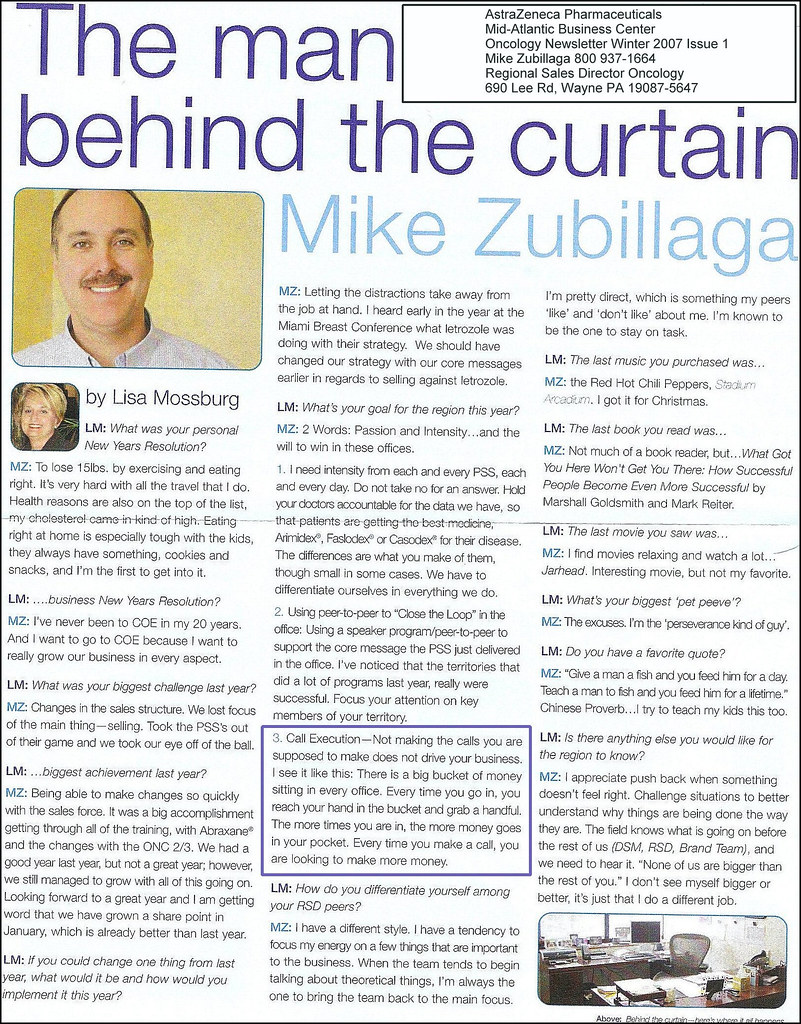
Sunday, April 08, 2007
The AstraZeneca "Bucket of Money" Scandal: More Employees to be Fired?
 AstraZeneca has issued a statement to the press saying among other things:
"...Our company is disturbed by the content and particularly concerned about the impact the content of this unapproved newsletter may have on our employees and others. In addition, we are concerned that a manager in our sales organization used this vehicle to communicate messages that directly contravene our core values as a responsible pharmaceutical company.
Our investigation into the development and distribution of this newsletter continues, in an effort to determine whether our current policies and procedures regarding AstraZeneca communications are being adhered to by employees..."
This statement indicates that more people may be fired in this evolving scandal. For instance, who did approve the newsletter? If anyone did, such a person might be in trouble. And who is "Lisa Mossburg" who did the interview with "Zube"? Finally, what did other Regional Sales Directors write in their newsletters? Every one is now being carefully scrutinized.
Most noteworthy in this scandal is how swiftly AstraZeneca reacted and fired Regional Sales Director Michael Zubillaga, 50, the day after his comments appeared on this blog. It is noteworthy, because clearly the offensive AstraZeneca Oncology Newsletter had been in circulation since "Winter 2007," which can be assumed to have been the January-February 2007 time period. So AstraZeneca had plenty of time to react, but didn't.
When they did react, however, they were caught with their pants down as the embarrassing newsletter became public knowledge on this blog.
Every major drug company has an extensive review process, consisting of legal, regulatory, medical and other departments, which have to approve any printed material going to doctors and to the sales force.
Any Regional Sales Director would be well aware of this review process; RSD is a senior job with often around one hundred sales representatives reporting in to this position, which in turn normally reports to the Vice President of Sales. Salary is commensurate with this experience; base pay of $150 to over $200k, bonus of $75 to $150k and stock option often valued at more than $100k per year.
An Oncology sales force usually has fewer sales representatives, but since this a lucrative field, the money they pull in is significant. So Mr. Zubillaga was a senior executive, who had been around the block a few times, and had also spent time in AstraZeneca headquarters; he knew the ropes.
And he would clearly not use those ropes to hang himself.
The reasonable conclusion is that there was nothing unusual in his comments, instead, the fact that he was caught was his biggest violation. He inadvertently violated the industry's own code of Omerta--the code of silence. This is also supported by the record number of people voting on PharmaGossip's poll, which I have reproduced below with a direct link to the poll itself. A majority felt the "Zube" should not have been fired and that AstraZeneca was covering up for something the company started.
The fact that mention on a blog such as this one gets a man fired the next day also demonstrates the rapid shift in the media landscape. By the way, the New York Times asked me if the story was really true, but before that big newspaper could react, the guy was already fired.
Thursday, May 31, 2007
AstraZeneca will NOT fire Compliance & Ethics Leader
 Andrea Paskman, AstraZeneca's Compliance & Ethics Leader, has been closely associated with the ZubeAffair, since she would normally have reviewed the offending newsletter that got regional sales director Mike Zubillaga fired, which was followed by the resignation of Zubillaga's boss, Scarlett Spring who will leave AstraZeneca today. Paskman also appears to have been involed in the subsequent investigation.
Brandweek has been closely monitoring Paskman's role in this process and today revealed that Paskman will remain with AstraZeneca, although AstraZenca now refuses to answer even basic questions, sticking to their mantra, that they've already "taken the appropriate action."
Too bad that doesn't make the blog world stop writing about this story the way the regular press politely backs off when a company with a big advertising budget tells them there is no more story to tell.
Thursday, June 28, 2007
AstraZeneca ethics report claims that Zubillaga's interim replacement threatened to fire whistleblowers . . .
 I have just received access to the report number and pass code for a recent report on AstraZeneca's ethics violation web site, http://www.azethics.com/. (Click on images to enlarge.)
Report Submission Date
6/18/2007
Reported Company/Branch Information
Name: USA
Location: Mid-Atlantic Oncology Regional Meeting
City/State/Zip: Baltimore, MD, USA
Violation Information
Violation Type
Retaliation
What is your relationship to AstraZeneca?
Employee
Please identify the person(s) engaged in this behavior:
[Name redacted] - Northeast Oncology Regional Sales Director
Do you suspect or know that a supervisor or management is involved?
Yes
If yes, then who?
[Name redacted] - Northeast Oncology Regional Sales Director
Is management aware of this problem?
Do Not Know / Do Not Wish To Disclose
What is the general nature of this matter?
Threats of retaliation against whistleblowers.
Where did this incident or violation occur?
Baltimore, MD
Please provide the specific or approximate time this incident occurred:
June 13th, 2007
How long do you think this problem has been going on?
1 to 3 months
How did you become aware of this violation?
I observed it
Details
June 13th 2007
This took place today at a regional meeting in Baltimore MD. Present were oncology pharmaceutical reps and their district managers from the Mid-Atlantic oncology region.
[Name redacted] is the Northeast Regional Sales Director for oncology. He also served as the interim Mid-Atlantic Regional Sales Director after Zubillaga was fired.
At this meeting [Name redacted] expressed the opinion that the whistleblowers who recently reported violations by AstraZeneca to the media and OIG should be tracked-down and fired, even after someone present pointed out that if AZ had actually responded to its own internal hotline, the whistleblowers would not have been forced to go public. He was the senior manager present.
According to AstraZeneca's Corporate Integrity Agreement with OIG "Consistent with the open compliance environment that AstraZeneca strives to maintain, company policy prohibits retaliation or retribution of any kind following the good faith reporting of a suspected violation."
Follow-Up Questions/Comments
The company has submitted a comment or a question for you to answer.
6/19/2007 8:48 AM - AstraZeneca takes allegations of wrongdoing very seriously. This matter has been sent for further investigation. AstraZeneca will investigate this matter promptly, thoroughly and diligently and will takes appropriate steps based on the outcome of the investigation.
Follow-Up Notes
Jun 27, 2007, 9:56 AM
[Name redacted] had each of us vow that anything said at this meeting would stay secret.
FYI - The premise of this meeting was to 'move forward', after numerous recent scandals, by forming a committee of representatives to make suggestions to management.
Follow-Up Questions/Comments
There are no questions asked or comments posted by the company.
Chat Transcripts
There are no chat transcripts for this incident.
Read AstraZeneca's official policy on retaliation, click on image below!

My new source inside AstraZeneca, "Susan Jones," wrote the following when she sent the report code and password to me:
"Dr. Rost, the premise of our meeting was to form a group of AZ oncology representatives to 'move forward' after the recent scandals in the region. We all agreed to keep what was said at the meeting to ourselves. However, in good conscience, I could not ignore a direct threat to fire whistleblowers by AZ management. What if I was one of the original whistleblowers? [Name Redacted] would have fired me. I picked up your book after the 'bucket of money' scandal and was inspired enough to override my fear and contact you. "
Saturday, April 07, 2007
Fired AstraZeneca Sales Director's Colleagues are Merciless
 The firing of AstraZeneca Sales Director Michael Zubillaga is met with scorn by his colleagues. Here are some of the comments on AstraZeneca's message board on CafePharma:
"Evil flourishes when good men do nothing." Maybe someone finally spoke up...
The Zube was canned. What sweet justice. He was an "insider" with many many buddies at HQ. Guaranteed many are worried themselves now. So long, Zube.
Just think of the arrogance behind those words. What an arrogant prick to think of cancer patients as "cash" in your pocket. Unfortunately, this is the only face of AZ that any one out there will see.
Quote:
Originally Posted by Anonymous
this is what Pharmalot writes....Here's a thought or two: AstraZeneca says the newsletter was published "outside" of the required approval process. What does that mean? And it was the Winter edition newsletter, which means it circulated for awhile. Why was he fired now? No one inside the company saw this until now? Or was it because the drugmaker was embarassed the remarks became public? If AstraZeneca was really upset, why didn't the company act sooner?http://pharmalot.com/
Absolutely, he was probably applauded for his comments until they were leaked. AZ protected the good old boy until it went public, then so long zubillaga. they probably gave him one hell of a severance though.he was such a jackass.
Mike, from one AZ employee to another, I hope you f-----g rot selling the used cars on the worst car lost imaginable. Your stupid attitude just undid all the effort that's gone into trying to turn our industry's reputation around. C--------r.
At PharmaGossip, however, early results from a poll that just went up indicates most PharmaGossip readers feel that "Zube" shouldn't have been fired, because he just told it like it is and AstraZeneca is trying to put out a fire the company is responsible for starting. (click below to vote in the PharmaGossip poll, and to check current status):
 Finally, one blogger took the position that "Zube" really had a really big mouth. That sentiment was illustrated over at Bill of Rights with the image to the left.
And Impactivti used the Donald Trump covered above, in a post with the headline "Speaking your Mind - and Paying the Price"
Friday, April 13, 2007
Interview with AstraZeneca "Group of Seven" Whistleblower
This is an interview between Question Authority and one of the AstraZeneca whistleblowers:
QA: "I appreciate the fact that you contacted me about this story . . . but seriously, why don't you want to talk to the other big media outlets? You have one of the three national television networks asking for an interview and the biggest US newspaper also trying to find you. You could have much more impact that way."
AZ: "We will seriously consider going to the media but right now I only trust you, as a fellow whistleblower."
QA: "Have you actually mailed your Open letter to the OIG, and have you signed with your real name?"
AZ: "We mailed, emailed, faxed and called in this information to OIG LAST MONTH to the OIG Hotline. No real names given. Just the report number. By Phone: 1-800-HHS-TIPS (1-800-447-8477) By Fax: 1-800-223-8164 By E-Mail: HHSTips@oig.hhs.gov. By Mail:Office of Inspector General Department of Health and Human Services Attn: HOTLINE 330 Independence Ave., SW Washington, DC 20201."
QA: "Any words for your coworkers?
AZ: "It is important to note that raising a legitimate issue - in good faith - of a possible violation by others will not adversely impact you. ANY act or threat of retaliation by an employee against another in response to the disclosure of a potential policy violation will be considered a serious violation of the Code."
QA: "Do you have any other thoughts you have on this story?"
AZ: "Three more things:
1) An even bigger scandal would be if OIG did nothing and didn't care.
2) Why didn't Zubillaga's Boss, Scarlett Spring, National Sales Director Oncology, fire Zubillaga months ago?
3) Also, Mid-Atlantic Oncology Newsletter Editor District Sales Manager [Name redacted] has a history of producing newsletters for the South West Region."
QA: "So I guess there may be more to come?"
QA: "Hello?"
QA: "Anyone still there?"
END
QA: "I appreciate the fact that you contacted me about this story . . . but seriously, why don't you want to talk to the other big media outlets? You have one of the three national television networks asking for an interview and the biggest US newspaper also trying to find you. You could have much more impact that way."
AZ: "We will seriously consider going to the media but right now I only trust you, as a fellow whistleblower."
QA: "Have you actually mailed your Open letter to the OIG, and have you signed with your real name?"
AZ: "We mailed, emailed, faxed and called in this information to OIG LAST MONTH to the OIG Hotline. No real names given. Just the report number. By Phone: 1-800-HHS-TIPS (1-800-447-8477) By Fax: 1-800-223-8164 By E-Mail: HHSTips@oig.hhs.gov. By Mail:Office of Inspector General Department of Health and Human Services Attn: HOTLINE 330 Independence Ave., SW Washington, DC 20201."
QA: "Any words for your coworkers?
AZ: "It is important to note that raising a legitimate issue - in good faith - of a possible violation by others will not adversely impact you. ANY act or threat of retaliation by an employee against another in response to the disclosure of a potential policy violation will be considered a serious violation of the Code."
QA: "Do you have any other thoughts you have on this story?"
AZ: "Three more things:
1) An even bigger scandal would be if OIG did nothing and didn't care.
2) Why didn't Zubillaga's Boss, Scarlett Spring, National Sales Director Oncology, fire Zubillaga months ago?
3) Also, Mid-Atlantic Oncology Newsletter Editor District Sales Manager [Name redacted] has a history of producing newsletters for the South West Region."
QA: "So I guess there may be more to come?"
QA: "Hello?"
QA: "Anyone still there?"
END
Friday, June 01, 2007
AstraZeneca puts lawyer in Regional Sales Director job!
Yesterday, National Oncology Sales Director Scarlett S. resigned from AstraZeneca. Today, according to an internal AstraZeneca source, the new National Sales Director Eric Vogel announced who would replace the recently fired Mike Zubillaga as Mid-Atlantic Regional Sales Director.
Her name is Rose Ann Scanlon, currently Senior Director of Regulatory and Promotional Affairs and formerly Assistant General Counsel for AstraZeneca.
 She is referenced in this article.
AstraZeneca is known in the drug industry as a hard-selling organization. For them to put a lawyer without any sales experience in a sales director job is - I'm looking for a word here - befuddling.
It would appear AstraZeneca's internal problems are very serious indeed.
Her name is Rose Ann Scanlon, currently Senior Director of Regulatory and Promotional Affairs and formerly Assistant General Counsel for AstraZeneca.
 She is referenced in this article.
AstraZeneca is known in the drug industry as a hard-selling organization. For them to put a lawyer without any sales experience in a sales director job is - I'm looking for a word here - befuddling.
It would appear AstraZeneca's internal problems are very serious indeed.
Subscribe to:
Posts (Atom)