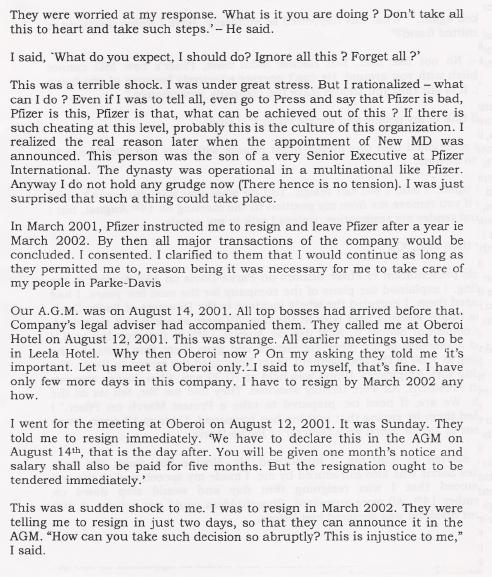
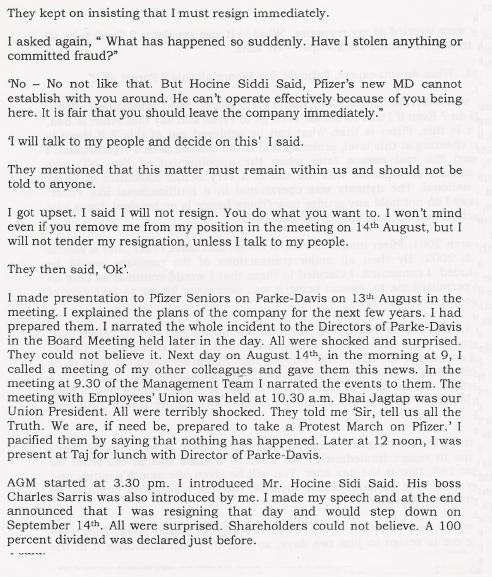
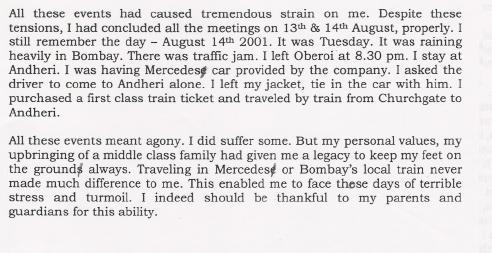
Showing posts sorted by relevance for query Idnani. Sort by date Show all posts

Wednesday, May 16, 2007

Pfizer Finance Executive Blows the Whistle - Part One

On November 17, 2005 Pfizer’s CEO Jeff Kindler, who was then Pfizer’s General Counsel, received and read a highly unusual e-mail, according to the internal read receipt on that mail.

In this e-mail an executive in Pfizer’s finance department in India accused local managers of taking kick-backs in connection with selling off company assets, including selling Pfizer’s manufacturing facility in Hyderabad, at 60% of market value.

But that was an optimistic calculation.

Recently, the finance executive petitioned the Indian government in Hyderabad and received documents which showed that he was wrong - the plant was actually sold for less than 10% of the market value assessed by the government.

The executive also claimed in his e-mail that Pfizer was engaged in unfair accounting practices.

The man behind this e-mail was Mr. Ashok S. Idnani, who has spent 28 years working for Pfizer and his e-mail was the culmination of three years of struggle.

(Click on thumbnails to read his entire e-mail. Certain information identifying Pfizer employees has been redacted.)

It all started in 2002, a year when Idnani's career with Pfizer would take a dramatic turn for the worse.

His formal title was Deputy Manager, Pfizer's Finance Division, and he spent his days in Mumbai, India. One fateful day he met one of Pfizer India’s senior executives in the Pfizer lobby. In a casual conversation the senior executive asked him if the Arthur Andersen people had approached Idnani, since they were working on the integration of Pfizer and Warner-Lambert/Parke-Davis; a company Pfizer had acquired.

Idnani mustered the courage then and there to inform this senior executive that rumors were circulating about kick-backs from Arthur Andersen. Idnani says: “I was curious as well as wanted to inform him what colleagues were saying and to see his reaction”

He thought the executive might take this as a friendly warning, but that is not how things worked out. During the four years that followed, Idnani alleges his salary was frozen, Pfizer withheld his bonuses and many other acts of retaliation took place.

Finally, after three years of increasing concern about numerous dubious transactions that Idnani could monitor in his centrally placed position in the finance department, Idnani finally gave up on achieving change locally. On November 17, 2005 Idnani contacted Pfizer’s leadership team; Hank McKinnell, CEO, Jeff Kindler, General Counsel, Karen Katen, President Pharmaceuticals, and David Shedlarz, CFO, with his allegations. At that point he was close to desperation and his letter clearly indicates his state of mind.

Pfizer's senior management had every reason to take Idnani’s allegations seriously, both based on his long tenure with Pfizer and his central position within the company. So Jeff Kindler ordered an investigation.

We know this because on December 2, 2005 Ms. Indrani Franchini from Pfizer Corporate Compliance and Ms. Sarah Alper, Corporate Audit in New York, conducted a two hour conference call with Idnani, requesting documents supporting his allegations. Idnani also claims that Ms. Franchini assured him there would be no retaliation.

Of particular interest to Pfizer was a “Memorandum of Understanding” (MOU) for sale of the Hyderabad plant, signed with the buyer, Nuziveedu Seeds Ltd, in 2004. The sale to Topnotch Infrastructure Ltd (a fully owned subsidiary of Nuziveedu seeds Ltd) was finalized in 2006.

The original MOU was for Rs.137 million ($3.4 million), however, ultimately Pfizer sold the plant for Rs.122.10 million ($3.0 million). Click on thumbnail to see scanned page from Pfizer India’s Annual Report confirming this amount.

There was only one problem with this agreed upon sale price: The fair market value for the property was more than ten times higher.

Government authorities in India in 2006 requested a tax called “Stamp Duty” payable on the market value of the sale of land and buildings, from the buyer, Topnotch Infrastructure Ltd. The valuation of the property was now Rs.1801 million ($44.4 million). Click on thumbnails below to view this valuation from 2006.


And, says Idnani, even if the Indian government valuation from year 2004 is used, the assessed land value was Rs.7630/ per Sq.Yard (instead of Rs.10000/ per Sq. Yard in year 2006) which adds up to Rs.1388 million ($34.2 million).

Idnani doesn’t have any proof that anyone took kick-backs to sell the plant at a 90% discount, but he has suspicions and he voiced those concerns loud and clear to Pfizer not just once, but several times. And, perhaps his suspicions aren’t surprising when $30 to $40 million in value vanishes into thin air.

Idnani notes that Transparency International ranked India #74 on their Corruption Index in 2006, (Scandinavian countries ranked in the top, and the US ranked #23)

“It doesn't help,” says Idnani, “that Pfizer is a signatory to the United Nations Global Compact or that Pfizer has its own grand in-house ethics and values – these are just decorations on their web site.”

So how did Pfizer resolve this situation?

On January 17, 2006, Pfizer dispatched a two-member team; Ms. Indrani Franchini from Pfizer Corporate Compliance, and Ms. Sarah Alper, Corporate Audit traveled to Mumbai, India, to meet with Idnani and they questioned him at length about the documents he sent to them.

Idnani claims that at this meeting it was agreed that he would be informed of the findings and actions to be taken by line management in New York. In the end, however, he was not given any information of such decisions. Instead, on March 13, 2006 Ms. Franchini sent an e-mail informing Idnani that the investigation was concluded, the matter closed and the details regarding specific steps taken or outcomes would not be provided to him.

Then, on August 28, 2006, Idnani’s employment was abruptly terminated, after 28 years with Pfizer.

Idnani is now 54 and unemployed, in spite of a science degree and a master of law degree. Recently he registered as a lawyer, a profession he resents. He is contemplating approaching what he calls the “corrupt courts in India” about Pfizer's retaliation and the undervaluation of the Hyderabad plant and the loss to Pfizer shareholders. But money is an issue; Idnani did not get rich on his Pfizer salary and he doesn’t even own a computer; he accesses his e-mails in an Internet cafe.

What is also noteworthy is that the retaliation against Idnani didn’t stop when he was fired. Pfizer India also withheld a number of payments due to Idnani after he was terminated.

In an April 30, 2007 e-mail, Ryan Trierweiler Pfizer Worldwide Pharmaceutical Operations (WPO) Japan/Asia HR, writes to Idnani, “As you can see by receipt of various checks over the past couple of weeks I have been working on your behalf to sort out any issues related to your dues. I've also been working with the India site to figure out why these dues were not paid to you sooner.”

So seven months after his termination, Idnani finally got paid. He has a suspicion about why this took so long; he stepped on some mighty big toes within Pfizer.

I asked him what could be the reason for Pfizer to fire the whistleblower and then do nothing if someone dumped corporate assets at 90% discount; that would hardly seem to be in Pfizer’s best interest.

Idnani responded that “by the time Pfizer was informed by me in November 2005 and they completed the investigation in March 2006 the transaction was nearing completion.” He also doesn’t think the Pfizer brass in New York worries too much about whistleblowers in India.

He adds, “In 2004 the company signed the Memorandum of Understanding with the purchaser, and therefore it was not easy to rescind the arrangement.”

Idnani also claims that Pfizer did, in fact, take some action: “When the next plant was sold at Chandigarh, in 2006-2007, they sent in a person, who I understand was Rick Davis from Pfizer N.Y, to personally interview all bidders and overlook the negotiation. For the first time local managers did not have full authority and control of negotiation for sale of a major manufacturing plant.”

But that doesn’t end the story about the plant sale, because Idnani didn’t give up.

In a September 12, 2006 e-mail to Jeff Kindler, who was now CEO of Pfizer, Karen Katen, Vice Chairman, David Shedlarz, Vice Chairman, Alan Levin, CFO, and Sylvia Montero, Senior Vice President, Human Resources, and copied to Pfizer’s Board of Directors, Idnani repeated his many allegations in great detail

And, suddenly, in March 2007, John S. Hong, Pfizer Corporate Counsel, International Investigations and Programs in Pfizer’s Legal Division/Corporate Compliance group wrote an e-mail to Idnani: “Regarding the documentation you reference related to the Hyderabad Plant allegation please forward any relevant documents to my attention. You may send them electronically, by mail or via fax, whichever is most convenient, and we will review them accordingly.”

So clearly Pfizer’s review of the sale of the Hyderabad plant isn’t completed yet.

Over the coming days I will disclose many more of Idnani’s allegations with associated documents, including how Pfizer hired detectives to follow shareholders and a former executive, and documents that show, according to Idnani, how Pfizer bribed government officials and tax authorities. But the story doesn’t stop there; he also tells a detailed tale about voodoo in the Indian finance department and a mysterious guru receiving checks from local Pfizer employees.

Idnani’s final words to me were, “The lesson I have learned - don't be smart - if seniors are defrauding the company, look away.”

PART TWO FOLLOWS TOMORROW: Pfizer's private investigators, their surveillance reports, and whom they followed.

PART THREE ON FRIDAY: Allegations of bribes to tax officials and voodoo practice in Pfizer's finance department.

Update - don't miss the other parts of this story:

1. Pfizer Finance Executive Blows the Whistle - Part One
2. Pfizer Finance Executive Blows the Whistle – Part Two
3. Pfizer Finance Executive Blows the Whistle – Part Three
4. PFIZER CFO RESIGNS after PFE finance executive blows the whistle
5. Will Pfizer CEO Mr. Kindler also resign?

Monday, May 21, 2007

Will Pfizer CEO Mr. Kindler also resign?

Pfizer's CFO Alan Levin's resignation was announced yesterday, after three days of disclosures of corruption in Pfizer's finance department, revealed by former Pfizer finance executive Mr. Ashok S. Idnani, on the Question Authority with Dr. Peter Rost blog.

Brandweek wrote that "Rost this week has devoted his blog to an astonishing series of posts which allegedly describe how Pfizer execs in India took kickbacks in connection with the sale of a Pfizer building for far less than it was worth; how Pfizer hires private detectives to spy on rival executives and pay bribes, and how Pfizer India kept a "gift" list for certain Indian government officials."

Here is a look at what Pfizer CEO Mr. Jeff Kindler knew about these allegations - and when.

After reading this, perhaps the next question should be:

Will Pfizer CEO Mr. Kindler also resign?

The irony is that Mr. Kindler during a December 18, 2006 employee meeting stated:

"I’d like to see a culture where people feel freer than I think they do today, to be perfectly candid, to be open and frank and express their points of view, ah, without fear of some consequences to them. Ah, I think in different parts of the company that kind of culture exists, but I see a lot of evidence where it doesn’t exist. I get very, very depressed when I get emails, which I sometimes do, from people that said I need to send you this email anonymously, ah, because something bad will happen to me or please don’t tell my boss I told you this and their answer and perfectly reasonable idea, maybe it’s not a good idea, maybe it is not something they want to do, but the notion that somebody would be afraid to express themselves that way is very troubling to me."

November 17, 2005: Pfizer’s CFO Alan Levin, Vice Chairmen Jeff Kindler, Karen Katen and David Schedlarz; and Sylvia Montero, Senior Vice President, Human Resources, received an e-mail from Ashok S. Idnani, Deputy Finance Manager, alleging that Pfizer execs in India took kickbacks in connection with the sale of a Pfizer manufacturing plant for far less than it was worth; and that Pfizer India was “cooking the books.”

December 2, 2005: Ms. Indrani Franchini from Pfizer Corporate Compliance, which at the time reported to Jeff Kindler, and Ms. Sarah Alper, Corporate Audit, which reported to Alan Levin, conducted a two hour conference call with Idnani, requesting documents supporting his allegations. Idnani also claims that Ms. Franchini assured him there would be no retaliation.

January 17, 2006: Pfizer dispatched Ms. Indrani Franchini and Ms. Sarah Alper to Mumbai, India, to meet with Idnani and they questioned him at length about the documents he sent to them.

March 13, 2006: Ms. Franchini sent an e-mail informing Idnani that the investigation was concluded, the matter closed and the details regarding specific steps taken or outcomes would not be provided to him.

August 28, 2006: Idnani’s employment was abruptly terminated, after 28 years of service.

September 12, 2006: Idnani sent e-mail to Jeff Kindler, who was now CEO, Karen Katen, Vice Chairman, David Shedlarz, Vice Chairman, Alan Levin, CFO, and Sylvia Montero, Senior Vice President, Human Resources. He alleged he had been wrongfully terminated in retaliation for reporting illegal acts. Idnani also alleged Pfizer India executives “sold Company's properties at undervalued prices which generated kickbacks.” He also alerted management that Pfizer India “hired detectives to tail Mr. Pramod Lele the ex-Country Manager of Parke Davis.”

October 20, 2006 Idnani wrote to John Hong, Corporate Counsel, International Investigations and Programs, and Indrani Franchini. He stated, “I shall be able to prove my charges of fraud, corruption, kickbacks, unfair accounting . . . on my charges of 'cooking of books' one of the items that was brought to the notice of Ms. Franchini and Ms. Alper was transfer of ad hoc (without basis) amounts/provisions to "make up" profits of divisions/business. Idnani also reiterated that the sale “of Pfizer's Hyderabad Plant [was made] at grossly undervalued price,” and that Pfizer “sent detectives behind a[n] ex-CEO of Pfizer's subsidiary and others.”

December 11, 2006: Idnani wrote to John Hong, Pfizer Corporate Counsel, International Investigations and Programs, copied to Jesma Johnson, and Melanie Trinidad. “If you recall - at our teleconference on November 16, 2006, you questioned me on . . . practices Occult and Voodoo and about his Guru . . . It has come to my knowledge, that recently, the Income-Tax Authorities of the Government of India (equivalent to IRS/CID in U.S.) served notices on several employees working in Finance Division demanding from them a reply and detailed explanation as to why they have given certain amounts in the year 2004, to an individual named "Mr. Shivdasani". . . Now who is "Mr. Shivdasani." You guessed correctly - he is [redacted]'s Guru."

December 13, 2006: Jesma Johnson wrote to Idnani with copy to Melissa Maxwell-Avila. “My investigation in this matter is in regards to what you believe where acts of retaliation against you. Therefore any issues that you feel were not in compliance with policies and procedures should have been reported to corporate compliance.”

December 14, 2006: E-mail from Idani to Jesma Johnson. “I am giving below briefly, direct acts of retaliation, as requested by you.”

March 13, 2007, Idnani was informed by Mr. Ryan Trierweiler, Pfizer Worldwide Pharmaceutical Operations (WPO) Japan/Asia HR, that after a “very thorough investigation” and “having reviewed all relevant evidence in this case it is our determination that no such retaliation is evident and that your termination was for appropriate reasons under both Pfizer policy and local law”.

March 28, 2007: Idnani wrote to Ryan Trierweiler with copy to John Hong, Melanie Trinidad, and Indrani Franchini. “It is apparent that, by default, the Board of Directors - Pfizer Inc and N.Y. Pfizer Leadership Team have condoned, justified and given a clean certificate to . . . in respect of frauds, money laundering, undervaluation of Pfizer assets sold and other misdemeanors/felonies.”

March 29, 2007, John S. Hong, Pfizer Corporate Counsel, International Investigations and Programs in Pfizer’s Legal Division/Corporate Compliance group wrote an e-mail to Idnani: “Thank you for your below feedback, and I ensure you that the allegations which you have raised were treated seriously and reviewed appropriately. As you are aware, an investigation was conducted by a Legal and Audit Compliance team who traveled to India to meet with you and review your concerns. In regards to your requests below, we will not be able to provide you with any documentation related to the investigation of this matter, as that information is privileged and confidential. Regarding the documentation you reference related to the Hyderabad Plant allegation please forward any relevant documents to my attention. You may send them electronically, by mail or via fax, whichever is most convenient, and we will review them accordingly. Lastly, I want to make clear that the Company does not tolerate or condone any misconduct on the part of our colleagues, and I would like to emphasize that considerable time and effort were resourced to thoroughly review your claims.”

March 29, 2006: Idnani wrote back to John Hong. “It is a bit too late to ask me for further documentation on Hyderabad Plant . . . Either, you have not investigated, or there has been deficient investigation . . . I have given documents to Ms. Franchini of payments . . . for detectives, to tail the ex-country manager of Pfizer affiliate.”

April 5, 2007: Idnani wrote email to Jeff Kindler, CEO, Alan Levin, CFO, David Shedlarz, Vice Chairman, with copy to Indrani Franchini, Melanie Trinidad, John Hong and Ryan Trierweiler. He summarized his allegations:

** Undervaluation of manufacturing plant at Hyderabad (frauds and money laundering).
** Undervaluation of residential property at Brighton (frauds and money laundering).
** Unfair and fraudulent accounting (fraud, criminal conspiracy).
** Financial negligence (payments of very excessive advance Income-Tax, later refunded)
** Money laundering activities . . . This activity took place in Pfizer premises. An e-mail detailing the complete fraudulent and racketeering scheme was sent to Mr. John Hong in December 2006 (fraud, money laundering, perjury, tax evasion, criminal conspiracy committed by . . .
** Sending detectives behind litigants and the ex-country manager of a Pfizer Inc. affiliate and possibly to shadow a sitting judge of the high court (unethical, criminal and possibly anti-national behavior).
** Retaliation against me: reducing my grades, freezing of my salary and denial of bonuses for unprecedented four (4) years because I challenged the integrity of . . . and other acts of retaliation.
** Abusing women employees.

April 30, 2007: E-mail from Ryan Trierweiler to Idnani. “As you can see by receipt of various checks over the past couple of weeks I have been working on your behalf to sort out any issues related to your dues. I've also been working with the India site to figure out why these dues were not paid to you sooner.”

May 11, 2007: Idnani contacted Peter Rost. “My name is Ashok S. Idnani. I was a Deputy Manager with Pfizer-India, Finance Division, in Mumbai. I worked with Pfizer-India for 28 years. Suddenly, on August 28, 2006, my services were wrongfully terminated. Cover-up reasons were given immediately after terminating my employment and only after I demanded the reasons. Actually, the termination was in retaliation for reporting to the New York Pfizer Leadership Team in November 2005, a Corporate Compliance Issue for frauds and unfair Accounting.”

May 16, 2007: Pfizer Finance Executive Blows the Whistle - Part One
May 17, 2007: Pfizer Finance Executive Blows the Whistle – Part Two
May 18, 2007: Pfizer Finance Executive Blows the Whistle – Part Three

May 20: Pfizer CFO Alan Levin resigns.

Friday, May 18, 2007

Pfizer Finance Executive Blows the Whistle – Part Three

BRIBES AND VOODOO?

A former Pfizer finance executive alleges that Pfizer paid bribes to government officials and tax authorities. He also talks about a darker side of Pfizer – voodoo worship.

This is the third of three articles focusing on allegations by a centrally placed whistleblower; Mr. Ashok S. Idnani, a former Deputy Manager in Pfizer’s finance department who spent 28 years working for the company.

You can read the first article here, and the second here.
The documents to the left show how Pfizer management gave gifts such as liquor to “government officials,” “income tax officials,” “sales tax officials,” and “registrars.”

The recipient of this authorization was Mr. Hocine Sidi Said, who was the Managing Director for Pfizer India at the time when this internal memo was written and the sender was Kewal Handa, CFO Pfizer India.

Kewal Handa was later promoted and is currently Pfizer’s Managing Director. Please note that both men signed these documents.

Mr. Ashok S. Idnani claims that in spite of the fact that “sweets” are listed on the first two pages, what was usually given to income tax officials was liquor.

This is confirmed on the third page, which according to Idnani, lists income tax officials by name.


These documents should be compared with Pfizer’s Blue Book, which explicitly forbids giving "anything of value to a government official."

Pfizer's Blue Book also states, "You must not make a bribe, payment or gift to a government official or any other person, whether or not it is intended to influence a decision."

Based on this, it would appear that if Pfizer doesn’t remove Kewal Handa after this article, Pfizer’s entire “business policy” can be thrown in the trash bin.

But maybe that won't happen.

Mr. Handa is a big fish inside Pfizer.

In fact, Pfizer India' Annual Report notes that he just received a 111% base salary raise, increasing his salary from Rs. 8,500,000 ($210,000) to Rs. 18,000,000 ($446,000) per year, effective June 2006. (Click on image of annual report to review details).


The “Diwali” mentioned in the documents is a major Hindu festival in October, and, just to be sure, I asked Idnani if the perception of these “gifts” is different in India compared to the US.

He responded, “Naturally, the income tax people will be obliged to you and 'take care of you'.” He adds, “Frankly, liquor is a taboo when you talk of a religious festival in India. For Diwali, sweets and gifts are acceptable, but liquor . . . no way”

If Pfizer has provided bribes overseas, they would be in violation of the U.S. Foreign Corrupt Practices Act. The fact that Pfizer's corporate compliance department has investigated these allegations and documents, fired the whistleblower and rewarded the man giving liquor bottles to government officials, in clear violation of Pfizer policy, says everything we need to know about Pfizer and their commitment to ethical business practices.

VOODOO in Pfizer’s finance department?

But there is more amazing information to be found in Idnani’s many e-mails to Pfizer.

Apparently he has been questioned about voodoo practice among Pfizer’s employees and this is how he responds in a December 11, 2006 to John Hong, Pfizer Corporate Counsel, International Investigations and Programs, copied to Jesma Johnson, and Melanie Trinidad:

“If you recall - at our teleconference on November 16, 2006, you questioned me on [redacted] practices Occult and Voodoo and about his Guru. You also mentioned it could be personal belief. If this is indeed, personal belief, then you are right, it is not an issue."

Idnani adds in his e-mail, “[Redacted] told [redacted] and [redacted] in the meeting on May 17, 2006 that his Guru (spiritual) in his presence brought back to life a dead child and (pointing towards me) he has told [redacted] many times before, if his Guru tells him to jump from 23rd floor he will jump.

It has come to my knowledge, that recently, the Income-Tax Authorities of the Government of India (equivalent to IRS/CID in U.S.) served notices on several employees working in Finance Division demanding from them a reply and detailed explanation as to why they have given certain amounts in the year 2004, to an individual named "Mr. Shivdasani". The questions asked were like, How long they know this person, Why they paid the money to him, What services were rendered by this person.

Now who is "Mr. Shivdasani". You guessed correctly - he is [redacted]'s Guru."

At this point in the story you may wonder why Indian income tax officials were interested in whom had sent checks to the guru. The explanation is simple, according to Idnani. In return for the checks they received the same amount in cash. Idnani thinks this was done so that the guru could practice good old fashioned money laundering, converting stacks of ill-gotten gains into clean money that could be traced to innocent individuals. And he says that's exactly what the tax authorities did.

And why would the employees in Pfizer's finance department participate in such a scheme?

Idnani has an explanation for that as well in his e-mail to Pfizer:

"The Income-Tax Authorities were assessing the Income-Tax Return of "Mr. Shivdasani" for the year ended March 31, 2004, found entries of the so-called "donations" in his Tax Return and took the matter for scrutiny and investigation.

None of these employees know the person or at least most of them do not know this person, have not met this person, have not received any services from this person for the payment they have made to him. Yet, they were asked by [redacted] - as they were trapped - to blatantly lie in their recorded written statement submitted to the Government of India (Income-Tax Authorities).

For example, they averred, that they knew this person for certain times. They were explicitly directed by [redacted] not to mention in their replies that they worked for Pfizer (Pfizer was a common employer). The Income-Tax Authorities had sent the notices to the residential addresses of these employees.

In other words, [redacted] has forced his Pfizer reportees and colleagues, vulnerable to Undue Influence into Money Laundering activities in Pfizer premises."

We only have Idnani's word and e-mails to Pfizer confirming the voodoo story. But many of his other allegations could be verified with independent documents, and Idnani would probably not have brought these allegations all the way up to Jeff Kindler and other senior Pfizer managers, if he didn't believe them to be true.

Voodoo in Pfizer's finance department, or just organized plain old money laundering?

You be the judge.

Update - don't miss the other parts of this story:

1. Pfizer Finance Executive Blows the Whistle - Part One
2. Pfizer Finance Executive Blows the Whistle – Part Two
3. Pfizer Finance Executive Blows the Whistle – Part Three
4. PFIZER CFO RESIGNS after PFE finance executive blows the whistle
5. Will Pfizer CEO Mr. Kindler also resign?

Sunday, May 27, 2007

Economic Times: "Pfizer CFO exit may've India angle"

Here is first "mainstream" coverage of the Pfizer India scandal. It is rather surprising that some individuals can deny allegations that are supported by written documents, which you can download right here on this site . . . see "Don't miss multiple evolving Pfizer scandals!"

Pfizer CFO exit may've India angle
GIREESH CHANDRA PRASAD & JAVED SAYED

TIMES NEWS NETWORK
MONDAY, MAY 28, 2007 02:44:12 AM

NEW DELHI: The recent exit of the world’s largest drug-maker Pfizer Inc’s CFO Alan Levin may have an India angle if the allegations of a US-based blog quoting a former Pfizer India employee are to be believed.

The blog, quoting Ashok S Idnani, an ex-deputy manager at Pfizer’s finance division in Mumbai alleges that Pfizer sold its Hyderabad manufacturing plant in 2004 at a price much lower than the market price, bribed government officials in violation of the MNC’s world-wide policies, and hired a detective agency to spy on unfriendly shareholders. It also accuses some unnamed Pfizer India officials of being involved in money laundering. Pfizer denies the allegations.

These allegations were made in a sensational three-part series carried by peterrost.blogspot.com in the week running up to the announcement of Mr Levin’s resignation on May 20. The blog claims that Mr Levin’s exit last Sunday may be a result of its campaign featuring the ‘revelations’ made by Mr Idnani.

However, it does not specify a direct link between Mr Levin and the allegations made by Mr Idnani. In a company statement Mr Levin said he was leaving the company to explore career opportunities outside Pfizer.

Pfizer India, on its part, completely denies the allegations. “Blog sites in general provide open and unfiltered forums for the exchange of all kinds of information that may or may not have any validity. To date, investigations completed in response to Mr Idnani’s claims have found them to be baseless.

Pfizer takes such claims seriously and has by Mr Idnani’s own admission dedicated significant amounts of time and resources to evaluate them thoroughly,” said a Pfizer India spokesperson in an e-mailed response to ET. Pfizer Inc did not respond to a questionnaire sent over the weekend.

A Pfizer India official told ET that the present top-level shifts in the parent company are very much part of its restructuring announced in January to cut costs and to invest in new business development. Pfizer had announced in January that it would cut 10,000 jobs and close down three research sites and two factories in the US, as well as a factory in Germany and research sites in Japan and France.

Sources in the domestic pharma industry however say some of the allegations are being taken seriously by Pfizer’s top brass in the US. Adds an industry veteran, who has visited the blog: “These charges don’t just appear serious. They are very serious.” But a Mumbai-based investment banker and ex-Pfizer employee, who has not seen these postings, dismisses the blog. “Peter Rost is a joker. I do not believe any of these allegations,” he says.

So far, the foreign media does not appear to have made any connection between Mr Levin’s departure and India. Overseas media reports have cited “Pfizer’s desire for a CFO with Wall Street experience” to be the reason for his departure.

Overseas reports quoting analysts said that Pfizer is reinventing itself to beat competition from generic rivals and to tackle the expiry of patents. One analyst said Pfizer may now want a CFO who is less of a traditional accountant and more of a deal-maker.

None of this appears to faze Peter Rost, a former Pfizer veep, who describes himself as a “recovering blogaholic”. “While it is impossible to know if the latest whistleblower revelations contributed to his exit, the timing should result in some serious questions about what precipitated the decision to get rid of the 45-year old CFO who had only held the job for two years,” writes Rost, in his blog.

According to the blog, Mr Idnani doesn’t have any proof that anyone took kick-backs to sell the Hyderabad plant at a discount. Still he informed the then Pfizer general counsel and the present CEO Jeff Kindler of his suspicion. The company responded by instituting an inquiry in early 2006.

Quoting Mr Idnani, the blog alleges that he was told that the outcome of the probe would not be disclosed to him and he was fired six months later on August 2006. Mr Idnani says that when Pfizer recently sold its Chandigarh plant, officials from the parent personally interviewed the bidders and local officials did not have full control over the matter.

Thursday, May 17, 2007

Pfizer Finance Executive Blows the Whistle – Part Two.

A former Pfizer finance executive alleges that Pfizer is a company which hires detectives who pay bribes, use corporate spies, pretexting, and pays off competitor's employees to leak confidential information, and uses other potentially illegal means of obtaining information for the company. And the documents he has provided appear to support his allegations.

This is the second of three articles focusing on allegations by a centrally placed whistleblower; Mr. Ashok S. Idnani, a former Deputy Manager in Pfizer’s finance department who spent 28 years working for the company.

Idnani was fired after he informed Pfizer CEO Jeff Kindler of numerous illegal acts and provided documents to Pfizer's Corporate Compliance and Corporate Audit departments in support of his allegations.

In my first article, I described how a manufacturing plant had been sold at less than 10% of its government assessed market value, with over $30 million disappearing into thin air.

I also described when in January 2006, a two-member team, Ms. Indrani Franchini, Deputy Compliance Officer, and Ms. Sarah Alper, Compliance Audit Supervisor from Pfizer New York traveled to Mumbai, India, to meet with Idnani.

Here is new information about that meeting: When they arrived in Mumbai they received written proof that Pfizer India had hired a team of detectives who operated by using bribes, corporate spies, pretexting, and even suggested paying off employees in other companies to leak confidential information which Pfizer desired.

Dinesh Lakhani was one of the persons who had his privacy violated by Pfizer. He was a Parke-Davis shareholder who opposed the Pfizer Warner-Lambert merger.

The Pfizer and Park-Davis merger in India had been approved by a single-judge bench on February 7, 2003. However, four shareholders — Dinesh Lakhani, Janak Mathuradas, Arvind Vyas and Hiren Vyas — appealed against that order and obtained an ad interim stay. The Bombay High Court admitted the appeal by these minority shareholders in May 2003. More here.

This very much angered Pfizer management, and they sent their goons to spy on Dinesh Lakhani and also Janak Mathuradas. Janak Mathurdas is known in India as an activist investor who frequently opposes management, including objecting against fat pay packages. More here.

In this article you'll be able to download and read Pfizer's surveillance reports on these two men and many others. Clicking on any image in the article will provide larger image.

It is interesting to note that the surveillance reports directly implicate Mr. Kewal Handa, Pfizer India’s Managing Director, in this nefarious activity (picture left).

Hence, these surveillance reports demonstrate that senior Pfizer management was involved in this activity.

It is also clear that Pfizer Corporate Compliance and Corporate Audit appear to have no problem with such clandestine efforts.

After all, if they did, Mr. Handa wouldn't still be the Managing Director of Pfizer India.

The key person in charge of Pfizer’s entire security apparatus at the time all this happened, in 2003, was Mr. Jeff Kindler.

Mr. Kindler is now Pfizer CEO, and on the image to the left he is posing in Pfizer’s security and monitoring bunker. At the time these events took place, Pfizer's Corporate Compliance group reported directly to him, so it is likely that he would have reviewed and approved any recommendation made by Ms. Indrani Franchini, Deputy Compliance Officer related to the surveillance operation in India.

According to pages 1-2 of the June 2003 surveillance proposal (picture above and to the left), Mr. Handa was requested to approve a plan which included obtaining confidential and personal bank account information for Dinesh Lakhani, the Parke-Davis shareholder who sued Parke-Davis over the terms of Pfizer's acquisition of that company.

The document also lists need for phone records, even bribes are openly discussed.

The report also makes clear that an office assistant working for Trent Ltd. is available as an in-house spy.


Page 3 (left) shows Pfizer's Company Secretary A. Anjeneyan’s handwriting and recommendation to Handa (Anjeneyan reported to Handa and has since left the company).

Download the full surveillance reports here:

Surveillance strategy to Handa, June 2003

Surveillance/Phone records Dinesh Lakhani April 2003

Surveillance/Phone records Dinesh Lakhani May 2003

Surveillance Janak Mathuradas May 2003

Surveillance/Phone records Pramod Lele, December 2003

Surveillance report S.V. Phene December 2003


According to the surveillance reports above, Pfizer also spied on Shreeharsha Vasant Phene (picture left), who at the time was a corporate planning vice president of Trent Ltd, which owns supermarkets and retail stores, and belongs to the TATA group (more here).

Mr. Idnani comments: "Why Pfizer and Handa ordered this surveillance, I cannot fathom. It is possible the Pfizer India people were taking advantage of the situation to settle personal scores or even to harm and blackmail them."

Pramod Lele, one of the targets for Pfizer's investigations, had been the country manager of Warner-Lambert (Parke-Davis) in India, and had started reporting to Pfizer N.Y where the merger had already taken place.

According to Idnani, he had been promised that he would become the Pfizer India managing director of the merged company.

At a meeting in New York he received a shock, when he was suddenly told that Hocine Sidi Said had been designated as the new country manager of the merged Pfizer/Park-Davis organization. More here.

Pramod Lele resigned and took over as the CEO of Hinduja Hospital in 2003 (more here), and later that same year Pfizer's surveillance of him started.


According to the surveillance reports, the investigators working for Pfizer also obtained Mr. Lele’s phone records from the Indian cell phone service provider Orange (Orange was later renamed "Hutch").

These phone records have most likely been obtained through “pretexting” a practice in which someone impersonates a person to obtain his private data.

This is a practice which led to the resignation of Hewlett-Packard’s chairwoman, Patrica Dunn.

In her case the target was a board member on her own Board of Directors.

Idnani has in his correspondence with Pfizer asked whether any Judge of the Bombay High Court who was hearing the Dinesh Lakhani vs. Parke-Davis. case, was also followed.

He considered this a possibility because he had seen another document, which he no longer has access to, attached to the surveillance reports with a listing of people who were monitored, in which at the top the initials "HCJ 2" was followed vertically by "Lakhani," "Janak," "PL," "Phene."

Pfizer is not likely to tell us.

But one thing is clear.

Pfizer may very well be in violation of the Foreign Corrupt Practices Act.

And even if that were not the case, at a minimum, Pfizer has been exposed as a company going to any length to win the game they're playing, using hired goons to do their shadowy bidding.

Don't forget, Jeff Kindler was the man who was in charge of Corporate Security during this time.

Imagine to be a fly on the wall and know all of Pfizer's secrets . . . the way Mr. Kindler knows them.

One thing is for sure; he'll never tell us.

But, perhaps it shouldn't be very surprising that Mr. Kindler, who was initially described as the "dark horse" in the race to replace Dr. McKinnell, is now Pfizer's new CEO.

STAY TUNED FOR PART THREE IN THIS SERIES TOMORROW: Allegations about bribes to government officials and voodoo practice in Pfizer's finance department.

Update - don't miss the other parts of this story:

1. Pfizer Finance Executive Blows the Whistle - Part One
2. Pfizer Finance Executive Blows the Whistle – Part Two
3. Pfizer Finance Executive Blows the Whistle – Part Three
4. PFIZER CFO RESIGNS after PFE finance executive blows the whistle
5. Will Pfizer CEO Mr. Kindler also resign?

Wednesday, May 30, 2007

Pfizer Admits Finance Scandal Investigation in India

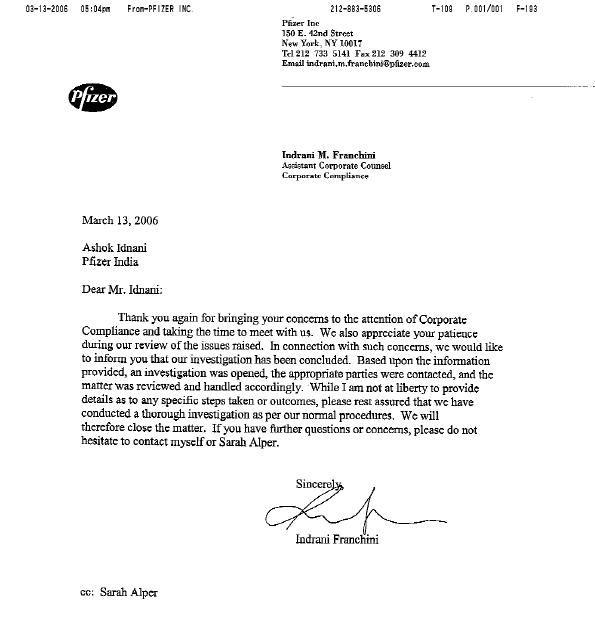
Pfizer reply

As for the content of this letter, personally I'm ROFL.

Only a lawyer could have written such a letter to Mr. Idnani, the poor whistleblower in India:

"We would like to inform you that our investigation has been concluded. Based upon the information provided, an investigation was opened, the appropriate parties were contacted, and the matter was reviewed and handled accordingly."

I consulted an expert in corporate legalese and this is his translation:

"WE'RE WETTING OUR PANTS BECAUSE WE'RE SO SCARED YOU FOUND OUT ABOUT OUR DIRTY LITTLE SECRETS IN INDIA. WHEN WE HAVE FINALIZED OUR INTERNAL COVER-UP WE'LL FIRE YOUR SORRY ASS TO ERADICATE ANY CORPORATE MEMORY OF THIS EVENT."

Six months after this memo was sent, in August 2006, the whistleblower, Pfizer Deputy Finance Manager Mr. Ashok Idnani, was fired. Pfizer refused to even pay him vaction pay owed until 2007, and also refused to give him his 25 year anniversary faithful service medal until Pfizer's treatment of Mr. Idnani was revealed on Question Authority.

Thursday, May 24, 2007

Pfizer India Whistleblower Finally Gets His "25 Year Service Award" Gold Coin: 4 Years too Late!

Pfizer's finance department whistleblower has gone through some really hard times since he was fired from Pfizer, after 28 years of faithful service.

As you may remember he was terminated less than a year after he contacted Pfizer CEO Jeff Kindler with numerous allegations which I have covered on this blog. And after he was terminated Pfizer refused to pay him money they owed him for six months.

But they also did something else. For four years Pfizer refused to give Idnani the faithful service medal awarded to all Pfizer employees in India, after 25 years of service.

Idnani wrote numerous e-mails about this to Pfizer New York, but no one cared.

But now, finally, there is some good news for Ashok Idnani.

He just told me, "I received the 25-year service award gold coin on last Friday, May 18, after the first two articles and four years after I completed 25-years with Pfizer.

And, perhaps we should mention, almost one year after he was fired.

Shame on you Pfizer. SHAME ON YOU!

Friday, June 08, 2007

Next week more exclusive documents: What Pfizer wrote to finance whistleblower AFTER he was fired.

Don't miss these new documents of what Pfizer wrote to its former finance executive, Mr. Idnani, six months after he was fired.

Idnani made allegations about extensive financial malfeasance at the Pfizer India operating unit, in an e-mail to Pfizer CEO Jeff Kindler in November 2005

Idnani was then abruptly fired, after 28 years of faithful service, in August 2006.

Pfizer refused to pay him vacation pay and give him his 25 year service medal for another six months after he was terminated.

Links to full story here.

Wednesday, June 27, 2007

Interview with former Pfizer finance executive and whistleblower Ashok Idnani.

The article by Business World, which picked up on my story about the Pfizer India finance scandal, has created a lot of interest.

A Pfizer insider appears to have tried to use the article to discredit the whistleblower,Ashok Idnani, leaving comments both on CafePharma and on this blog.

On CafePharma this comment appeared, "Looks like Rost got burned on his India stories. The plant that Pfizer supposedly sold for 10% of it's value was actually sold at slightly higher than the market rates. I wonder if that India stuff was a joke someone played on Rost. It is pretty funny though, mainly because of how much time he spent on it. Hopefully he can check out his stories in the future so he does not get duped again."

And on my blog, this comment was posted, "Well, according to the article posted on this website the property was sold for higher than market rates. According to the Indian contact it was sold for one-tenth the value. So, it looks like that aspect was a non-issue. I am not sure what the guys credentials are, but maybe Dr. Rost can post them too. Most companies conduct annual written reviews so that would be a good thing to publish in order to tell how well credentialed this guy was. Maybe the other allegations have a basis but I would think that most rational people might have a legitimate reason to question them. I mean, every company hires detectives and it is not always for a nefarious reason. For all I know it the people being followed could have threatened to blow up a plant. The Indian contact has a credibility problem right now, if he could establish that he was receiving good reviews then the general public would be more likely to believe he was retaliated against. Maybe he was just a crazy guy with an ax do grind and this was his best forum."

So, I thought, why not let the whistleblower reply?

Mr. Idnani's what do you think about these comments which question you credentials?

This appears to be written by a Pfizer insider. I can reply to that easily sending you my last appraisals done in 2001 and 2002 which were good, including an email to me in Jan 2002 from then country manager Hocine appreciating my role in integration activities of Pfizer-Parke Davis. Starting January 2003 they "froze" my salary and bonuses and there were no appraisals since then.

But what about the allegation that the article disproves that the plant was sold for less than its real value?

As for the property being sold for more than market value . . . this is simply not true. The government valuation of the property of Rs. 1800 million (conservative) has not changed. Only the Stamp Duty demand has been waived. The charge remains that Pfizer India sold the property at 10% of potential market value, and that is no doubt an undervaluation.

So aren't you just an employee with an ax to grind?

As for the comment about "an ax to grind" in your forum, the facts speak for themselves. I had approached my superiors in 2002, 2003, 2004 and ultimately Pfizer Inc & Jeff Kindler in November 2005 and until today the outcome of the November 2005 investigation has not been disclosed to me.

Is anything wrong in the Business World story?

Pfizer India has only now, falsely, started telling the newspapers "he has been told, his charges are baseless." So only after the postings on your blog and without any communication to me from Pfizer NY, who investigated the charges, and from whom I had been demanding the outcome and the detailed investigation reports, which was denied to me, do they say this.

So what about this Pfizer apologist who claims “every company hires detectives and it is not always for a nefarious reason"?

No company should authorize breaking into your bank accounts and start tracing your telephone calls, this is illegal. And bribing government officials is illegal. If you do that (and it was done by Pfizer with knowledge of Jeff Kindler, since I notified him) then you should also be sacked, just like HP's chairwoman was forced out. But instead the salary of the current Pfizer-India country manager was increased by a phenomenal 111%.

So do you think these comments were written by a Pfizer PR hack?

Where is the credibility problem really - with the person accusing or the accused? You have the documents and the facts. Let the people who read this decide!

Thursday, July 05, 2007

Is Ashok Idnani's Life in Danger after Blowing the Whistle on Pfizer?

Based on today's story in the New York Times, Ashok Idnani, former finance executive for Pfizer in India, should be very careful. You can read what I've written about Idnani's ongoing story on my blog here.

And this is the article in the New York Times today:

In India, Protecting a Whistle-Blower


J. N. Jayashree began blogging in the hopes of finding allies in the battle against corruption and violence.

By ANAND GIRIDHARADAS
Published: July 5, 2007
The New York Times

MUMBAI, July 4 — J. N. Jayashree did not want her husband to die the death of an Indian whistle-blower.

Four years ago, India was rocked by the murder of Satyendra Dubey, a government engineer who exposed corruption in the national highway building program. Two years later, Shanmughan Manjunath, a manager at a state-owned oil company, laid bare a scheme to sell impure gasoline. His body was found riddled with bullets in the back seat of his car.

To Ms. Jayashree, her husband, M. N. Vijayakumar, appeared to be following in their footsteps. Mr. Vijayakumar, 51, is a bureaucrat in the southern state of Karnataka, and he has a penchant for chastising colleagues who supplement their modest salaries with bribes, kickbacks and garden-variety pilferage.

In recent months, his chastising ruffled feathers at high levels, and he began seeing the signs often directed at whistle-blowers in India: He was pushed around the civil service like a hockey puck, switching jobs seven times in the last nine months, most recently on June 26.

As her husband made powerful enemies, Ms. Jayashree began to fear for his life. And so she devised an unusual ploy to protect him: she blogged.

In the YouTube era, she reasoned, it is harder to kill a man who has a bit of Internet renown.

“We’re creating a fortress around him — a fortress of people,” she said in a telephone interview. “I wanted to inform the people that this is happening, that my husband is a whistle-blower, so that it becomes the responsibility of every citizen to protect him.”

The result is a small-scale test of whether India’s technology revolution, which is empowering tens of millions, can tamp the corruption that hinders India’s ambitions. Transparency International, a Berlin-based group that monitors global corruption trends, ranks India below Colombia, Bulgaria and 67 other countries in its most recent index of corruption. In a 2005 study, it concluded that Indians pay more than $5 billion a year in bribes.

“The people who are supposed to be controlling corruption and fighting on behalf of the poor, they are sucking blood out of the poor,” Ms. Jayashree said in the interview.

She built her Web site, fightcorruption.wikidot.com, with help from her son, a doctoral student in computer science at Delaware State University. On the site, she chronicles her husband’s case and criticizes the government. An aficionado of India’s new right-to-information laws, she has acquired and uploaded reams of documents. She updates the site nearly every day and has received responses from around the world, including many from Indian émigrés who say they left the country because they found it too corrupt. Government officials in predicaments like her husband’s have sought advice.

Arun Duggal, a senior adviser to Transparency International, called the Web site pathbreaking for India.

“For an individual to use the powerful media of the Internet to take a stand against corruption, to expose wrongdoing, to build a campaign and a following, I think it’s the first time I’ve seen it,” said Mr. Duggal, who is based in New Delhi.

Mr. Vijayakumar, in a telephone interview, said he had seen corruption since his first days on the job. He said he had threatened to resign five times and had filed about 25 formal complaints detailing specific instances of corruption to P. B. Ma- hishi, the highest-ranking civil servant in Karnataka, which includes the technology hub of Bangalore. He said his complaints were rarely heeded.

The complaints have not been made public, but in the interview, Mr. Vijayakumar offered an example of how he said officials operate with near impunity: In the government agency that oversees state-owned enterprises in Karnataka, he said it was routine for officials to invent imaginary losses, and to solicit — and pocket — extra budgetary allocations to recover those losses.

“People at the top are involved, so they hope people will forget about it,” Mr. Vijayakumar said. “But I don’t forget.”

Mr. Mahishi, the civil service chief, conceded in a telephone interview that corruption was “everywhere,” in his own bureaucracy and in bureaucracies elsewhere. But he criticized Mr. Vijayakumar, calling him a lazy, ineffective worker who often skipped meetings and stayed silent about corruption for years before suddenly recoiling at it.

“Why did it take him 26 years to become active on the cause of corruption?” Mr. Mahishi said.

Mr. Vijayakumar contended that he had always battled corruption, but from the inside. What changed more recently, he said, is that his pleas ceased to make a difference and that he began to sense his life was in danger.

For instance, his wife said, one night last year, their doorbell rang soon before midnight. There were men at the door, and they told Mr. Vijayakumar that his younger son, a college student, had been in an accident. Come with us, they said.

But the son was asleep in his bed at home, just steps from his father, and the family concluded that the men had crafted a ruse to draw Mr. Vijayakumar from the house. After 13 years in that home, they moved to another neighborhood.

Corruption is nothing new in India. International surveys have consistently described the country as a superpower of graft. But Ms. Jaya- shree sees the temptation to swindle growing in an era when bureaucratic salaries pale beside private-sector pay.

In the early years of the Indian republic, the civil service was plum work. It came with a chauffeured car, cooks and servants, perhaps a white bungalow in a posh neighborhood. Private enterprise, strangled by socialist controls, often failed to match the perks and pay of public service. The marriage market reflected the dynamic: Men with admission to the civil service — and it was overwhelmingly male — were among the most sought-after grooms.

But as India trades socialist dogmas for capitalist ones, the private sector is becoming king. A sexagenarian veteran of the civil service typically earns no more than $9,000 a year, excluding perks like housing and a car. A 21-year-old engineer fresh out of college can make about that much at a software firm like Infosys, with annual raises of 15 percent.

Thursday, June 14, 2007

Pfizer's version of the India story

There are always two sides to each story. This is also the case with Pfizer's finance whistleblower, who was terminated after 28 years with the company, nine months after he notified Pfizer CEO Jeff Kindler of numerous allegations of wrongdoing in Pfizer's finance department.

For full story go here.

When Mr. Idnani questioned his termination, Pfizer "investigated" and then sent the e-mail to the left to Idnani (click on image to enlarge).

The e-mail was followed by a hard copy version of the same message. Only the message wasn't exactly the same. And sometimes omissions and changes can tell us a lot . . .

What had changed in the final hard copy version was that the investigation was no longer labeled "very thorough," nor did Pfizer claim that they had "reviewed all relevant evidence."

Sounds like Mr. Ryan Trierweiler, Pfizer Worldwide Pharmaceutical Operations Japan/Asia HR, got cold feet.

Thursday, July 26, 2007

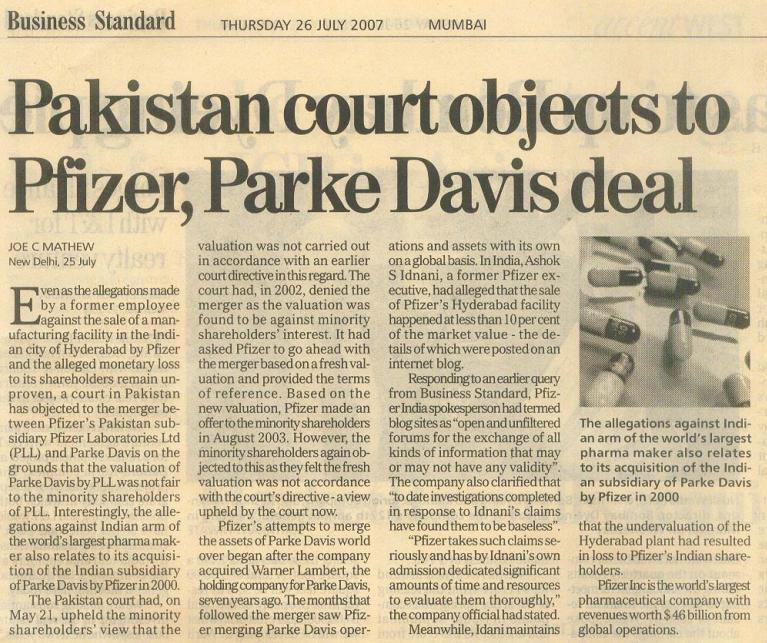
Pfizer India Scandal spills into Pakistan: Court says "valuation was not fair"

For full background on the Pfizer India scandal, which also started with a minority share holder revolt, just like Pakistan, which then lead to Pfizer hiring private detectives and allegations by whistleblower Idnani, a former Pfizer finance executive, click here.

BusinessStandard

Link to article here.

Monday, June 04, 2007

Me - empathy!? Am I turning soft?

Say it aint so. I'm feeling the jelly swirling around in my head.

By now I've spent a full year honing a carefully crafted cynical persona and suddenly that rock-solid image melts with one word.

I'm accused of empathy!

Empathy.

Empathy?

Empathy!

Fortune Magazine Touches on a Secret of Peter Rost’s Blog Success: Empathy

Posted by pharmamanufacturing

John Mack once suggested that some pharma bloggers write about Peter Rost in the hope of “riding in his wake,” and increasing their own site traffic and links. It might seem that way, but, let’s face it. Rost has been one of the most enigmatic figures in the industry for quite a few years, and his story only continues to become more interesting.

The latest evidence? Fortune just published a sympathetic, yet balanced piece on Rost and his blog.

Of course Rost’s Question Authority is serving the public by calling attention to questionable industry marketing practices, but there’s another reason why it is so effective: Empathy.

I was glad that Fortune picked up on this, because empathy is what makes me want to read Question Authority. Between the “self marketing” posts that Fortune referred to (and that Mack had teased Rost for—the marketing of the Question Authority clothing line, for example) and the rants against Pfizer, its CEO and management, Rost has listened to marginalized “outsiders on the inside”—-whether Ashok Idnani of India, or “Jane Roe, “and brought their stories to the world. For this alone, he deserves praise. And there are, no doubt, many more stories out there waiting to be told.

Rost may not have become a pharma CEO but has become something more interesting (More on critics who love pharma here)

As Mack observed, Rost needs no promotion and most people surfing the Net will find his blog immediately. But, like many others, I’ll continue to post updates on his story—out of sheer interest, and for some of our core readers who are distanced from marketing and corporate functions. Here’s a link from his site to the Fortune article.

Wednesday, June 06, 2007

Why did Pfizer hire detectives to spy on former PFE executive?

Pramod Lele was one of Pfizer's spy victims in India. Documents released by a former Pfizer finance executive reveal how he and others were followed by detectives hired by Pfizer.

Download the full surveillance reports here:
Surveillance strategy to Handa, June 2003
Surveillance/Phone records Dinesh Lakhani April 2003
Surveillance/Phone records Dinesh Lakhani May 2003
Surveillance Janak Mathuradas May 2003
Surveillance/Phone records Pramod Lele, December 2003
Surveillance report S.V. Phene December 2003

Lele had been the country manager of Warner-Lambert (Parke-Davis) in India, before the Warner-Lambert/Pfizer merger. He had started reporting to Pfizer in 2001, when he was suddenly asked to resign.

After Lele was forced out, Hocine Sidi Said (left) took over as country manager of Pfizer India. He reported to Charles Sarris who was the Regional Vice President for Asia & Japan region. Charles Sarris, in turn, reported to Hocine's father, Mohand Sidi Said. Mohand Sidi Said was President, Japan/Asia/Africa/Latin America/Middle East and he reported directly to Karen Katen. Shortly after Mohand Sidi Said retired in 2004, Hocine resigned from Pfizer India, in early 2005. We don't know if any of this had anything to do with Pfizer whistleblower Idnani's early allegations about selling a plant way below market value, as described in my post "Pfizer Finance Executive Blows the Whistle - Part One"

But we do know that in December 2003, almost two years after Lele was forced out, Pfizer sent their hired goons to spy on Lele. Why did they do this? You may wonder.

Some of Pfizer's surveillance appears to be related to shareholders who challenged the merger. That monitoring of individuals took place in April/May of 2003. But the legal challenge against the merger was completed in the first week of November 2003. So that can't be the reason for a spy operation in December 2003.

The second wave of detectives were dispatched to monitor both Lele and real estate executive Phene in December 2003. In my post "Interview with two angry Pfizer spy victims" I described Phene's unusual connection to Pfizer and Pfizer India's CEO.

But I didn't go into the reasons Pfizer may have had to spy on Lele, long after he'd been forced out and the legal case settled.

So here is something that might be the explanation:

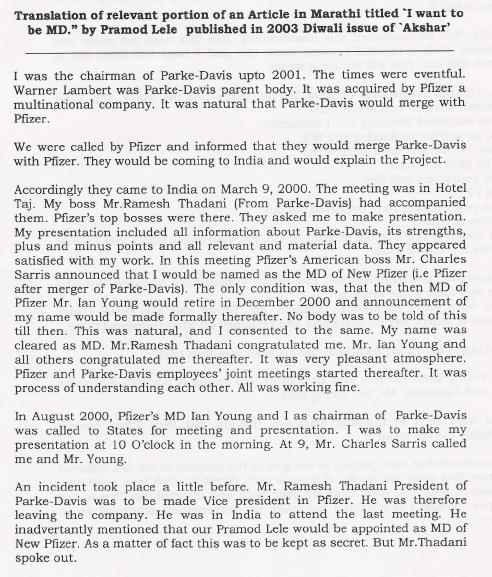
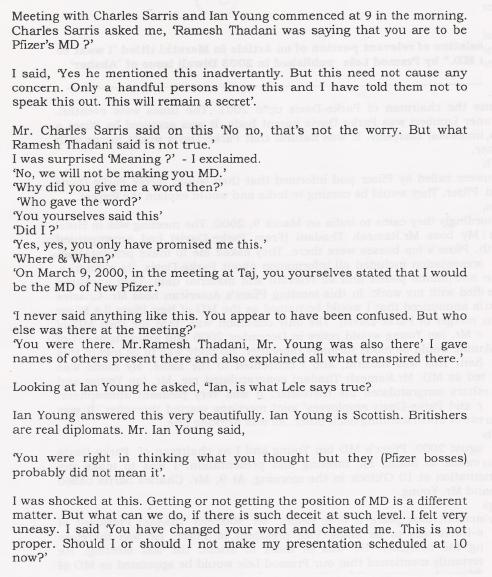
Lele wrote an article in an India newspaper which came out in the Diwali (October) issue of 2003. And Pfizer could not have liked what Lele had to say. In the article Lele describes what really happened inside Pfizer and how Pfizer management handled the Warner-Lambert acquisition.

It is very possible that Pfizer's goons targeted him because of what he wrote in this article (MD stands for Managing Director, not for the American M.D. or physician); to simply try to dig up some dirt on him. Below is a slightly imperfect translation:

WL1
WL2
WL3
WL4
WL5

Of course, for a big corporation to send out hired goons to monitor shareholders and former executives almost resembles mafia activity, or how Russia sends agents to kill dissidents.

And while it may appear surprising for a large corporation to send out detectives to dig up dirt, I think that is exactly how Pfizer operates.

When they fired me after I blew the whistle on illegal conduct which Pfizer was recently forced to pay a $35 million fine for, they called me all kinds of names:

The New York Times reported in its December 2, 2005 article that a Pfizer PR person, Mr. Fitzhenry, "also remarked that Mr. Rost had been the vice president in charge of marketing Genotropin at Pfizer, so that he was essentially blowing the whistle on his own conduct.” And the American Council on Science and Health, an organization funded by Pfizer, among others, labeled me “Whiny Whistleblower of the Year” in a December 30, 2005 press release. And in a Brandweek March 20, 2006 article, it was reported that Pfizer called my qui tam suit "parasitical."

So not only was it not enough to simply fire me; to make sure I never got another job again Pfizer labeled me a criminal and a parasite.

No one should be surprised if Pfizer hires detectives to throw mud at people.

I think the fact that Pfizer's head of security is a former FBI agent says it all. After all, former head of FBI, J. Edgar Hoover, had surveillance, even of Presidents, down to an art.

Pfizer is simply acting like any minor dictatorship when it comes to suppressing dissidents.

Sunday, May 20, 2007

Other blogs on Pfizer's Indian scandal.

Peter Rost, the Frankenstein's Monster of Pfizer
By BrandweekNRX

"I care about things from a marketing and brand image point of view, of course. I'm happy to cover good news and bad coming out of Pfizer.

But in terms of the company's image, it just makes me think that about November 2005, when Pfizer had the opportunity to pay Rost to shut up and go away. Instead, he was fired. Wouldn't it have been a lot easier to settle with him?"

Riding in Peter Rost's Wake
By Pharma Blogosphere

Contrary to John's thought in this post that I link to other blogs to "reward" them - I don't. I link because I think QA readers may be interested in their opinion, including John's opinion. I simply write about stuff I enjoy reading and link to things I find interesting.

Rost Busts Pfizer... Again and Again and Again
By CL Psych on Peter Rost

"Rost continues to bring the hammer down on Pfizer. I won't even bother to summarize his work, suffice to say that it involves a combination of..."


Pfizer's India Unit Spied On...Everyone?
By Ed Silverman

"Supposedly, this was done with the approval of the head of Pfizer India, who remains on the job, despite the fact that Pfizer execs in New York were presented with the same documents Question Authority has posted. The last installment should be available in a few hours. Get out your voodoo dolls....now."


Whistleblowing While You Don’t Work
By impactiviti on News

"The latest revelation - possible misdeeds in India, linked to the Pfizer/Parke-Davis transaction. You have to have some time on your hands, and, in fact, a willingness to wash your hands afterward, but to read more, go over to the Question Authority blog . . . Peter has thus become a “rock star” among some of the pharma bloggers that love dishing dirt, or at least, reporting headline-worthy news. So be forewarned - Question Authority is not a blog where you will find industry cheerleading!"


PHARMA: Rost--Pfizer's Indian problem
By Matthew

"I do think that sometime around now Pfizer probably wishes that it had just given Rost the job he wanted when they bought Pharmacia, and reacted with less paranoia. But you make your bed, and…."


BLOGSCAN - More Strange Deeds by Pfizer's Indian Subsidiary Alleged
By Roy M. Poses MD

"Rost noted that the person in charge of Pfizer's security operations at the time was the current CEO, Jeff Kindler, and speculated whether Pfizer's actions could have violated the US Foreign Corrupt Practices Act."


Pfizer Finance Mgr In India Blows Whistle
By Ed Silverman

"He has a complicated tale about discovering that the sale of a Pfizer plant in Hyderabad went for a fraction of its real value, raising suspicions of kickbacks. Ashok Idnani also alleges there were accounting irregularties, and that an internal investigation, which he tried to propel, was stifled by Pfizer execs in India and New York."


MORE ON PFIZER AT QUESTION AUTHORITY
By Absurd Realities by anniepema


Pfizer Finance Executive Blows the Whistle - Part One
By Bill of Rights

"The real story is a must read: http://peterrost.blogspot.com/"


BLOGSCAN - Strange Deals Alleged by Pfizer's Indian Subsidiary
By Health Care Renewal

"The blog Question Authority with Dr Peter Rost seems to be making a transition from commenting on the news (as we do here on Health Care Renewal) to investigative reporting. "


Pfizer Finance Executive Blows the Whistle - Part One
Bt The Black Kitty

"This is so &^&(*&%* audacious you have to read it to believe it. Pfizer is going DOWN, BABY. They will regret the day they messed with the Health Care Hitman. If this story doesn't give Dr. Rost his own News shows, then You ^&*'ers at CNN and CNBC are wack. Rost plays a Dan Rather... how ironic Veronica?"


PFE executive alleges detectives snooped on shareholders, bribes to tax ...
By BuzzTracker


Pfizer may very well be in violation of the...
By Absurd Realities by anniepema

"A VERY DARK STORY AT PETER ROST'S BLOG QUESTION AUTHORITY IS BEING REVEALED Read the gory details at Question Authority"


Rost Raises Questions, and Shares Documents, About the Sale of Pfizer’s Hyderabad Facility
By pharmamanufacturing on The Pharma Industry

"But, whatever the outcome or ultimate merits of this story as it unfolds, three cheers for transparency, corporate governance and Web 2.0."

Whistle Blower Blowout
By John Mack on Dr. Peter Rost

"Corruption regarding the sale of a plant in India has very little relevance to "me", which is what is really important. Maybe that's why not many other blogs are picking up on this latest whistle blower story." (I guess John is eating his words about right now.)


Dr Peter Rost celebrates US National Whistleblowing Week
By PharmaGossip

"Looks like it's gonna be quite a party!"


Dr. Peter Rost Will Break ANOTHER Whistle Blower Case Today - Check Blog!
By Digg

"Dr. Peter Rost is the self- proclaimed "health care Hitman" formally a VP from the EVIL PHARMA Empires (Biggie P and Biggie W), who defected to use his "special powers" for the forces of good, In the course of a couple of months, he has BROKE several of the biggest health care media Whistle-blower stories GLOBALLY. His new BIG story breaks today."