Peter Rost, M.D., is a former Pfizer Marketing Vice President providing services as a medical device and drug expert witness and pharmaceutical marketing expert. Judge Sanders: "The court agrees with defendants' view that Dr. Rost is a very adept and seasoned expert witness." He is also the author of Emergency Surgery, The Whistleblower and Killer Drug. You can reach him on rostpeter (insert symbol) hotmail.com. Follow on https://twitter.com/peterrost
Friday, May 23, 2008
The House Energy and Commerce Committee goes after Jeff Kindler in strongly worded letter.
My article about flood of suicide and traffic accidents related to Pfizer's anti-smoking pill Chantix made front cover news in Sweden.
You can read the article in Swedish or translated with Google translate to broken English.
(The latter option provided as a courtesy to Pfizer.)
Thursday, July 05, 2007
Is Ashok Idnani's Life in Danger after Blowing the Whistle on Pfizer?
And this is the article in the New York Times today:
In India, Protecting a Whistle-Blower

J. N. Jayashree began blogging in the hopes of finding allies in the battle against corruption and violence.
By ANAND GIRIDHARADAS
Published: July 5, 2007
The New York Times
MUMBAI, July 4 — J. N. Jayashree did not want her husband to die the death of an Indian whistle-blower.
Four years ago, India was rocked by the murder of Satyendra Dubey, a government engineer who exposed corruption in the national highway building program. Two years later, Shanmughan Manjunath, a manager at a state-owned oil company, laid bare a scheme to sell impure gasoline. His body was found riddled with bullets in the back seat of his car.
To Ms. Jayashree, her husband, M. N. Vijayakumar, appeared to be following in their footsteps. Mr. Vijayakumar, 51, is a bureaucrat in the southern state of Karnataka, and he has a penchant for chastising colleagues who supplement their modest salaries with bribes, kickbacks and garden-variety pilferage.
In recent months, his chastising ruffled feathers at high levels, and he began seeing the signs often directed at whistle-blowers in India: He was pushed around the civil service like a hockey puck, switching jobs seven times in the last nine months, most recently on June 26.
As her husband made powerful enemies, Ms. Jayashree began to fear for his life. And so she devised an unusual ploy to protect him: she blogged.
In the YouTube era, she reasoned, it is harder to kill a man who has a bit of Internet renown.
“We’re creating a fortress around him — a fortress of people,” she said in a telephone interview. “I wanted to inform the people that this is happening, that my husband is a whistle-blower, so that it becomes the responsibility of every citizen to protect him.”
The result is a small-scale test of whether India’s technology revolution, which is empowering tens of millions, can tamp the corruption that hinders India’s ambitions. Transparency International, a Berlin-based group that monitors global corruption trends, ranks India below Colombia, Bulgaria and 67 other countries in its most recent index of corruption. In a 2005 study, it concluded that Indians pay more than $5 billion a year in bribes.
“The people who are supposed to be controlling corruption and fighting on behalf of the poor, they are sucking blood out of the poor,” Ms. Jayashree said in the interview.
She built her Web site, fightcorruption.wikidot.com, with help from her son, a doctoral student in computer science at Delaware State University. On the site, she chronicles her husband’s case and criticizes the government. An aficionado of India’s new right-to-information laws, she has acquired and uploaded reams of documents. She updates the site nearly every day and has received responses from around the world, including many from Indian émigrés who say they left the country because they found it too corrupt. Government officials in predicaments like her husband’s have sought advice.
Arun Duggal, a senior adviser to Transparency International, called the Web site pathbreaking for India.
“For an individual to use the powerful media of the Internet to take a stand against corruption, to expose wrongdoing, to build a campaign and a following, I think it’s the first time I’ve seen it,” said Mr. Duggal, who is based in New Delhi.
Mr. Vijayakumar, in a telephone interview, said he had seen corruption since his first days on the job. He said he had threatened to resign five times and had filed about 25 formal complaints detailing specific instances of corruption to P. B. Ma- hishi, the highest-ranking civil servant in Karnataka, which includes the technology hub of Bangalore. He said his complaints were rarely heeded.
The complaints have not been made public, but in the interview, Mr. Vijayakumar offered an example of how he said officials operate with near impunity: In the government agency that oversees state-owned enterprises in Karnataka, he said it was routine for officials to invent imaginary losses, and to solicit — and pocket — extra budgetary allocations to recover those losses.
“People at the top are involved, so they hope people will forget about it,” Mr. Vijayakumar said. “But I don’t forget.”
Mr. Mahishi, the civil service chief, conceded in a telephone interview that corruption was “everywhere,” in his own bureaucracy and in bureaucracies elsewhere. But he criticized Mr. Vijayakumar, calling him a lazy, ineffective worker who often skipped meetings and stayed silent about corruption for years before suddenly recoiling at it.
“Why did it take him 26 years to become active on the cause of corruption?” Mr. Mahishi said.
Mr. Vijayakumar contended that he had always battled corruption, but from the inside. What changed more recently, he said, is that his pleas ceased to make a difference and that he began to sense his life was in danger.
For instance, his wife said, one night last year, their doorbell rang soon before midnight. There were men at the door, and they told Mr. Vijayakumar that his younger son, a college student, had been in an accident. Come with us, they said.
But the son was asleep in his bed at home, just steps from his father, and the family concluded that the men had crafted a ruse to draw Mr. Vijayakumar from the house. After 13 years in that home, they moved to another neighborhood.
Corruption is nothing new in India. International surveys have consistently described the country as a superpower of graft. But Ms. Jaya- shree sees the temptation to swindle growing in an era when bureaucratic salaries pale beside private-sector pay.
In the early years of the Indian republic, the civil service was plum work. It came with a chauffeured car, cooks and servants, perhaps a white bungalow in a posh neighborhood. Private enterprise, strangled by socialist controls, often failed to match the perks and pay of public service. The marriage market reflected the dynamic: Men with admission to the civil service — and it was overwhelmingly male — were among the most sought-after grooms.
But as India trades socialist dogmas for capitalist ones, the private sector is becoming king. A sexagenarian veteran of the civil service typically earns no more than $9,000 a year, excluding perks like housing and a car. A 21-year-old engineer fresh out of college can make about that much at a software firm like Infosys, with annual raises of 15 percent.
Wednesday, June 27, 2007
Interview with former Pfizer finance executive and whistleblower Ashok Idnani.
A Pfizer insider appears to have tried to use the article to discredit the whistleblower,Ashok Idnani, leaving comments both on CafePharma and on this blog.
On CafePharma this comment appeared, "Looks like Rost got burned on his India stories. The plant that Pfizer supposedly sold for 10% of it's value was actually sold at slightly higher than the market rates. I wonder if that India stuff was a joke someone played on Rost. It is pretty funny though, mainly because of how much time he spent on it. Hopefully he can check out his stories in the future so he does not get duped again."
And on my blog, this comment was posted, "Well, according to the article posted on this website the property was sold for higher than market rates. According to the Indian contact it was sold for one-tenth the value. So, it looks like that aspect was a non-issue. I am not sure what the guys credentials are, but maybe Dr. Rost can post them too. Most companies conduct annual written reviews so that would be a good thing to publish in order to tell how well credentialed this guy was. Maybe the other allegations have a basis but I would think that most rational people might have a legitimate reason to question them. I mean, every company hires detectives and it is not always for a nefarious reason. For all I know it the people being followed could have threatened to blow up a plant. The Indian contact has a credibility problem right now, if he could establish that he was receiving good reviews then the general public would be more likely to believe he was retaliated against. Maybe he was just a crazy guy with an ax do grind and this was his best forum."
So, I thought, why not let the whistleblower reply?
Mr. Idnani's what do you think about these comments which question you credentials?
This appears to be written by a Pfizer insider. I can reply to that easily sending you my last appraisals done in 2001 and 2002 which were good, including an email to me in Jan 2002 from then country manager Hocine appreciating my role in integration activities of Pfizer-Parke Davis. Starting January 2003 they "froze" my salary and bonuses and there were no appraisals since then.
But what about the allegation that the article disproves that the plant was sold for less than its real value?
As for the property being sold for more than market value . . . this is simply not true. The government valuation of the property of Rs. 1800 million (conservative) has not changed. Only the Stamp Duty demand has been waived. The charge remains that Pfizer India sold the property at 10% of potential market value, and that is no doubt an undervaluation.
So aren't you just an employee with an ax to grind?
As for the comment about "an ax to grind" in your forum, the facts speak for themselves. I had approached my superiors in 2002, 2003, 2004 and ultimately Pfizer Inc & Jeff Kindler in November 2005 and until today the outcome of the November 2005 investigation has not been disclosed to me.
Is anything wrong in the Business World story?
Pfizer India has only now, falsely, started telling the newspapers "he has been told, his charges are baseless." So only after the postings on your blog and without any communication to me from Pfizer NY, who investigated the charges, and from whom I had been demanding the outcome and the detailed investigation reports, which was denied to me, do they say this.
So what about this Pfizer apologist who claims “every company hires detectives and it is not always for a nefarious reason"?
No company should authorize breaking into your bank accounts and start tracing your telephone calls, this is illegal. And bribing government officials is illegal. If you do that (and it was done by Pfizer with knowledge of Jeff Kindler, since I notified him) then you should also be sacked, just like HP's chairwoman was forced out. But instead the salary of the current Pfizer-India country manager was increased by a phenomenal 111%.
So do you think these comments were written by a Pfizer PR hack?
Where is the credibility problem really - with the person accusing or the accused? You have the documents and the facts. Let the people who read this decide!
Tuesday, June 26, 2007
The HIV sales force scandal just exploded in Pfizer's face.
Ed Silverman over at Pharmalot just followed up with his own Pfizer HIV sales force whistleblower story, complete with e-mail and power point presentation, focusing on Viracept, which is the drug this HIV sales force is actually selling.
This well researched story is a must read and I'm simply reproducing Ed's outstanding work below. I can't wait for his next installment!
At Pfizer, Improper Marketing Is An Infectious Disease; Drugmaker Probes Another AIDS Med
June 26th, 2007 8:58 am By Ed Silverman
Over the past few weeks, Pfizer has had nothing but trouble with its new AIDS drug, maraviroc. The FDA unexpectedly delayed approval and the reasons aren’t clear. Meanwhile, the drugmaker quietly began investigating allegations that its sales team was instructed to promote maraviroc to physicians. This is a big no-no, because the drug still isn’t approved and this would violate a Corporate Integrity Agreement with the feds.
As it turns out, Pfizer is also investigating charges that the same HIV sales force was encouraged to improperly promote Viracept, an aging AIDS drug. Sales reps were given unapproved training and detailing materials (see below). The allegations, which also involve unapproved funding of CME programs, were made by a sales rep who now complains of retaliation. A Pfizer spokesman confirms the investigation is under way, adding that “we take any concerns about any appropriateness of activities involving the company very seriously.”
Why did this happen? A mix of panic and frustration. Pfizer got into the AIDS business in 2000 by acquiring Warner-Lambert, which itself had bought Agouron Pharma and its Viracept, or nelfinivir, a new AIDS med that generated about $420 million in sales in 1998. But Viracept was soon eclipsed by other drugs, such as Kaletra, Sustiva and Reyataz, and by last year, annual sales dwindled. Underscoring the point, Viracept is no longer listed separately in Pfizer financial reports. (Look here for the decline. On the far left, Viracept is the green line that begins at 20 percent and later plummets).
“We call it has-been-avir, not nelfinivir” says the sales rep. “They had to do something. And so we were given all sorts of materials to boost business. You know, a sales rep just doesn’t wake up one morning and say ‘I’ll use these unapproved studies or slides or whatever.’ It has to come from somewhere. And we were told that our performance was based on whether we were able to use that material in the field. But it violates Pfizer’s own policy. That’s why I reported these things.”
Here’s one example. This e-mail was written by a Pfizer professional science liasion, a position more commonly called medical science liasion at other big drugmakers. The note encourages HIV sales reps to show doctors a set of slides entitled ‘Treatment Considerations for HIV Today and Tomorrow.’ But the sales rep points out that the slides disclose a problem.
From: REDACTED
> > Sent: Thursday, November 09, 2006 11:09 AM
> > To: Wilson, Blythe Ashley; Weiss, Lawrence; Wynn, Jeffrey S;
> > Bilawsky, Leslie J; Miller, Vanessa Z; Raymond, James; Fazzina,
> > Douglas; DeRamus, Lisa A; Turner, Edward; Shimp, Christine Lynn
> > Cc: Zaleski, Carolyn
> > Subject: Slides - Today’s HIV Patient
> >
> > New York/New England Team,
> >
> > Attached are the slides that we discussed at the POA. This is an
> > excellent slide deck to present to your providers to provide value,
> > and sell Viracept. This is for your information, and to be shared
> > only with your providers. Please let me know if you have any
> > questions on utilizing these slides in your territory.
> >
POA is plan of action, a scheduled meeting for a sales force to discuss strategy. You can either flip through the slide set or go right to page 19, and there’s a chart that compares Viracept with other protease inhibitors and their affect on lipid levels. However, this is a prospective, observational study, not a head-to-head trial. In other words, it’s an inappropriate comparison.
This would appear to violate Pfizer’s own policy, which is described in The Field Guide, a manual given sales reps: “A comparative claim generally must be backed up by at least two adequate, well-controlled studies in which the drugs were compared head-to-head using comparable dosage regiments or a single, large, well-controlled study.” See pgs. 21 and 22.
The sales rep also alleges the slides and other materials were never approved by the Pfizer Review Committee, a mandatory step. This is the sort of activity that Pfizer is required to report to the HHS Office of Inspector General as part of its CIA, which Pfizer signed as a result of its settlement over improper marketing of Neurontin. “…Our obligations under these settlements include…disclosing activities by Pfizer colleagues that are non-compliant with the health care laws,” according to the drugmaker’s own rules on page 9 in The Field Guide.
The Viracept investigation is occuring at the same time as the maravoric investigation, since the same marketing and sales teams were involved and many of the same sales reps are being questioned. The probe is being handled by the same outside lawyer, Ropes & Gray’s Josh Levy, who spoke with the sales rep who provided this information. The maravoric investigation was first disclosed in April by Peter Rost, who has subsequently posted numerous updates on the way Pfizer has handled the problem.
The slide set was just one of many materials and documents the sales rep tells us were part of a so-called road map designed to make it possible for the HIV sales force to ultimately convince doctors to write Viracept scrips. Internally, this effort was known as ‘promotional mapping,’ which the sales rep says contained various clinical arguments that also came in the form of obscure studies.
“This was a way to put all of these unapproved materials into one place and then train us. But it didn’t just appear – the sales rep didn’t get together one Sunday afternoon by themselves and decide to use these materials. We weren’t renegade reps. We went to a POA and it was represented to us as a way to do business.”
Two notes to Pharmalot viewers:
1 – There will be a few additional installments in coming days.
2 – The sales rep was granted anonymity due to this person’s role as a whistleblower.
Monday, June 25, 2007
Pfizer's India Scandal Raises Questions in Mainstream Media
May 16, 2007: Pfizer Finance Executive Blows the Whistle - Part One
May 17, 2007: Pfizer Finance Executive Blows the Whistle – Part Two
May 18, 2007: Pfizer Finance Executive Blows the Whistle – Part Three
Click on images below to read full size article:

Thursday, June 21, 2007
Pfizer risked HIV drug approval "to make it a little harder" for plaintiff's lawyers.
I first wrote about the internal Pfizer whistleblower who alleged that Pfizer illegally premarketed the HIV drug maraviroc, before FDA approval, on April 30, 2007.
In response to these allegations, Mark Brown, Vice President, Sales, Pfizer Anti-Infective and HIV/AIDS Divisions on May 3, 2007, issued the following statement to Pfizer's sales force:
"The consequences of pre-approval promotion can be significant, and can go beyond disciplinary action for violation of a Company Policy. The FDA has not approved the Maraviroc label. Nor has the FDA finalized its views on an appropriate risk management plan for Maraviroc. Any promotional conduct at this point in time could adversely influence the FDA’s views on either the label or the Risk Plan, could prompt the FDA to send Pfizer a Regulatory letter or could lead to other legal action."
Clearly Pfizer realized that the whistleblower's allegations were explosive and could impact the FDA approval of maraviroc.
These events constitute an indictment of Pfizer CEO Jeff Kindler's legal strategy:
Back in 2006 Kindler told the Wall Street Journal, "By virtue of being a large company we have a lot of resources. So we can go to war for a long period of time with plaintiffs lawyers if we need to. None of these cases are threatening the financial viability of this enterprise. We have the resources to take them on and we manage them, I think, very effectively. Plaintiffs lawyers are in business like anybody else. They think about how to most quickly and most easily get their rewards from their business. So we're hoping that when a plaintiffs lawyer is thinking about who to go after maybe they'll think Pfizer's going to make it a little harder for me than so-and-so, so maybe I'll go after so-and-so."
Pfizer had the opportunity to handle the maraviroc scandal internally, and to deal fairly with the whistleblower. Instead the company elected to fight and tried to shut down the maraviroc whistleblower, who then turned to the press.
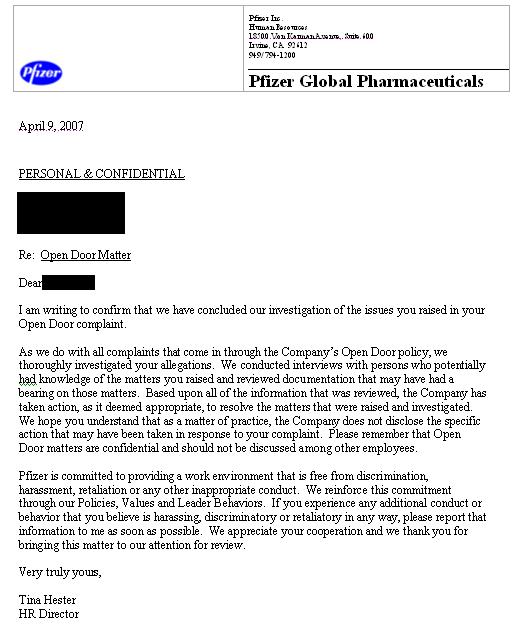
Below is an e-mail from Pfizer HR, confirming Pfizer's initial investigation of the maraviroc affair. Please note that they write that Pfizer will “not disclose the specific action that may have been taken in response to your complaint.”
The fact that they "may" have taken action certainly doesn't give anyone confidence that anything was done. And very clearly, the fact that they wrote "we have concluded our investigation" is something that indicates they didn't try very hard.
If they had tried harder, they wouldn't have been forced to start a new investigation when I started writing about the maraviroc scandal, and wouldn't have been forced to hire the law firm Ropes & Gray. So, it is easy to conclude that this letter is the smoking gun indicating a corporate cover-up:

In response to this letter, on April 10, 2007, the maraviroc whistleblower's attorney wrote a letter to Thomas “T.R.” Kelley, Office of the General Counsel of Pfizer, in which he stated:
"As a result of blowing the whistle on [redacted], [redacted] is now a pariah among upper level management at Pfizer . . . [redacted] also received a letter from Tina Hester of Pfizer Human Resources warning her that the details underlying his complaint must remain confidential. In addition, she wrote that Pfizer will “not disclose the specific action that may have been taken in response to your complaint.” (Emphasis added). Without knowing what action Pfizer may have taken, what level of confidence can [redacted] have that Pfizer has addressed all of its ethical and legal obligations in this matter? Have federal regulators been informed? Has criminal conduct occurred triggering reporting obligations? I suggest that Pfizer’s so-called “Open Door” policy works both ways. However, not only has Pfizer refused to tell [redacted] what action has been taken in response to [redacted] complaint, [redacted] has been issued a threatening gag order. This hints at a concerted cover-up effort."
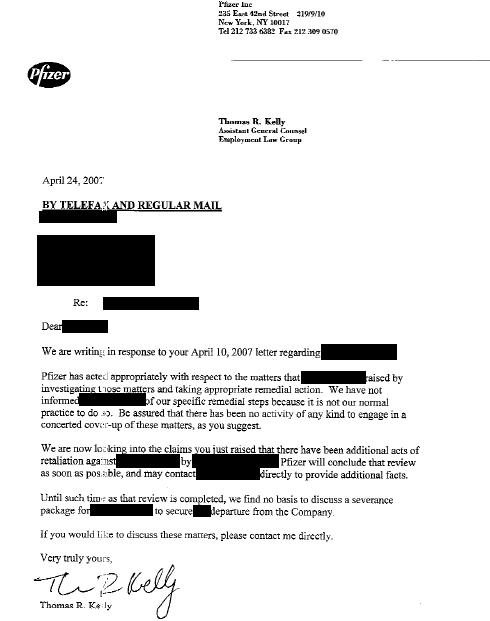
In response to this letter, Pfizer sent the following reply:

What happened next is that Pfizer used the redacted e-mails in my maraviroc articles to triangulate and capture the whistleblower and then shut down this person's corporate e-mail account.
No retaliation, of course, simply what you do with a whistleblower who reports allegations about illegal marketing.
For Pfizer there is one final question: Was Pfizer CEO Jeff Kindler's legal strategy "to make it a little harder" for plaintiff's lawyers worth risking approval of a new drug?
After all, Pfizer already has admitted that "The consequences of pre-approval promotion can be significant . . . Any promotional conduct at this point in time could adversely influence the FDA’s views on either the label or the Risk Plan."
So perhaps it would have been a good idea to cooperate with the whistleblower instead of trying to silence her.
Wednesday, June 20, 2007
Pfizer Receives Approvable Letter For Maraviroc. Investigation Continues.
Pfizer did not comment on the ongoing investigation related to unapproved marketing allegations by a sales rep.
You can read that story here.
Tuesday, June 19, 2007
Pfizer's letters to the maraviroc whistleblower!
Pfizer whistleblower Jane Roe contacted Question Authority in April which resulted in the story "Pfizer whistleblower accuses company of using sales force to illegally market new AIDS-drug before FDA approval".After the additional articles, "Pfizer sales rep: "PFE tried to find 'naïve doctors' for illegal premarketing of maraviroc!" and "Pfizer's "Delete! Delete!" memo: "Do NOT forward or retain this e-mail . . ." were published, Pfizer hired the eminent Boston law firm Ropes & Gray to investigate the maraviroc scandal and the interrogation of numerous sales reps started.
I was just told that yet another sales rep who met with Josh Levy from Ropes & Gray in New York was "very disturbed to find out all they wanted to know was his involvement in the maraviroc issue and who was in contact with Rost."
Pfizer also used the redacted e-mails reproduced on Question Authority to identify Jane Roe* and haul her in for interrogation.
But before Jane came to Question Authority, she had tried for over a year to address the internal problems at Pfizer. And it didn't help that she'd worked almost a decade for Pfizer with outstanding performance appraisals; after she started to report her concerns her performance rating suddenly went into tailspin. It does appear, however, as if Pfizer took some action; the district manager Jane reported to "left Pfizer" and some senior managers within Pfizer allegedly has told the sales force that Jane "got her fired."
If true, I'm sure they did this just to make sure that Jane got real popular with her colleagues.
Below is an e-mail from Pfizer HR, confirming Pfizer's initial investigation of the maraviroc affair. Please note that they write that Pfizer will “not disclose the specific action that may have been taken in response to your complaint.”
The fact that they "may" have taken action certainly doesn't give anyone confidence that anything was done. And very clearly, the fact that they wrote "we have concluded our investigation" is something that indicates they didn't try very hard.
If they had tried harder, they wouldn't have been forced to start a new investigation when I started writing, and wouldn't have been forced to hire Ropes & Gray. So, it is easy to conclude that this letter is the smoking gun indicating a corporate cover-up.

In response to this letter, on April 10, 2007, Jane Roe's attorney wrote a letter to Thomas “T.R.” Kelley, Office of the General Counsel of Pfizer, in which he stated that, Jane Roe's "continued employment at Pfizer is untenable. I have no doubt that Pfizer fired [name redacted] based upon Jane Roe's complaint about her conduct. This is common knowledge within the company even though Ms. Roe was given assurances of confidentiality."
Jane's lawyer also writes, "As a result of blowing the whistle on [redacted], Ms. Roe is now a pariah among upper level management at Pfizer . . . Ms. Roe also received a letter from Tina Hester of Pfizer Human Resources warning her that the details underlying his complaint must remain confidential. In addition, she wrote that Pfizer will “not disclose the specific action that may have been taken in response to your complaint.” (Emphasis added). Without knowing what action Pfizer may have taken, what level of confidence can Ms. Roe have that Pfizer has addressed all of its ethical and legal obligations in this matter? Have federal regulators been informed? Has criminal conduct occurred triggering reporting obligations? I suggest that Pfizer’s so-called “Open Door” policy works both ways. However, not only has Pfizer refused to tell Ms. Roe what action has been taken in response to his complaint, she has been issued a threatening gag order. This hints at a concerted cover-up effort."
In response to this letter, Pfizer sent the following reply:
So about a week before Jane Roe contacted Question Authority, Pfizer claimed they took "appropriate remedial action," and they were looking into "additional acts of retaliation."
After doing this they apparently decided that the right course of action was to shut down Jane Roe's corporate e-mail account. No retaliation, of course, just what you do with a whistleblower who reports allegations about illegal marketing.
The question then remains, if they took "appropriate remedial action," why did they need to call in the lawyers again when the maraviroc story was published in Question Authority?
*Pseudonym.
Wednesday, June 13, 2007
Pfizer lawyer throws a fit over latest maraviroc whistleblower story
Apparently Pfizer didn't appreciate my article PFIZER CATCHES MARAVIROC WHISTLEBLOWER.*So to Joshua and the other Pfizer lawyers; and to the AstraZeneca PR people; and to anyone else featured on this blog, including Indian private detectives:
Please don't get upset. Write and tell me if you disagree with anything on this site and your letter will be published. Or just use the comment section to set the record straight. This is an open forum and we'd all love to hear from you!
This blog contains a mix of investigative reporting, spoofs, and satire.
That's one reason I have a broad TERMS OF USE AGREEMENT AND PRIVACY POLICY and this great and very Important Legal Disclaimer.
That disclaimer contains lots of words, among them this sentence describing Question Authority: "You can expect to encounter generalizations, simplifications, hypothecations, exaggerations, inflations, fabrications, but mostly a lot of truths no one ever had the guts to tell you before. (The last part I wrote, my lawyer made me put in those other words.)"
It also contains this sentence: "This blog is designed to be provocative, confrontational, irreverent, mocking, impertinent, flippant, impudent, bold, enlightening, naughty, mischievous, funny and tongue-in-cheek. If you have no humor or if you are a boring person you are not supposed to read this blog."
So seriously, Joshua, since I have been told that you are using this blog in the internal legal maraviroc investigation, even contradicting witnesses using this blog, perhaps you should show those important statements to the employees you interrogate . . . just a thought.
And to all the corporations out there, don't get upset and don't beat up the whistleblower:
Instead, write Question Authority and tell your version of the story!
We'd love to hear from you. And if you decide not to respond, you can't really complain.
At Question Authority we're always ready to set the record straight.
*Image is used for illustrative purposes only and does not depict anyone named or referred to in this article. It depicts a little boy. Duh.
Monday, June 11, 2007
Pfizer comments on 17,000 stolen names and social security numbers.
Pfizer "couldn’t say for sure whether anyone actually stole the vulnerable data," according to the WSJ Health Blog.Pfizer could, however, say that 15,700 employees "had their data accessed and copied" and 1,250 "may have had their data copied."
Not stolen.
Just copied.
According to Pfizer.
PFIZER CATCHES MARAVIROC WHISTLEBLOWER
Several sources inside Pfizer have informed Question Authority that Pfizer has caught "Jane Roe," the maraviroc whistleblower."Once you posted the redacted e-mails it was easy," one source commented. (You can read those e-mails here.)

"Our security people searched millions of e-mails, looking for date and time and certain phrases. We had Jane Roe identified within hours of your article."
"We triangulated her name, and a few days later shut down her e-mail access," another source claims.
According to the second source, last week Jane and some of her colleagues were hauled in front of Pfizer's lawyer from Ropes & Gray, an associate or paralegal from Ropes & Gray, and an in-house Pfizer lawyer and and were interrogated for several hours.
"We left her knowing exactly what we know about her. Now she's is 'marinading.' That's the word we use to break someone. We leave them in limbo until the pressure makes them voluntarily resign, or they have a breakdown."
Apparently, Pfizer had reams and reams of documents and analysis to force Jane Roe to confess that she was the recipient or had written the e-mails that were posted on Question Authority.
Unfortunately for Pfizer, that doesn't prove that Jane is the one who actually forwarded them to me. And there was no other way for Pfizer to find out other than to ask Jane:
After showing all the proof they had, Joshua Levy from Ropes & Gray allegedly confronted Jane asking, "who's been sending material to Rost's site?"
Jane responded, "well it could be anyone, there are many disgruntled employees"
Levy allegedly then said "who? who?"
Jane responded, "maybe it is a composite of people."
Levy said "you still haven't answered me" and Jane responded, "I really can't say for sure. If you have any other questions send them to me."
Levy had one stack with postings from Question Authority, and how those posts corresponded to Jane's emails, a second stack of documents with various unapproved slide presentations, pdf-documents, and clinical studies on maraviroc and Viracept, and a meeting list with times and dates and names of physicians who had been approached.
My source claims they even brought testimony from other reps from around the country, and also from Dennis Pontani, Medical Affairs, Art Rodriquez, Sales Director, and Kelly Fitzgeralds, formerly Assistant Sales director and now District Manager for Boston.
The key objective in this situation (based on my personal experience with Pfizer), is for Pfizer lawyers to try to shoot as many holes as possible in the whistleblower story, and to build a defense against the allegations rather than dig for the truth.
Based on what I've been told, this meeting was no different.
The format was basically to ask questions that were aimed at disputing that any maraviroc pre-marketing meetings ever took place with physicians, or that if they were, that they didn't rise to the level of illegal promotion.
Unfortunately for Pfizer's lawyers, I hear they came back exasperated, since Jane Roe, without notes or anything, gave them the full story, the same way she's told it to me.
One person claimed, "If you hadn't made this public with all those documents, the company could have disavowed knowledge of the exsistence of any of these meetings."
Another HIV sales sales rep who was interrogated claims Joshua S. Levy from Ropes & Gray let it slip that others in sales management were disputing they had any knowledge of any of the allegations by Jane Roe.
Since there are only 43 reps in Pfizer's HIV sales force, it begs the question, if this assertion is true, shouldn't they have known this, and if they didn't know, why not? Have they had a sales force going crazy behind their backs? Or were they just not up to the job of supervising their employees? Or is this a truthful statement in the first place?
Levy was, as expected, not forthcoming with any information at all but it was clear Pfizer sees a problem and wants it fixed.
Among the most explosive allegations made at these meetings with Joshua Levy was that "in a conference call we were were told to delete all maraviroc info off our computers."
Levy allegedly disputed this saying "didn't they say to put it in a folder?"
The reps responded, "no they told us to do that with all the unapproved materials they have been asking us to use."
As expected, a number of Pfizer HIV sales reps are now corresponding with each other about the interrogations they've gone through and speculation is rampant what will happen to sales management in the HIV area.
As for Pfizer, they are sitting tight and have not yet fired Jane Roe.
"We expect FDA approval for maraviroc by June 20 and we'll be launching this baby in July. Until then, everyone has been ordered not to rock the boat."
So, perhaps, Jane Roe is safe in her job for another month.
As for Pfizer, clearly they have a very different approach to whistleblowers than AstraZeneca, who never started a witch hunt.
The whistleblowers at AstraZeneca stated, "We see that the company is making an effort to clean up their act and want to give them a chance to do so. To their credit, there has been no 'witch hunt' to discover our identities or retaliate against us."
Unfortunately, that is not a claim Pfizer can make.

[Identifying information in this article has been changed and certain quotes modified to maintain confidentiality of sources. For legal disclaimer go here. And read all about the maraviroc scandal here.]
Friday, June 08, 2007
Next week more exclusive documents: What Pfizer wrote to finance whistleblower AFTER he was fired.
Idnani was then abruptly fired, after 28 years of faithful service, in August 2006.
Pfizer refused to pay him vacation pay and give him his 25 year service medal for another six months after he was terminated.
Links to full story here.
Pfizer CEO going to Voodoo show in India?
According to my sources Kindler's jet is expected to touch Indian soil in Mumbai on Saturday evening.On Sunday presentations by key executives at Pfizer India have been scheduled, and Monday he is expected to travel to Delhi with Pfizer India CEO Kewal Handa to meet with government officials to discuss patent issues, drug exclusivity, price controls, government drug budgets.
Kindler might also have a special new agenda item for Indian authorities: Tax incentives for disposing company properties at 10% of market value.
Kindler can be identified wearing a turban with a hidden camera with the Pfizer-India spy chief sniffing at his feet . . . Yes Saar, Yes Sir.
At the end of the meetings, liquor-bottles (sorry, Diwali sweets), hidden in the turbans, will be distributed and followed by a Voodoo show. My source wasn't 100% sure on the Voodoo show, but thinks it would be a good idea, considering recent allegations of gurus and Voodoo practice in Pfizer India's finance department.
Wednesday, June 06, 2007
Why did Pfizer hire detectives to spy on former PFE executive?
Download the full surveillance reports here:
Surveillance strategy to Handa, June 2003
Surveillance/Phone records Dinesh Lakhani April 2003
Surveillance/Phone records Dinesh Lakhani May 2003
Surveillance Janak Mathuradas May 2003
Surveillance/Phone records Pramod Lele, December 2003
Surveillance report S.V. Phene December 2003
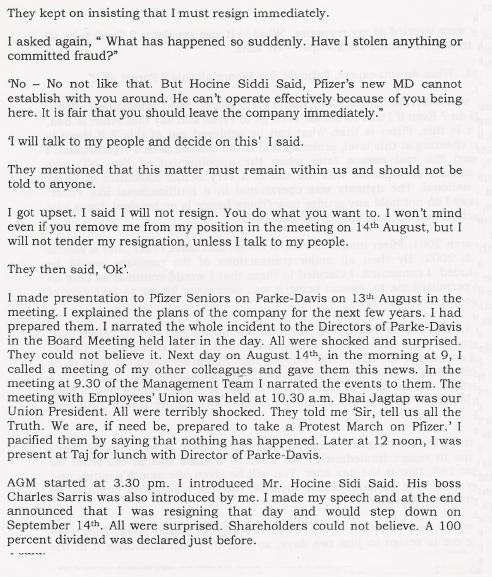
Lele had been the country manager of Warner-Lambert (Parke-Davis) in India, before the Warner-Lambert/Pfizer merger. He had started reporting to Pfizer in 2001, when he was suddenly asked to resign.
After Lele was forced out, Hocine Sidi Said (left) took over as country manager of Pfizer India. He reported to Charles Sarris who was the Regional Vice President for Asia & Japan region. Charles Sarris, in turn, reported to Hocine's father, Mohand Sidi Said. Mohand Sidi Said was President, Japan/Asia/Africa/Latin America/Middle East and he reported directly to Karen Katen. Shortly after Mohand Sidi Said retired in 2004, Hocine resigned from Pfizer India, in early 2005. We don't know if any of this had anything to do with Pfizer whistleblower Idnani's early allegations about selling a plant way below market value, as described in my post "Pfizer Finance Executive Blows the Whistle - Part One"But we do know that in December 2003, almost two years after Lele was forced out, Pfizer sent their hired goons to spy on Lele. Why did they do this? You may wonder.
Some of Pfizer's surveillance appears to be related to shareholders who challenged the merger. That monitoring of individuals took place in April/May of 2003. But the legal challenge against the merger was completed in the first week of November 2003. So that can't be the reason for a spy operation in December 2003.
The second wave of detectives were dispatched to monitor both Lele and real estate executive Phene in December 2003. In my post "Interview with two angry Pfizer spy victims" I described Phene's unusual connection to Pfizer and Pfizer India's CEO.
But I didn't go into the reasons Pfizer may have had to spy on Lele, long after he'd been forced out and the legal case settled.
So here is something that might be the explanation:
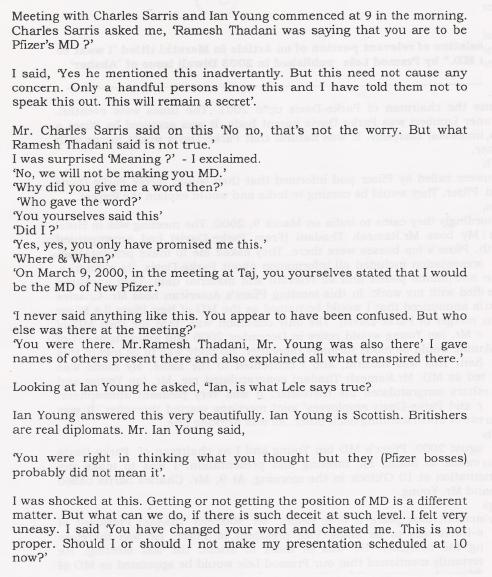
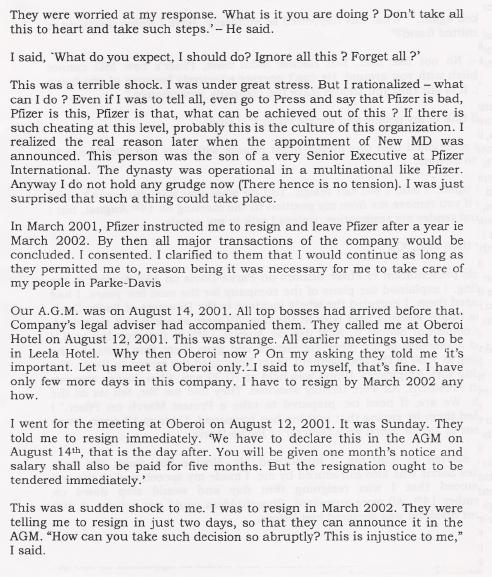
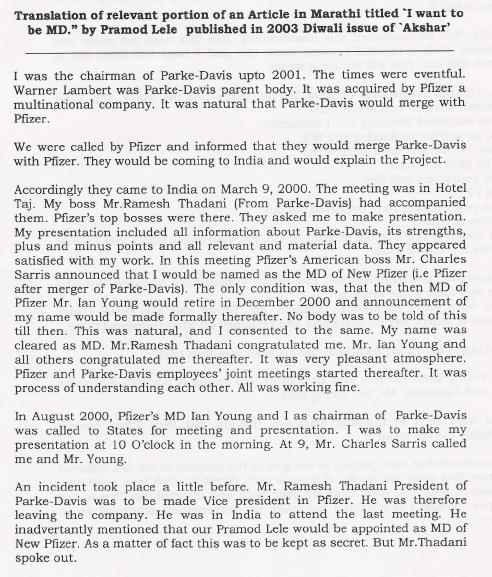
Lele wrote an article in an India newspaper which came out in the Diwali (October) issue of 2003. And Pfizer could not have liked what Lele had to say. In the article Lele describes what really happened inside Pfizer and how Pfizer management handled the Warner-Lambert acquisition.
It is very possible that Pfizer's goons targeted him because of what he wrote in this article (MD stands for Managing Director, not for the American M.D. or physician); to simply try to dig up some dirt on him. Below is a slightly imperfect translation:


Of course, for a big corporation to send out hired goons to monitor shareholders and former executives almost resembles mafia activity, or how Russia sends agents to kill dissidents.
And while it may appear surprising for a large corporation to send out detectives to dig up dirt, I think that is exactly how Pfizer operates.
When they fired me after I blew the whistle on illegal conduct which Pfizer was recently forced to pay a $35 million fine for, they called me all kinds of names:
The New York Times reported in its December 2, 2005 article that a Pfizer PR person, Mr. Fitzhenry, "also remarked that Mr. Rost had been the vice president in charge of marketing Genotropin at Pfizer, so that he was essentially blowing the whistle on his own conduct.” And the American Council on Science and Health, an organization funded by Pfizer, among others, labeled me “Whiny Whistleblower of the Year” in a December 30, 2005 press release. And in a Brandweek March 20, 2006 article, it was reported that Pfizer called my qui tam suit "parasitical."
So not only was it not enough to simply fire me; to make sure I never got another job again Pfizer labeled me a criminal and a parasite.
No one should be surprised if Pfizer hires detectives to throw mud at people.
I think the fact that Pfizer's head of security is a former FBI agent says it all. After all, former head of FBI, J. Edgar Hoover, had surveillance, even of Presidents, down to an art.
Pfizer is simply acting like any minor dictatorship when it comes to suppressing dissidents.
Tuesday, June 05, 2007
Why did Pfizer spy on a former country manager?
Brandweek: "AstraZeneca would love to be Pfizer, dealing with Rost"
Can Pfizer Get Over Its Anger and Utilize the Leverage It Has With Rost?
It's extremely difficult to ignore the fact that Fortune has done a flattering feature story on Peter Rost. Rost could be on the verge of parlaying his position in the media from "one hit blogging wonder" into "permanent fixture that all drug companies will have to deal with in the future."
Whether Rost can successfully negotiate the transition over the next couple of years will be interesting. (It won't be a secret, of course. He'll tell us all about it whether we like it or not.) My money says Rost could be in this for the long run.
There is, of course, one variable -- his two ongoing lawsuits against Pfizer, which to my knowledge are both unresolved.
What Pfizer's general counsel's office has been ignoring so far -- probably because the lawyers there find Rost infuriating -- is that they actually have a fantastic opportunity in front of them that no other drug company has: The ability to tie Rost up in a legal settlement that would prevent him from blogging about Pfizer ever again.
If Pfizer is ever able to swallow its pride and offer Rost a decent settlement, it is highly likely that they would require that he never say a public word again about the company. And given the scale of pharma settlements, it is highly likely, IMHO, that Rost would feel duty bound to accept those terms. He has a house, wife and kids to provide for after all, and bloggging and publishing don't make people rich.
Ironically, there are several pharma companies -- AZ among them -- who would love to be in Pfizer's position right now for that exact reason.
END
------------------------------------------------------------------------------------------------
More comments on other blogs, click on headline to read:
Peter Rost Makes a Fortune
By Impactiviti
"Fortune magazine, that is. The Whistleblower gets written up for his activities exposing wrongdoing among Big Pharma companies."
Peter Rost: A Professional Pain In The…
By Ed Silverman
"The man Pfizer loves to hate is profiled in Fortune magazine…."
"One mistake Fortune made in its article - in discussing Rost and the AstraZeneca scandal, the magazine asserts the mainstream press followed the trail. In fact, except for The Philadelphia Inquirer and The Delaware News-Journal, the mainstream press missed the boat. The blogs, Rost and just a few others, including this one, forced big pharma to come to grips with this new medium. "
Fortune Magazine Touches on a Secret of Peter Rost’s Blog Success: Empathy
By pharmamanufacturing
"John Mack once suggested that some pharma bloggers write about Peter Rost in the hope of “riding in his wake,” and increasing their own site traffic and links. It might seem that way, but, let’s face it. Rost has been one of the most enigmatic figures in . . ."
FORTUNE - PharmaGossip: " Witty Brit takes on drugmakers"
By insider
"Click on this link and See the box in the middle! Oh yeah! There's also an article about some guy called Rost."
Friday, June 01, 2007
Jeff Kindler discovered in India
He is traveling in disguise, but Question Authority has the picture!!
If you look carefully there's a hidden camera in the turban.
Rumor has it he will wear this turban in New York when he returns.
When asked for comment he allegedly said, "I will film and record everyone. All the time. These whistleblowers will be caught."
Pfizer's public relations department had no comment.
An assistant slipped and said, "They are all getting turbans just like Kindler. If you ask me, they look ridiculous. A big turban is no turn-on."
Another Pfizer source claims the next Viagra commercial will feature big turbans.