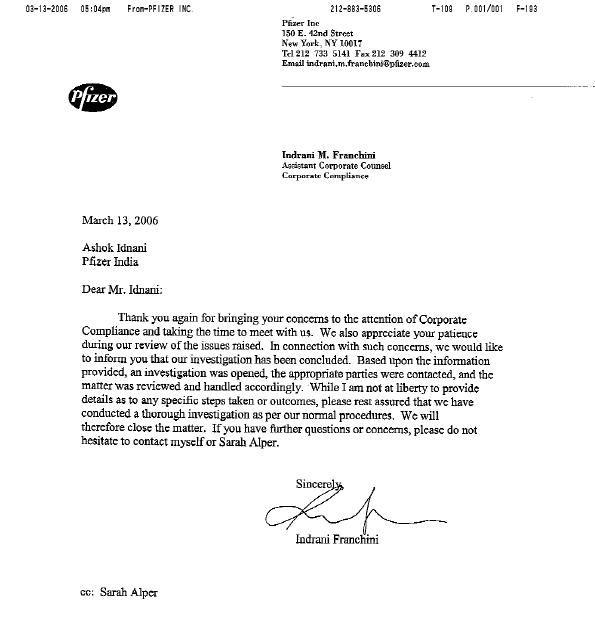
And this is the article in the New York Times today:
In India, Protecting a Whistle-Blower

J. N. Jayashree began blogging in the hopes of finding allies in the battle against corruption and violence.
By ANAND GIRIDHARADAS
Published: July 5, 2007
The New York Times
MUMBAI, July 4 — J. N. Jayashree did not want her husband to die the death of an Indian whistle-blower.
Four years ago, India was rocked by the murder of Satyendra Dubey, a government engineer who exposed corruption in the national highway building program. Two years later, Shanmughan Manjunath, a manager at a state-owned oil company, laid bare a scheme to sell impure gasoline. His body was found riddled with bullets in the back seat of his car.
To Ms. Jayashree, her husband, M. N. Vijayakumar, appeared to be following in their footsteps. Mr. Vijayakumar, 51, is a bureaucrat in the southern state of Karnataka, and he has a penchant for chastising colleagues who supplement their modest salaries with bribes, kickbacks and garden-variety pilferage.
In recent months, his chastising ruffled feathers at high levels, and he began seeing the signs often directed at whistle-blowers in India: He was pushed around the civil service like a hockey puck, switching jobs seven times in the last nine months, most recently on June 26.
As her husband made powerful enemies, Ms. Jayashree began to fear for his life. And so she devised an unusual ploy to protect him: she blogged.
In the YouTube era, she reasoned, it is harder to kill a man who has a bit of Internet renown.
“We’re creating a fortress around him — a fortress of people,” she said in a telephone interview. “I wanted to inform the people that this is happening, that my husband is a whistle-blower, so that it becomes the responsibility of every citizen to protect him.”
The result is a small-scale test of whether India’s technology revolution, which is empowering tens of millions, can tamp the corruption that hinders India’s ambitions. Transparency International, a Berlin-based group that monitors global corruption trends, ranks India below Colombia, Bulgaria and 67 other countries in its most recent index of corruption. In a 2005 study, it concluded that Indians pay more than $5 billion a year in bribes.
“The people who are supposed to be controlling corruption and fighting on behalf of the poor, they are sucking blood out of the poor,” Ms. Jayashree said in the interview.
She built her Web site, fightcorruption.wikidot.com, with help from her son, a doctoral student in computer science at Delaware State University. On the site, she chronicles her husband’s case and criticizes the government. An aficionado of India’s new right-to-information laws, she has acquired and uploaded reams of documents. She updates the site nearly every day and has received responses from around the world, including many from Indian émigrés who say they left the country because they found it too corrupt. Government officials in predicaments like her husband’s have sought advice.
Arun Duggal, a senior adviser to Transparency International, called the Web site pathbreaking for India.
“For an individual to use the powerful media of the Internet to take a stand against corruption, to expose wrongdoing, to build a campaign and a following, I think it’s the first time I’ve seen it,” said Mr. Duggal, who is based in New Delhi.
Mr. Vijayakumar, in a telephone interview, said he had seen corruption since his first days on the job. He said he had threatened to resign five times and had filed about 25 formal complaints detailing specific instances of corruption to P. B. Ma- hishi, the highest-ranking civil servant in Karnataka, which includes the technology hub of Bangalore. He said his complaints were rarely heeded.
The complaints have not been made public, but in the interview, Mr. Vijayakumar offered an example of how he said officials operate with near impunity: In the government agency that oversees state-owned enterprises in Karnataka, he said it was routine for officials to invent imaginary losses, and to solicit — and pocket — extra budgetary allocations to recover those losses.
“People at the top are involved, so they hope people will forget about it,” Mr. Vijayakumar said. “But I don’t forget.”
Mr. Mahishi, the civil service chief, conceded in a telephone interview that corruption was “everywhere,” in his own bureaucracy and in bureaucracies elsewhere. But he criticized Mr. Vijayakumar, calling him a lazy, ineffective worker who often skipped meetings and stayed silent about corruption for years before suddenly recoiling at it.
“Why did it take him 26 years to become active on the cause of corruption?” Mr. Mahishi said.
Mr. Vijayakumar contended that he had always battled corruption, but from the inside. What changed more recently, he said, is that his pleas ceased to make a difference and that he began to sense his life was in danger.
For instance, his wife said, one night last year, their doorbell rang soon before midnight. There were men at the door, and they told Mr. Vijayakumar that his younger son, a college student, had been in an accident. Come with us, they said.
But the son was asleep in his bed at home, just steps from his father, and the family concluded that the men had crafted a ruse to draw Mr. Vijayakumar from the house. After 13 years in that home, they moved to another neighborhood.
Corruption is nothing new in India. International surveys have consistently described the country as a superpower of graft. But Ms. Jaya- shree sees the temptation to swindle growing in an era when bureaucratic salaries pale beside private-sector pay.
In the early years of the Indian republic, the civil service was plum work. It came with a chauffeured car, cooks and servants, perhaps a white bungalow in a posh neighborhood. Private enterprise, strangled by socialist controls, often failed to match the perks and pay of public service. The marriage market reflected the dynamic: Men with admission to the civil service — and it was overwhelmingly male — were among the most sought-after grooms.
But as India trades socialist dogmas for capitalist ones, the private sector is becoming king. A sexagenarian veteran of the civil service typically earns no more than $9,000 a year, excluding perks like housing and a car. A 21-year-old engineer fresh out of college can make about that much at a software firm like Infosys, with annual raises of 15 percent.